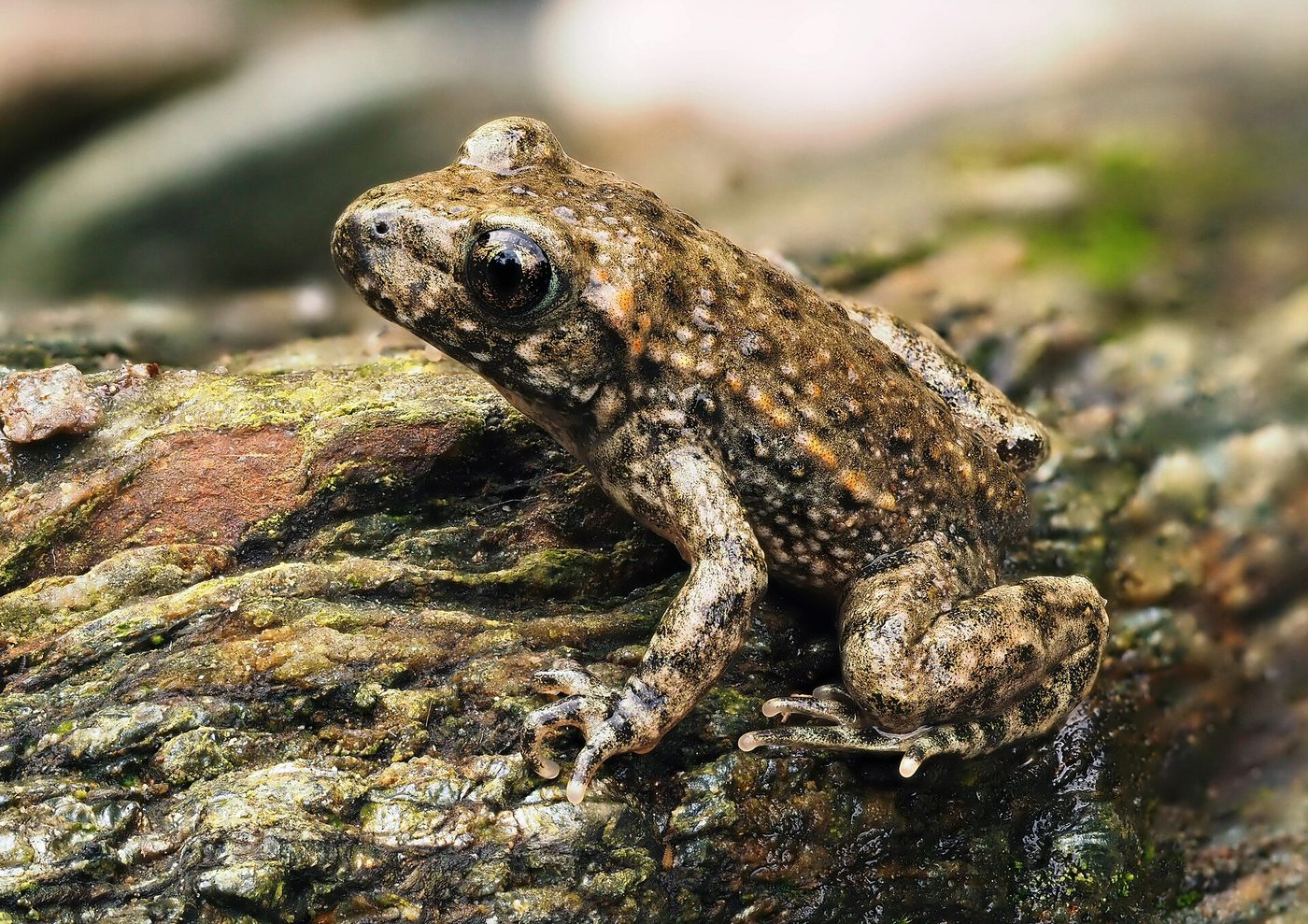
Common midwife toad
Alytes obstetricans
A small European amphibian with unique habits, the common midwife toad is named for the male, who carries the eggs wrapped around his legs until they hatch.
Characteristics
Temperament
Nocturnal, ground-dwelling, shy; a devoted father
Diet
Insectivore: insects and small invertebrates
A devoted father
The common midwife toad is a small, stout amphibian only a few centimetres long, with grey-brown warty skin and large eyes with vertical pupils. Its name comes from an extraordinary breeding behaviour, rare in the amphibian world: after mating, it is the male that takes charge of the eggs. The females lay strings of eggs that the males wrap around their hind legs, carrying them for weeks on land until they are ready to hatch.
Habitat and distribution
It lives in western Europe, from Portugal and Spain to Belgium, France, Germany, Switzerland and parts of the United Kingdom. It frequents varied habitats — hills, scree, gardens, quarries — as long as there are pools or small bodies of water for the larval stage and damp hiding places to shelter in by day.
Behaviour and parental care
It is nocturnal and ground-dwelling. The male, carrying the eggs, protects them from aquatic predators and fungi and keeps them moist; when the tadpoles are ready, he goes to water and releases them. The male's call is a fluting, repeated whistle, like the sound of a small bell, ringing out on spring and summer evenings. It feeds on insects and other small invertebrates.
Curiosities
The midwife toad's paternal care has fascinated scientists since the nineteenth century. The case became famous in biology through a scientific controversy over the inheritance of acquired traits, now settled. Despite its small size, the midwife toad can live several years.
Conservation
The IUCN lists the species as Least Concern, but some populations are declining due to the loss of wetlands, pollution and fungal diseases affecting amphibians.
Pros
- Paternal care unique among amphibians
- Distinctive fluting call
- Long-lived despite its small size
Cons
- Declining locally from habitat loss
- Sensitive to pollution and fungal disease
- Not a terrarium amphibian for beginners