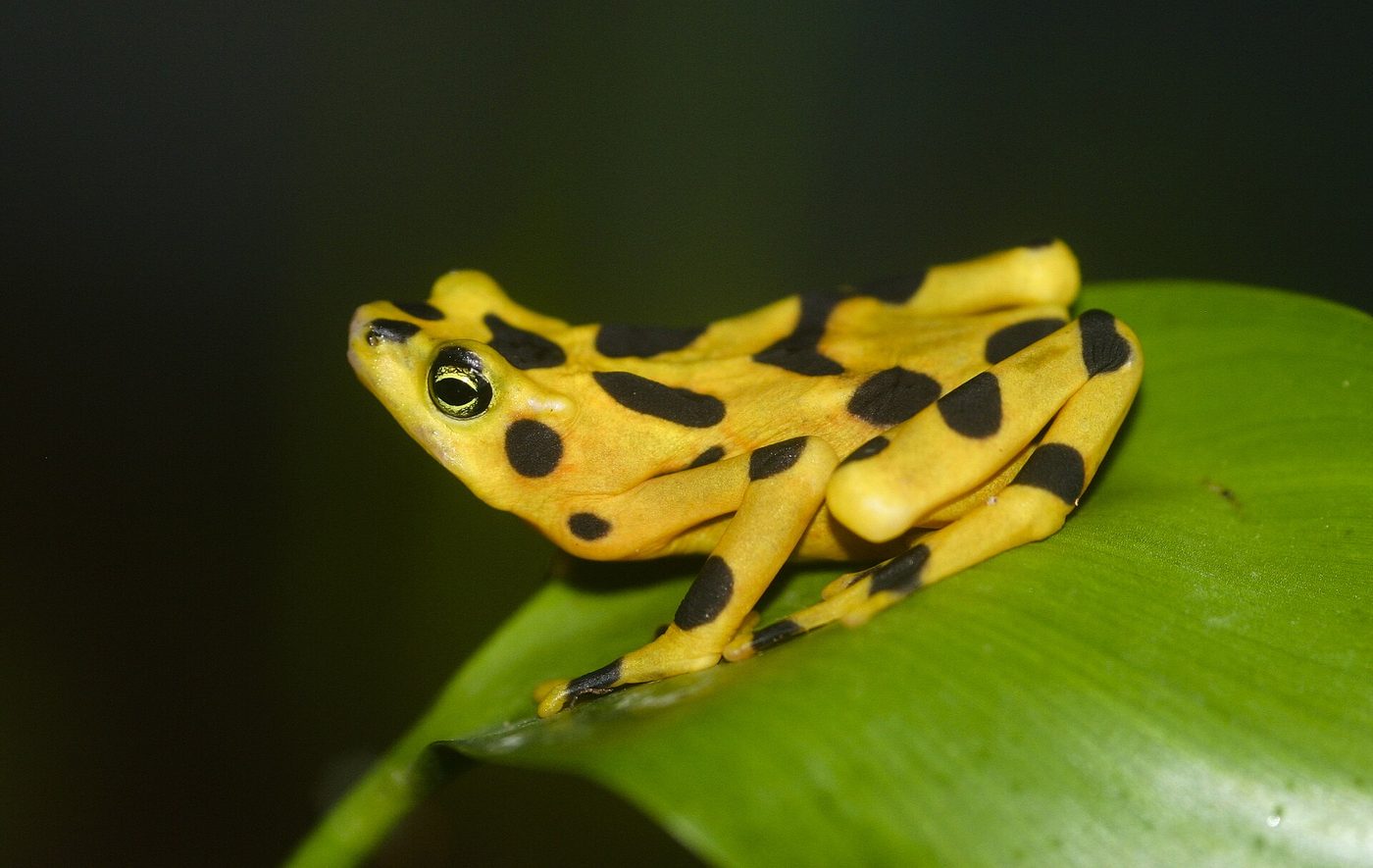
Photo: Brian Gratwicke · CC BY 2.0
Panamanian golden frog
Atelopus zeteki
The Panamanian golden frog is a small golden-yellow amphibian, a national symbol of Panama, now likely extinct in the wild and surviving only in captivity.
Characteristics
Temperament
Diurnal and territorial; communicates by waving its feet.
Diet
Insectivorous: small invertebrates.
A small golden treasure
The Panamanian golden frog (Atelopus zeteki) is in fact a small toad of the family Bufonidae, with a slender body and smooth skin of a bright golden yellow, sometimes flecked with black. Its vivid colour is an aposematic signal: it warns predators of its dangerous toxicity, as its skin contains potent poisons. It is endemic to a small mountainous area of west-central Panama.
Habitat and range
It lived along the streams of the montane cloud forests around El Valle de Antón and the Altos de Campana park. It favoured humid, cool habitats near running water, among rocks and streamside vegetation.
Behaviour and communication
It feeds on small invertebrates. A fascinating trait is its way of communicating: in the roar of the streams, where sound calls are lost, these toads use a form of sign language — they wave and rotate a front foot (a kind of "greeting" or semaphore) to signal presence and territory to rivals.
Did you know?
It is a national symbol of Panama, present in its culture, tradition and even on lottery tickets. Its scientific name honours the American entomologist James Zetek, who long worked as a naturalist in Panama.
Conservation
The IUCN lists it as Critically Endangered, but it is likely extinct in the wild since the mid-2000s, largely because of the deadly fungal disease chytridiomycosis as well as habitat loss. It survives thanks to captive-breeding programmes that preserve its last individuals in the hope of future reintroduction.
Pros
- Spectacular, aposematic golden-yellow colour
- Communicates with a rare 'sign language'
- A national symbol of Panama
Cons
- Critically endangered, likely extinct in the wild
- Struck by chytridiomycosis
- Survives only in captivity