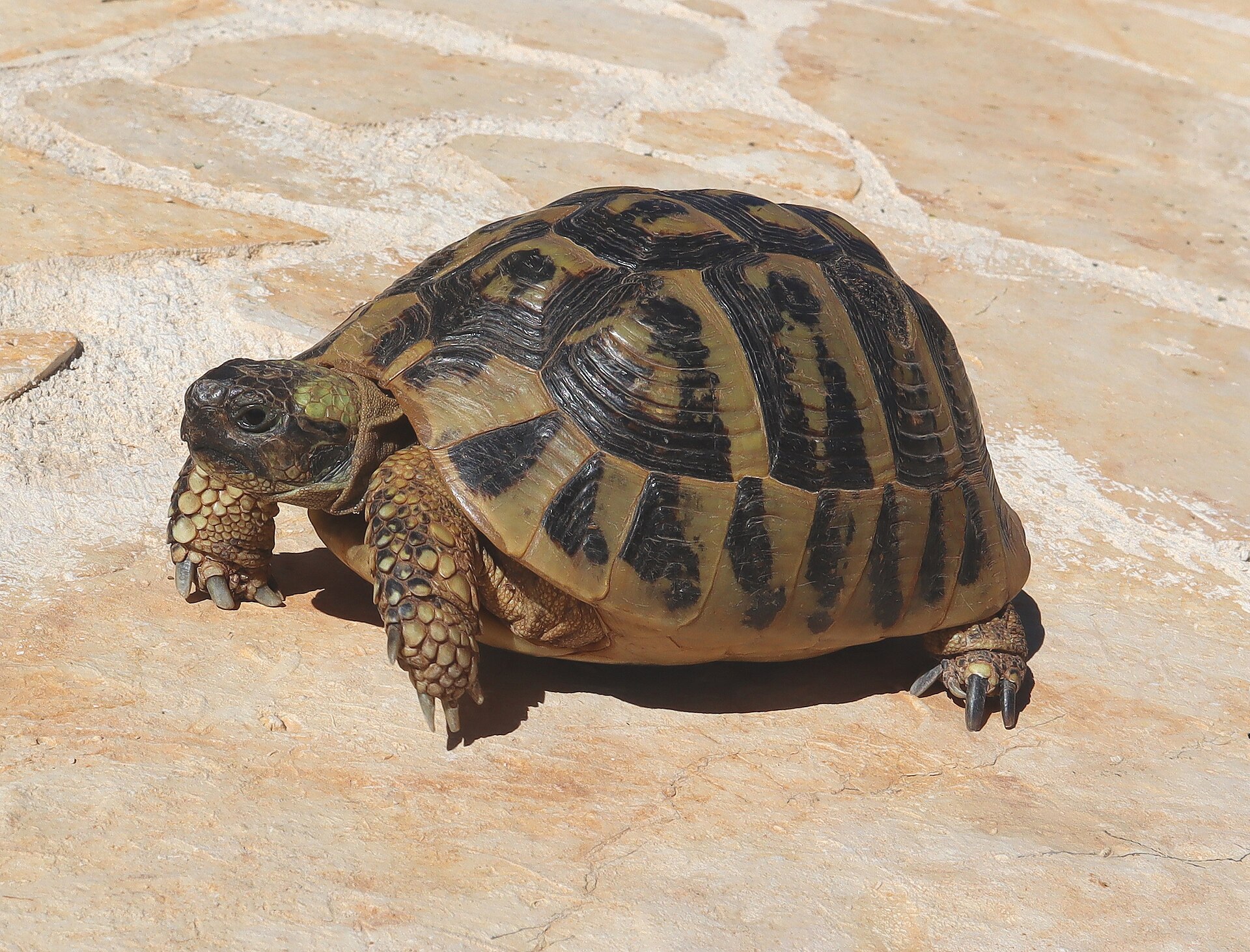
Hermann's Tortoise
Testudo hermanni
Characteristics
Temperament
Diurnal, territorial, reserved. Brumates from October to March. Becomes accustomed to its keeper without being interactive.
Diet
Herbivorous: dandelion, chicory, mallow, plantain, clover, edible flowers. Cuttlebone for calcium. Avoid sugary fruit and industrial food.
Hermann's tortoise (Testudo hermanni) is a small land tortoise native to the Mediterranean basin. Known since antiquity and now also widespread as a pet, it is a protected species due to the progressive decline of its wild populations and the loss of its original habitats.
Classification and category
Hermann's tortoise belongs to the order Testudines, class Reptilia, family Testudinidae. Two main subspecies are recognised: Testudo hermanni hermanni, found in the western Mediterranean, and Testudo hermanni boettgeri, distributed across the Balkans and the eastern Mediterranean. It is a small species, with a carapace averaging 18-22 cm long and an adult weight between 1.5 and 2 kg. Females are usually larger and bulkier than males.
Habitat and distribution
Hermann's tortoise lives in warm, dry Mediterranean environments: maquis, garrigue, open woodland of holm oak and cork oak, stony grasslands and dune areas. Its range covers Italy (notably Sardinia, Sicily, Tuscany and Apulia), southern France, Spain, the Balearic Islands, Croatia, Bosnia, Albania, Greece, European Turkey and Bulgaria.
The conservation status is listed as Near Threatened (NT) by the IUCN. The species is included in CITES Appendix II and EU Annex A: keeping and selling specimens requires proof of origin and an identification microchip. The main threat is habitat fragmentation, followed by summer wildfires and illegal collection for the pet trade.
Diet
Hermann's tortoise is strictly herbivorous. In the wild it feeds on wild grasses, flowers, tender leaves, wild legumes, occasionally fallen fruit and, in very small amounts, snails or carrion when encountered. The diet is low in animal protein and rich in fibre and calcium.
In captivity a fresh diet is recommended, based on dandelion, chicory, radicchio, mallow, plantain, clover, mulberry leaves and edible flowers. Tomatoes, citrus, banana and any industrial food should be avoided. A cuttlebone in the enclosure provides a natural calcium supplement.
Physical features
Hermann's tortoise has a domed carapace with a yellow and black pattern that varies considerably between individuals. The plastron shows two distinctive longitudinal black bands typical of the species. The head is dark with a light spot beneath the eye, the limbs are scaly and sturdy, with thick claws adapted for digging. A diagnostic feature is the horny spur at the tip of the tail, absent in related species such as Testudo graeca.
Males and females can be distinguished in adulthood: males have a longer, thicker tail, a slightly concave plastron and smaller size; females have a short tail, a flat plastron and a larger build.
Behaviour and curiosities
Hermann's tortoise is a diurnal and territorial animal. After waking it basks in the sun before setting off to forage, and retreats into the shade during the hottest hours of the day. From October-November to March-April it enters brumation, digging a shallow burrow in the soil or hiding under fallen leaves.
Mating takes place in spring and summer; the female usually lays 2-12 eggs in holes dug in the ground, which hatch after 70-90 days depending on temperature. The sex of the hatchlings is temperature-dependent (TSD): higher temperatures favour females. Hermann's tortoise can live over 80 years, with documented cases exceeding 100, making it one of the longest-lived companion animals.
Pros
- Estremamente longeva
- Silenziosa e poco invadente
- Ideale per chi ha un giardino
- Dieta semplice ed economica
Cons
- Specie protetta: serve documentazione CITES
- Letargo invernale richiede competenza
- Non adatta in appartamento
- Impegno per più decenni