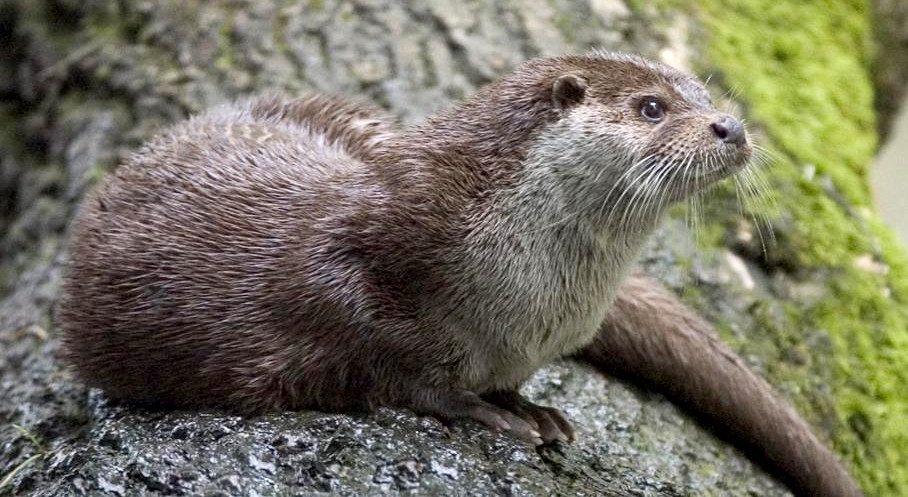
Photo: Bernard Landgraf · CC BY-SA 3.0
Eurasian otter
Lutra lutra
An elegant, playful predator of Europe's rivers, the otter has returned to waters from which it had nearly vanished: a living emblem of healthy waterways.
Characteristics
Temperament
Solitary, territorial and shy, active at dusk and by night. Curious and playful with its own kind, it carefully avoids people.
Diet
Chiefly fish, supplemented with amphibians, crustaceans, small mammals and waterbirds according to season.
A mustelid built for water
The otter is the most aquatic of Europe's mustelids, the family that also includes the badger and the marten. Every detail of its body speaks of a life spent in water: the tapered, streamlined form, the webbed feet, the muscular flattened tail that works as a rudder. Its coat is double, with an inner layer so dense that it traps a film of air, insulating the skin and keeping it dry even after hours submerged.
Underwater it closes its nostrils and ears, while long whiskers let it sense the movements of prey even in darkness or murky water.
Where it lives
The Eurasian otter has the widest range of all otters: from the rivers of western Europe to eastern Asia and North Africa. Its ideal habitat is clean, well-vegetated watercourses, but it also frequents lakes, marshes and sea coasts. Naturalists regard the otter's presence as an indicator of the quality of an aquatic environment: where the otter returns, the water is healthy.
A diet of water
Fish form the basis of its diet, supplemented by season with amphibians, crustaceans, small mammals and waterbirds. The otter hunts alone, in short dives broken by returns to the surface to breathe, and often eats smaller prey while floating on its back. Its fast metabolism forces it to eat a considerable amount of food every day.
Behaviour
Territorial and largely solitary, the otter marks the edges of its space with scent deposits along the banks. It is active mainly at dusk and by night. Its reputation as a playful animal is no legend: individuals, young ones especially, take to sliding and tumbling that, beyond being play, sharpen their swimming skills.
Conservation
The otter is listed as near threatened, a figure that reflects a difficult past. During the twentieth century European populations collapsed through water pollution, hunting and the destruction of riverside habitats. In Italy the species had all but disappeared. Improved river quality and protection measures have allowed a slow return in several regions, but the recovery remains fragile and tied to the health of watercourses.