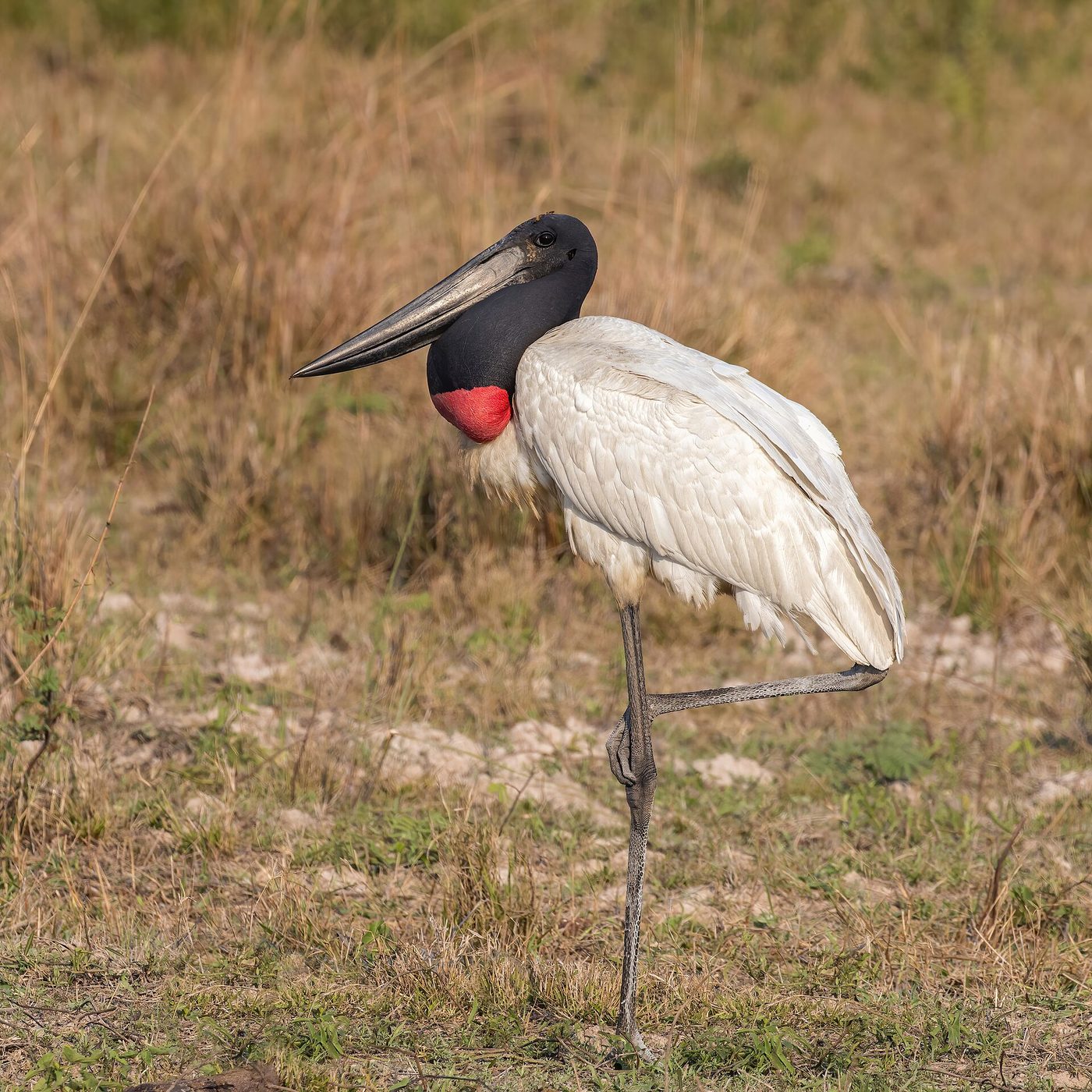
Photo: Charles J. Sharp · CC BY-SA 4.0
Jabiru
Jabiru mycteria
The jabiru is the largest stork in the Americas, an imposing wader of tropical wetlands with a bare red neck and a mighty bill.
Characteristics
Temperament
Patient, stately, solitary or in pairs
Diet
Carnivorous: fish, frogs, snakes, molluscs and reptiles
The giant of American wetlands
The jabiru is the largest stork of the American continent and one of the biggest flying birds of South and Central America. It reaches 120–140 cm in height and a wingspan of up to three metres. The plumage is white, but the head and neck are bare and black, with a striking red band at the base of the neck that swells when the bird is excited. The bill is huge, black and slightly upturned. Its name comes from the Tupi–Guaraní language and means "swollen neck".
Habitat and range
It lives in the wetlands of Latin America, from Mexico to Argentina, avoiding the strip west of the Andes. It is especially abundant in the Brazilian Pantanal and the Chaco region, and it frequents marshes, lagoons, riverbanks and flooded grasslands.
Behaviour and diet
It is a patient hunter that strides slowly through shallow water, catching fish, frogs, snakes, molluscs and small reptiles; it readily exploits shrinking pools where prey become concentrated. It nests on large platforms of sticks atop trees, reused and enlarged year after year.
Notable facts
It is the emblematic bird of the Pantanal, the world's largest wetland. Despite its bulk, it is a skilled flier that rides thermals to soar for long stretches. The red neck band changes intensity according to the bird's mood.
Conservation
The species is listed as Least Concern and remains widespread. Locally it can be affected by the draining of wetlands and disturbance at nesting sites, but overall populations remain stable.
Pros
- The largest stork in the Americas
- Emblem of the Pantanal and its wetlands
- Still widespread and unthreatened
Cons
- Depends on intact wetlands
- Sensitive to disturbance at nesting sites