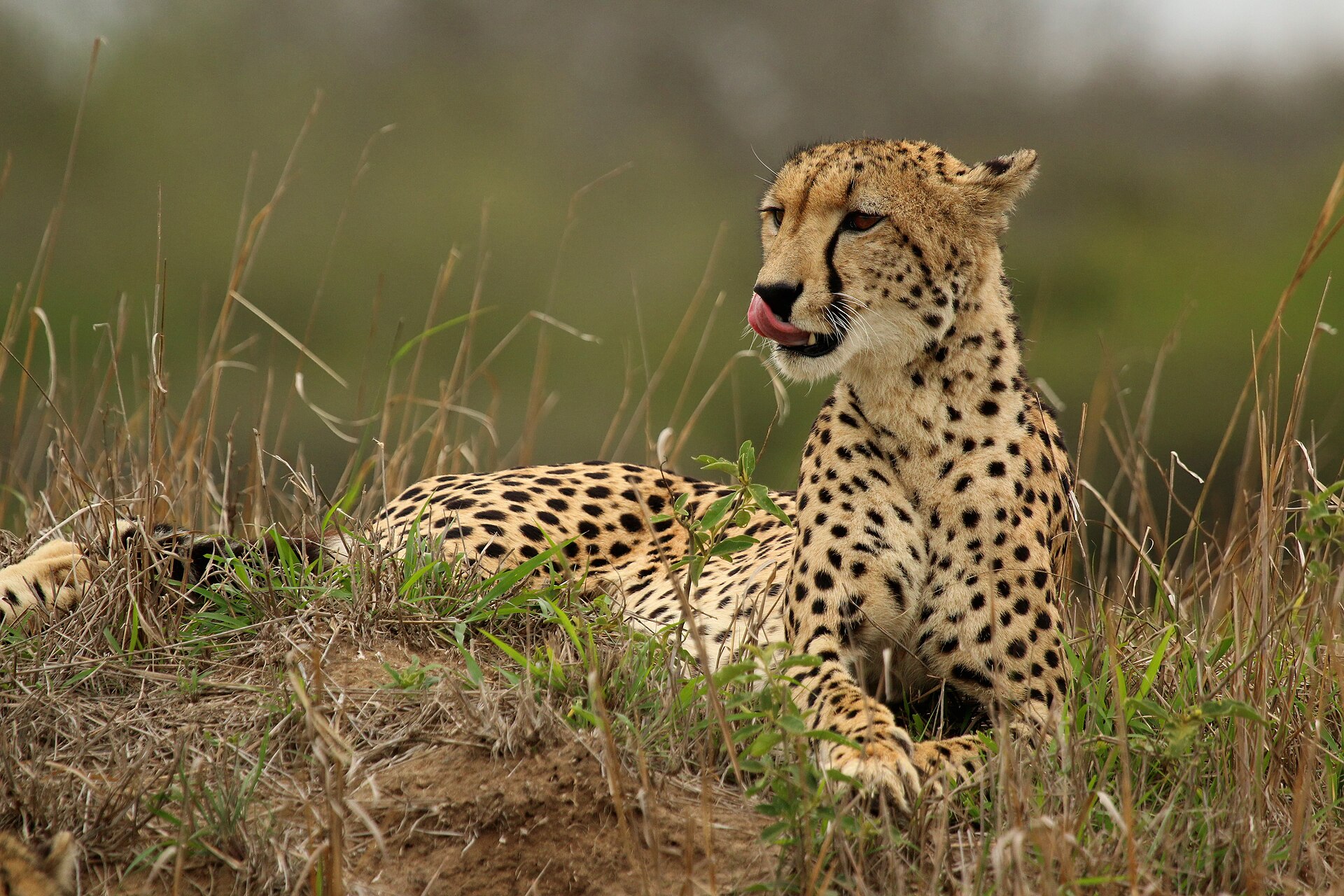
Cheetah
Acinonyx jubatus
Characteristics
Temperament
Diurnal predator solitary (females) or in small coalitions of brothers (males). Fastest land mammal (110 km/h). Doesn't roar but "chirps". Vulnerable to prey theft by other predators.
Diet
Carnivore specialised in small-medium gazelles (Thomson, Grant), impalas, springboks, young ostriches. Diurnal sight-hunt at 110 km/h. One prey lasts 1-2 days.
The Cheetah (Acinonyx jubatus) is the fastest land mammal in the world, capable of accelerating from 0 to 100 km/h in just three seconds and reaching peak speeds of 110 km/h. Native to African savannas, it is a unique cat: its slender body, long limbs and semi-retractable claws clearly distinguish it from other big cats. Today it is classified as Vulnerable by the IUCN, with populations declining throughout its range and a small Asian population critically threatened in Iran.
Classification and category
The Cheetah belongs to the order Carnivora, family Felidae, subfamily Felinae, genus Acinonyx — a monotypic genus (it is the only living species) that diverged from other cats about 6.7 million years ago. Five subspecies are recognised: A. j. jubatus (Southeast African, the most numerous), A. j. soemmeringii (Northeast African), A. j. hecki (Northwest African), A. j. raineyi (East African) and A. j. venaticus (Iranian or Asian, critically endangered). It is a medium-sized cat: body length ranges from 110 to 150 cm, with a tail of 60-80 cm; average adult weight is 21-55 kg for females, 35-72 kg for males.
Habitat and distribution
The Cheetah's natural habitat consists of open savannas, grasslands, semi-deserts, scrub and arid hilly zones. It prefers environments with long-range visibility (necessary for spotting prey and for running) and low density of other large predators such as lions, leopards and spotted hyenas, which systematically steal its caught prey and hunt its cubs (infant mortality of 70-95% in some areas).
The historical range covered all of Africa, the Middle East, India and much of Central Asia. Today it survives only in sub-Saharan Africa (90% of the total population, with large nuclei in Namibia, Botswana, Tanzania and Kenya) and in a critical population of just 12-50 individuals in Iran. Conservation status is listed as Vulnerable (VU) by the IUCN, with a global population estimated at 6,000-7,000 breeding adults. The Iranian subspecies (A. j. venaticus) is Critically Endangered. The main threats are habitat loss, conflict with livestock farmers, illegal cub trafficking and low genetic diversity (strong bottleneck effect about 10,000 years ago).
Diet
The Cheetah is a strict carnivore specialised in hunting small-to-medium gazelles. Main prey are Thomson's gazelles (40-60% of the diet), Grant's gazelles, impalas, springboks, young wildebeests, hartebeests, young ostriches, hares and occasionally birds or rodents. An average prey (15-30 kg) provides food for 1-2 days.
The hunting technique is completely different from that of other big cats: unlike lions and leopards that hunt by ambush at night, the Cheetah is a diurnal predator that hunts by sight in full chase. It approaches prey to within 50-100 metres, then launches a sprint at maximum speed (110 km/h for a few seconds), brings the prey down with a paw strike to the hind flank, and kills it with a bite to the throat that severs the trachea. Only half of the hunts succeed, and the meal must be eaten quickly (15-30 minutes) before lions, leopards or hyenas notice and steal it. After a top-speed run, the Cheetah must rest for 20-30 minutes to dispose of lactic acid: in this period it is extremely vulnerable.
Physical features
The Cheetah has an aerodynamic, slender body built entirely for speed: broad, deep chest (heart and lungs of exceptional size), long slender legs, long bushy tail used as a rudder for lightning-fast direction changes at 110 km/h. The spine is extraordinarily flexible: it arches and stretches like a spring during the run, extending the stride to 7-8 metres.
The coat is tawny-yellow with thousands of solid black spots distributed uniformly (unlike the rosettes of the leopard or jaguar). On the muzzle it has two characteristic "tear stripes" running from the inner corners of the eyes to the lips: they probably serve to reduce sun glare during diurnal hunting and as a recognition mark. The claws, unique among cats, are only partially retractable (more similar to those of dogs): they cannot be fully hidden, but provide exceptional grip when running. The Cheetah cannot roar like Panthera big cats: instead it emits meows, chirps, hisses and a characteristic chirp, similar to a bird's call.
Behaviour and curiosities
The Cheetah has an unusual social structure for cats: females are solitary (except when they have cubs, which stay with the mother for 18-24 months), while males live in small coalitions called "coalitions", generally composed of brothers, that defend shared territories and hunt together. A coalition of 2-4 males controls a territory of 50-100 km².
The female gives birth to 3-5 cubs after a gestation of 90-95 days. The young are born with a "ghost mantle": a mane of grey-silver hair on the back that camouflages them among dry grass and makes them look like honey badgers, predators feared by many carnivores. Infant mortality is very high (up to 95% in the Serengeti). Among genetic threats, the species went through a severe bottleneck 10,000 years ago: all current cheetahs are genetically almost identical (comparable to an inbred population), making it particularly vulnerable to diseases and reduced fertility. Lifespan is 10-12 years in the wild, 17-20 in captivity. The world speed record is 110 km/h (Sarah, Cincinnati Zoo cheetah, 2012, over 100 metres in 5.95 seconds).
Pros
- Specie iconica simbolo della conservazione africana
- Mammifero terrestre più veloce al mondo
- Genere monotipico, unico nel suo genere
- Programmi di reintroduzione attivi in India (2022)
Cons
- Specie selvatica e protetta, NON è un animale da compagnia
- Vulnerable IUCN, popolazione globale solo 6.000-7.000 adulti
- Mortalità infantile altissima (70-95% in alcune aree)
- Bottleneck genetico: bassa diversità, ridotta fertilità