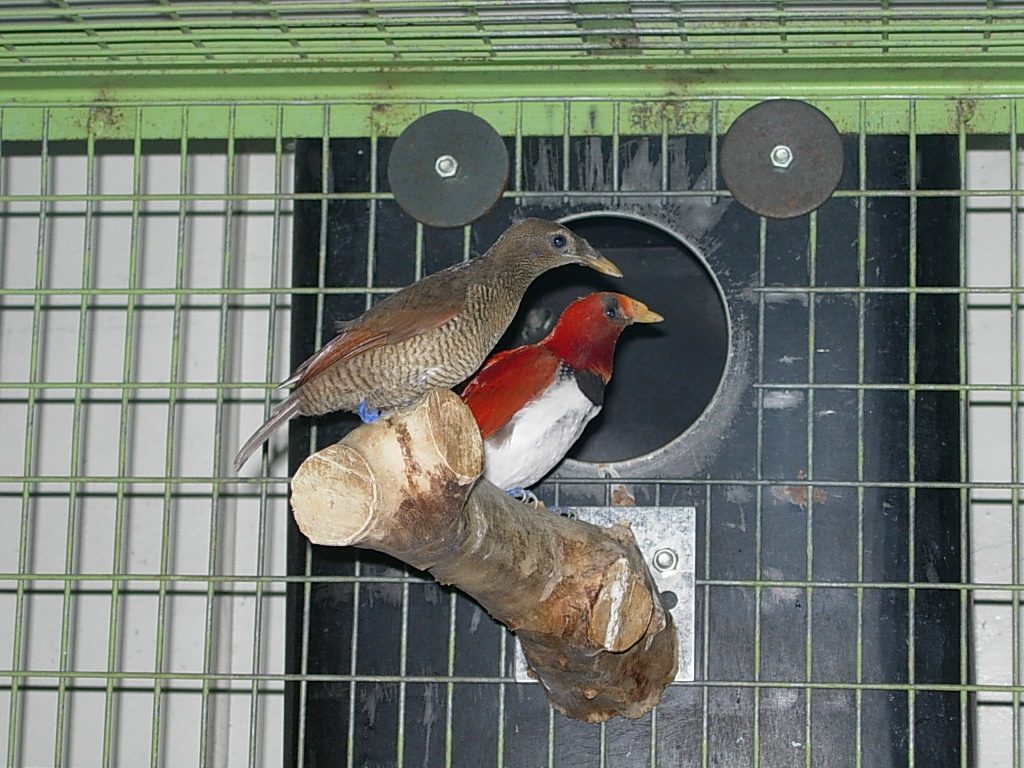
Photo: TJ Lin from Taiwan · CC BY-SA 2.0
King bird-of-paradise
Cicinnurus regius
The smallest of the birds-of-paradise, the king bird-of-paradise flaunts crimson plumage and two long tail wires ending in coiled emerald-green discs.
Characteristics
Temperament
Active, arboreal, acrobatic in courtship
Diet
Frugivore and insectivore: fruit and arthropods
A jewel of the forest
The king bird-of-paradise is regarded as the smallest of the birds-of-paradise, with a body barely fifteen centimetres long and a weight of about 50 grams.
(Note: the mass value given by Wikidata, 53.1 kg, is plainly wrong for a bird of this size; its true weight is only around fifty grams.)
The male is an intense crimson red on the back and head, with a white belly and striking emerald feather fans on the sides of the breast. From the tail spring two very long bare wires that curl at the tips into two discs of brilliant metallic green. The female, far plainer, is brownish and cryptic.
Habitat and distribution
It lives in the lowland forests of New Guinea and some nearby islands. It frequents the mid and lower levels of the vegetation, where it moves nimbly through the branches in search of food.
Behaviour and courtship
It feeds mainly on fruit and arthropods. The male performs an extraordinary courtship: he puffs out the breast feathers into two emerald fans, swings the tail discs like pendulums and even displays upside down, hanging head-down from a branch while vibrating his wings. Each male defends its own stage among the branches to attract females.
Curiosities
The green discs at the ends of the tail wires are in fact feathers coiled upon themselves, catching the light with a metallic sheen. Birds-of-paradise fascinated European explorers for centuries, who received skins with the legs removed and believed these birds never landed on the ground.
Conservation
The IUCN lists the species as Least Concern: it has a very large range and populations thought to be stable. Habitat loss nonetheless remains a potential long-term threat.
Pros
- The smallest and one of the most colourful birds-of-paradise
- Spectacular courtship, even performed upside down
- Wide range and stable populations
Cons
- Not a pet: highly specialised wild needs
- Depends on the lowland forests of New Guinea
- Hard to observe in dense vegetation