Photo: Andrea Lawardi · CC BY 2.0
Greater bird-of-paradise
Paradisaea apoda
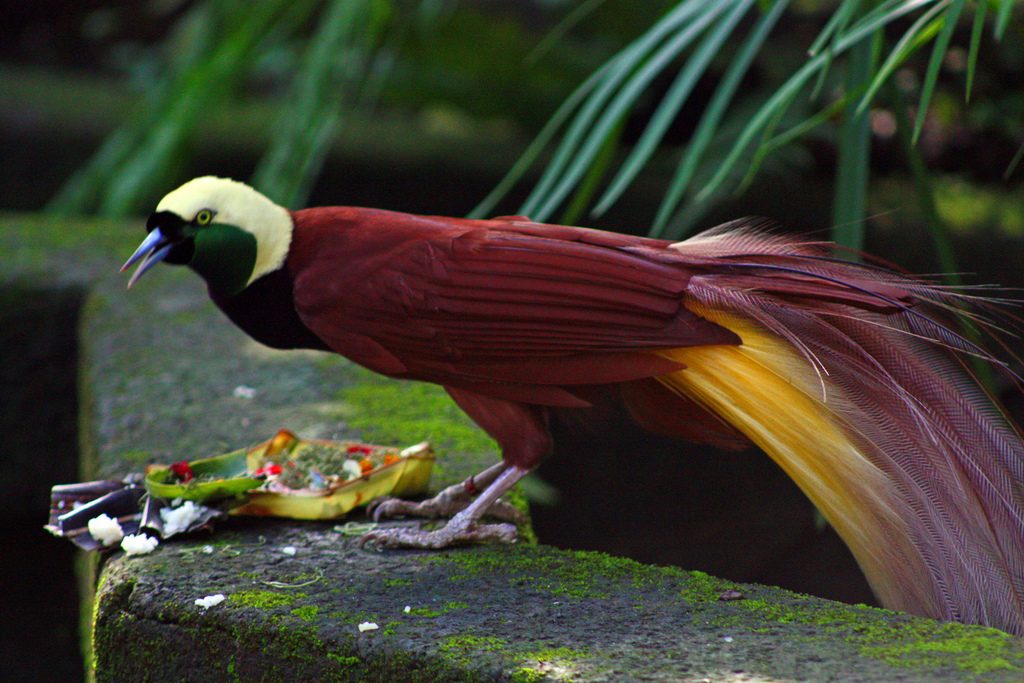
The greater bird-of-paradise is the largest of the birds-of-paradise, with long golden flank plumes the male displays in spectacular courtship dances.
Characteristics
Temperament
Diurnal and social; males in spectacular communal displays.
Diet
Frugivorous: fruit and invertebrates.
The giant of the birds-of-paradise
The greater bird-of-paradise (Paradisaea apoda) is the largest species of the genus Paradisaea, among the most famous birds-of-paradise. The male is splendid: a maroon-brown body, yellow head, iridescent emerald-green throat and, above all, a burst of very long ornamental golden-yellow and whitish plumes that fan out from its flanks like a cascade during display. The female, by contrast, is brown and lacks ornaments. It usually weighs between 170 and 320 grams. (Note: the body-mass value listed on Wikidata, 250 kg, is clearly an error — this is a bird of a few hundred grams.)
Habitat and range
It lives in the lowland rainforests of southern New Guinea and the Aru Islands. It feeds mainly on fruit and invertebrates, moving through the canopy.
Courtship
Its most extraordinary spectacle is the communal courtship display: on the high branches of traditional trees (arenas or leks), up to about fifteen males gather to call, hop and spread their golden plumes upside down in a contest of beauty. Females watch and choose, usually mating only with a few dominant males. The females then build the nest and raise the young entirely on their own.
Did you know?
Its scientific name apoda means "without feet": it comes from an old misunderstanding, because the first skins brought to Europe had their legs removed, leading people to believe these birds lived perpetually in flight, never landing.
Conservation
The IUCN lists it as Least Concern. It is still widespread, but hunting for its ornamental plumes and forest loss are pressures to watch in parts of its range.
Pros
- The largest of the birds-of-paradise
- Spectacular golden plumes and courtship displays
- Least Concern, still widespread
Cons
- Hunted for its ornamental plumes
- Depends on lowland forests
- Strong dimorphism: the female is drab