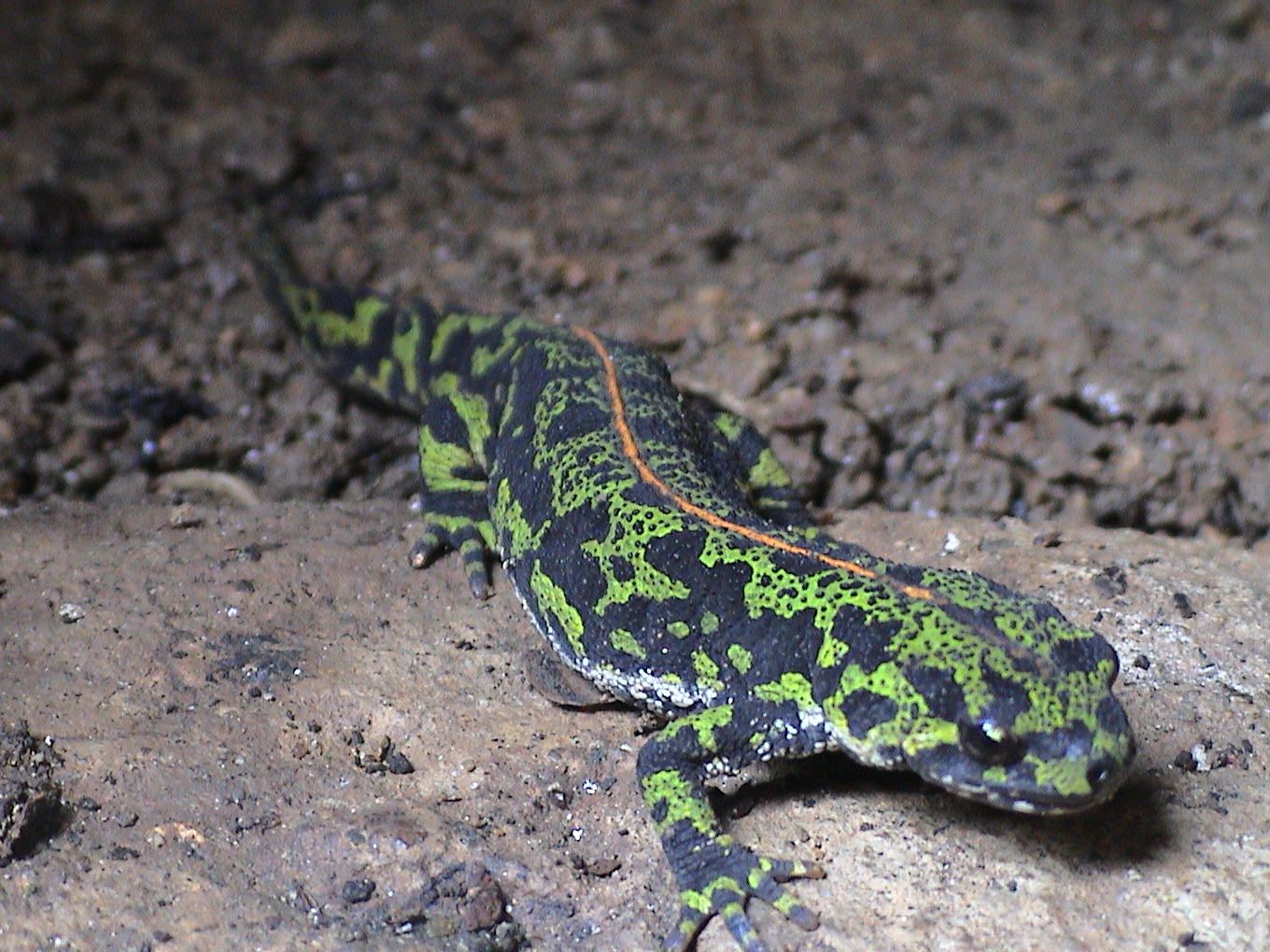
Photo: Clara Cartier · CC BY-SA 2.5
Marbled newt
Triturus marmoratus
The marbled newt is an elegant amphibian of south-western Europe, with a bright green coat marbled in black like a piece of marble.
Characteristics
Temperament
Largely terrestrial, nocturnal, shy
Diet
Carnivorous: insects, worms and small invertebrates
An amphibian veined like marble
The marbled newt is a medium-sized newt, among the most beautiful in Europe. Its most striking feature is the colouring: a bright green ground marbled with black spots and veins recalling the pattern of marble, hence the name. Females and juveniles often bear a thin orange dorsal line. During the breeding season the males develop a tall, wavy dorsal crest, banded light and dark.
Habitat and range
It is native to south-western Europe, from the Iberian Peninsula to France, where it lives mainly in hilly and mountain areas. It is a largely terrestrial amphibian: outside the breeding season it lives hidden under stones, logs and in the leaf litter of woods, hedgerows and cool meadows.
Behaviour and breeding
It feeds on small invertebrates such as insects, worms and mollusks. In spring it reaches ponds, pools and still water to breed: the males court the females with a dance, and the eggs are laid wrapped singly in the leaves of aquatic plants. The larvae develop in the water before transforming and moving to land.
Notable facts
The bright green colouring is unusual among European amphibians and acts as camouflage among vegetation. The skin secretes distasteful substances that deter many predators. It is closely related to the great crested newts of the genus Triturus.
Conservation
The species is listed as Least Concern by the IUCN, but populations are in slow decline in several areas due to the loss of small wetlands, intensive agriculture and the introduction of predatory fish.
Pros
- Unique, spectacular marbled-green coat
- Wavy crest in breeding males
- Useful natural control of invertebrates
Cons
- In slow decline through wetland loss
- Sensitive to introduction of predatory fish