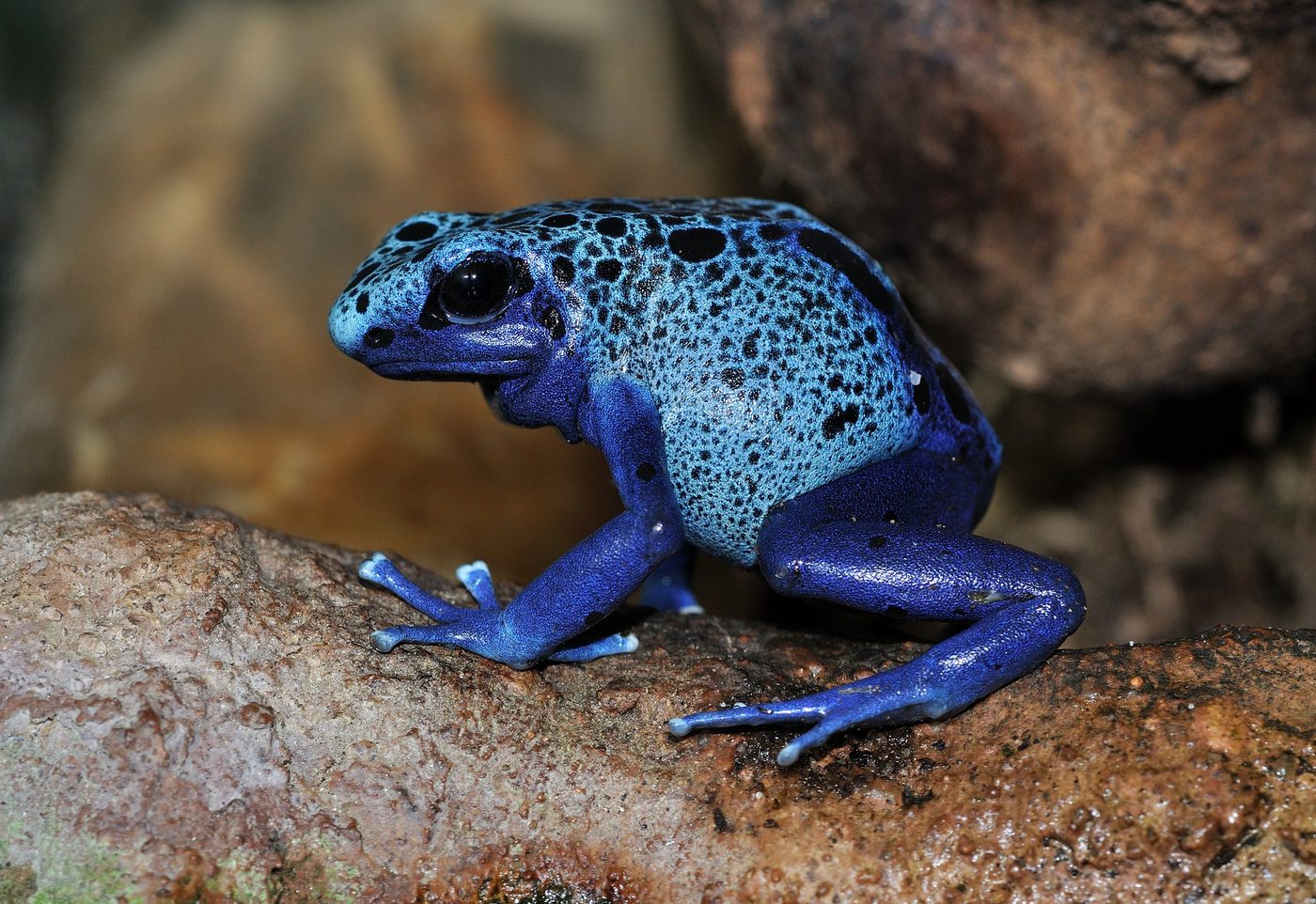
Photo: Quartl · CC BY-SA 3.0
Blue poison dart frog
Dendrobates azureus
The blue poison dart frog is a small amphibian of electric-blue colour, among the most toxic frogs in the world, endemic to the savannahs of Suriname.
Characteristics
Temperament
Diurnal and active; territorial males that tend the tadpoles.
Diet
Insectivorous: ants, mites, termites and small arthropods.
A blue and poisonous jewel
The blue poison dart frog (Dendrobates azureus) is a small amphibian of the family Dendrobatidae, famous for its intense electric-blue colouring, dotted with black spots. Its legs and belly tend toward a darker blue. It is only a few centimetres long, but its vivid colours carry a clear message: they are a warning (aposematism) signalling its extreme toxicity to predators. It is considered one of the most poisonous frogs on the planet. Today many authorities treat it as a colour form of Dendrobates tinctorius.
Habitat and range
It lives in the "forest islands" surrounded by the Sipaliwini Savanna in southern Suriname, near the border with Brazil, at around 300–400 metres. It favours humid, shady habitats near streams and pools, where moisture is constant.
Behaviour and diet
It is diurnal and active, moving over the forest floor hunting small invertebrates — ants, mites, termites and other arthropods. In the wild this very diet supplies the alkaloids it makes toxic through its skin: captive-bred individuals, fed differently, are effectively non-toxic. Males defend small territories and carry the tadpoles on their backs to water.
Did you know?
The name "dart frog" comes from the use, by some Amazonian peoples, of the poison of related frogs to tip their hunting darts. The species is also a model organism in the study of chytridiomycosis, a fungal disease threatening amphibians worldwide.
Conservation
It has a very restricted, fragmented range, which makes it vulnerable to habitat loss and collection for the exotic pet trade. Captive-bred animals are the better choice.
Pros
- Spectacular, aposematic blue colouring
- Parental care: the male carries the tadpoles
- Non-toxic when captive-bred and fed
Cons
- Extremely toxic in the wild
- Restricted, fragmented range
- Collected for the exotic pet trade