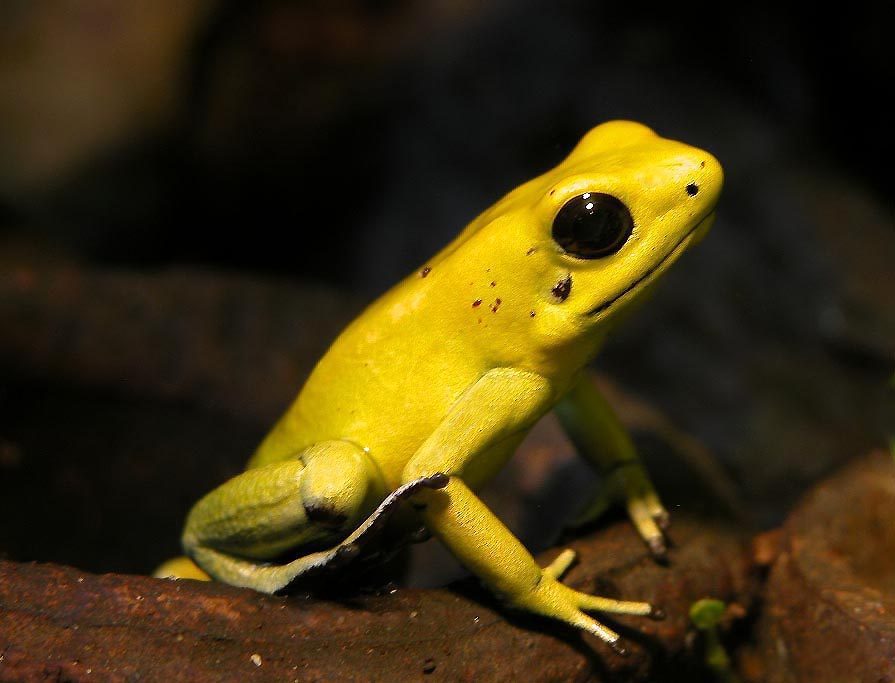
Photo: Wilfried Berns · CC BY-SA 2.0 de
Golden poison frog
Phyllobates terribilis
Small and dazzlingly yellow, the golden poison frog is among the most toxic animals on the planet: its colour is a warning, not an invitation.
Characteristics
Temperament
Active by day, confident thanks to chemical defence
Diet
Insectivore: ants, termites, small beetles
A small, lethal jewel
The golden poison frog is a small, brightly coloured amphibian, only a few centimetres long, yet it is considered one of the most toxic animals on the planet. Its body, an intense and uniform yellow, orange or green, certainly does not go unnoticed: it is a classic example of aposematic colouring, a signal that warns predators of danger. The skin secretes a powerful toxin, batrachotoxin, capable of being lethal in tiny amounts. The bright colour, far from being an ornament, is a clear 'do not touch' message.
Habitat and distribution
This frog lives in a very restricted area of the Pacific rainforest, in south-western Colombia. It prefers warm, humid environments rich in leaf litter on the forest floor, where it moves about by day with surprising confidence, secure in its chemical defence. Its limited range makes it particularly vulnerable to changes in its environment.
Behaviour and venom
Unlike many shy, nocturnal amphibians, the golden frog is active by day and is not afraid to show itself. It feeds on small invertebrates such as ants, termites and beetles. The toxin is thought not to be produced directly by the frog, but to derive from its diet of wild insects: in captivity, fed on different prey, the frog gradually loses its dangerousness. Females lay their eggs on the moist ground, and the males take care of carrying the newly hatched tadpoles to small pools of water.
A venom used by humans
The frog's very name recalls its traditional use: some indigenous peoples of Colombia have historically exploited its powerful secretion to poison the tips of hunting arrows and darts. It is from this use that the common name 'poison dart frog', given to it and its relatives, derives.
Conservation
The golden poison frog is classified as an endangered species. Its small range exposes it to habitat destruction, caused by deforestation and the expansion of human activities, and to collection. Protecting the patches of rainforest in which it lives is essential for the survival of this small, splendid and dangerous amphibian.
Pros
- Splendid, unmistakable colours
- Active and observable by day
- A fascinating example of chemical defence in nature
Cons
- Extremely toxic in the wild
- Limited range and endangered species
- Not an animal to handle or keep lightly