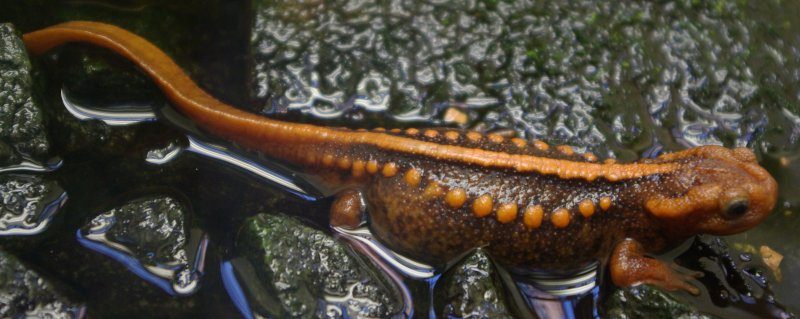
Photo: TomR (Thomas Ruedas) · CC BY-SA 2.5
Emperor newt
Tylototriton shanjing
The emperor newt is a vividly coloured amphibian from Yunnan, whose black and orange skin warns predators of its powerful toxicity.
Characteristics
Temperament
Slow, nocturnal, secretive; toxic to the touch
Diet
Carnivorous: insects, worms and small invertebrates
An amphibian painted in warning
The emperor newt, also called the Mandarin newt or Mandarin salamander, is one of Asia's most striking amphibians. Its body is chocolate-black, crossed by bold orange bands: the bony ridge along the back, the row of side warts, the head and the limbs. This vivid colouring is a classic case of aposematism, a signal warning predators of its powerful toxicity. The skin is granular and the tail is flattened at the sides.
Habitat and range
It is native to Yunnan and parts of southern China, where it lives in montane forests at altitudes of roughly 1000 to 2500 metres. It spends much of the year on land, among the damp leaf litter and hiding places of the undergrowth, moving to ponds and still pools only in the breeding season.
Behaviour and toxicity
It is a slow, nocturnal animal that feeds on insects, worms and other small invertebrates. Its skin secretes tetrodotoxin and related compounds, potent poisons that make it inedible to most predators: it therefore has no need to flee and relies on its warning colours. It is fairly common in captivity among amphibian enthusiasts, but must be handled with care.
Reproduction
In the rainy season adults migrate to bodies of water to breed. Females lay their eggs on aquatic vegetation; the larvae develop in the water before completing metamorphosis and moving onto land.
Conservation
The IUCN lists the species as Vulnerable. The main threats are the loss of forest habitat and over-collection for the pet trade and traditional medicine.
Pros
- One of the most spectacular colourings among amphibians
- Very long-lived, can exceed 15 years
- Natural control of insects and invertebrates
Cons
- Highly toxic skin, handle with care
- Vulnerable to over-collection and habitat loss