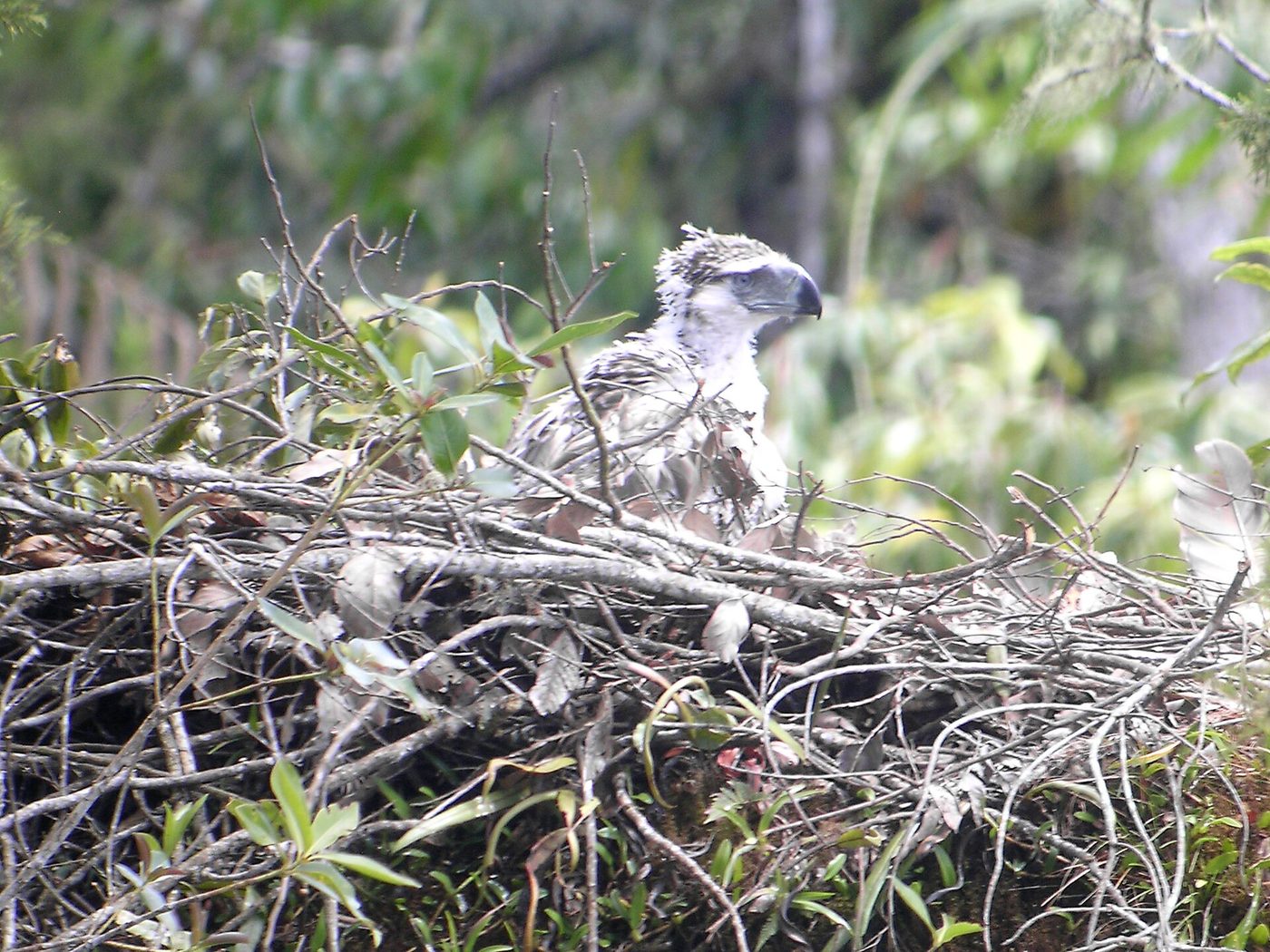
Photo: markaharper1 · CC BY-SA 2.0
Philippine eagle
Pithecophaga jefferyi
The Philippine eagle is one of the largest and most powerful raptors in the world, endemic to Philippine forests, with a striking shaggy crest and piercing gaze.
Characteristics
Temperament
A territorial apex predator; monogamous, lifelong pairs.
Diet
Carnivorous: flying lemurs, monkeys, civets, snakes, birds.
One of the world's mightiest raptors
The Philippine eagle (Pithecophaga jefferyi) is one of the largest and most powerful eagles on the planet, the only species of its genus. It measures 86 to 102 cm in length and weighs between about 4 and 8 kg. Its plumage is brown and cream-white, and on its head it bears a long crest of pointed feathers that, when raised, gives it a lion-like look. Its piercing blue-grey eyes and powerful legs armed with huge talons make it a formidable hunter.
Habitat and range
It is endemic to the Philippines, surviving on only a few islands — mainly Mindanao, but also Luzon, Samar and Leyte. It lives in primary and mature rainforest, which it needs for hunting and for nesting in giant trees.
Behaviour and diet
It is an apex predator at the top of the forest food chain. Its name "monkey-eating eagle" comes from its predation of flying lemurs and monkeys, but its diet also includes civets, snakes, lizards, birds and other mammals. Pairs are monogamous and bond for life, raising a single chick roughly every two years, with a very long period of parental care.
Did you know?
It is the national bird of the Philippines and a symbol of pride and conservation. Its image recurs in the culture and in campaigns to protect the archipelago's forests.
Conservation
The IUCN lists it as Critically Endangered: perhaps only a few hundred pairs remain. The destruction of primary forests, hunting and its very slow breeding make it extremely vulnerable. It is the focus of intensive protection and captive-breeding programmes.
Pros
- One of the largest and most powerful raptors in the world
- National bird of the Philippines
- A key apex predator of the forest
Cons
- Critically endangered
- Depends on mature primary forests
- Very slow breeding, one chick every ~2 years