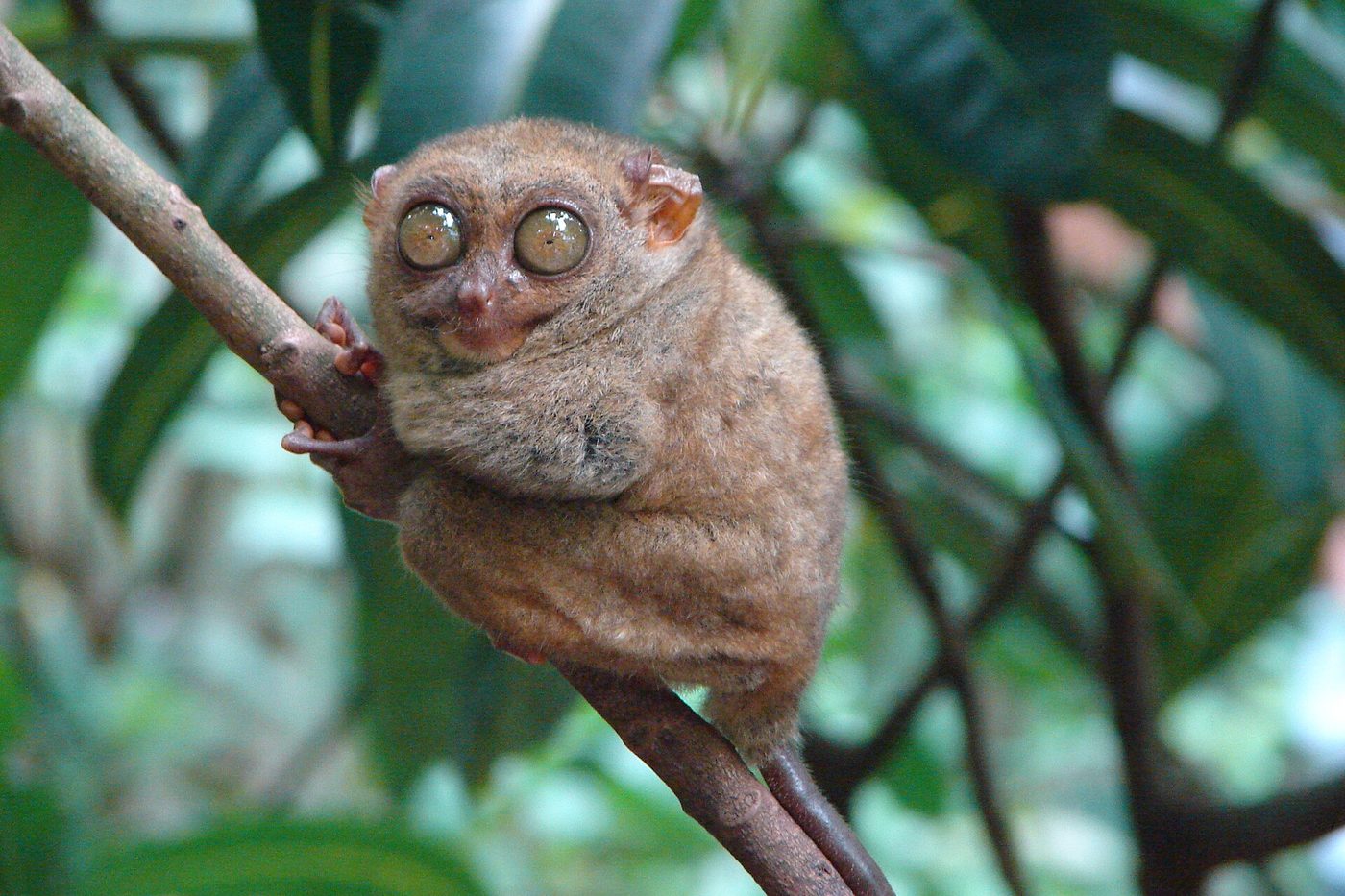
Photo: No machine-readable author provided. Plerzelwupp assumed (based on copyright claims). · CC BY-SA 3.0
Philippine tarsier
Carlito syrichta
With enormous eyes and a hypnotic gaze, the Philippine tarsier is one of the world's smallest primates, a tiny nocturnal hunter that leaps among the branches of the forest.
Characteristics
Temperament
Nocturnal, solitary, shy
Diet
Insectivore: insects and small vertebrates
The primate with giant eyes
The Philippine tarsier is one of the smallest primates on the planet, an animal of delicate, almost fairytale appearance. Its most striking feature is its eyes: enormous and round, out of proportion to its tiny body, so much so that each eye is roughly as large as its brain. It has soft brownish-grey fur, thin mobile ears, long fingers with widened pads for gripping, and a long, almost hairless tail. Its hind legs, with particularly elongated ankles, allow it to make extraordinary leaps from one branch to another.
Habitat and distribution
It is endemic to the Philippines, where it lives mainly on the islands of Bohol, Samar and Leyte, in the south-east of the archipelago. It inhabits dense tropical forests, secondary vegetation and wooded areas, where it finds shelter and food. It spends the day hidden among the thick vegetation, clinging to branches, and becomes active as night falls.
Behaviour
The tarsier is a nocturnal, insectivorous hunter: it feeds mainly on insects, which it catches with very rapid movements, but it can also prey on small vertebrates. Its giant eyes, unable to rotate in their sockets, are compensated by an extraordinary ability to turn its head almost 180 degrees in both directions, like owls. It is a solitary, shy animal, which communicates with high-pitched calls, some of them at ultrasonic frequencies inaudible to humans.
Curiosities and conservation
The Philippine tarsier is highly sensitive to stress: in captivity it can suffer enormously, which is why experts advise against keeping it as a pet. It is classified as a near-threatened species, mainly because of the destruction of its forest habitat and illegal capture. The protection of the Philippine forests is fundamental for its survival.
Pros
- One of the world's smallest primates
- Giant eyes and unmistakable gaze
- Extraordinary leaps between branches
- Valuable controller of insects
Cons
- Near-threatened species
- Extremely sensitive to stress, unsuited to captivity
- Threatened by forest destruction