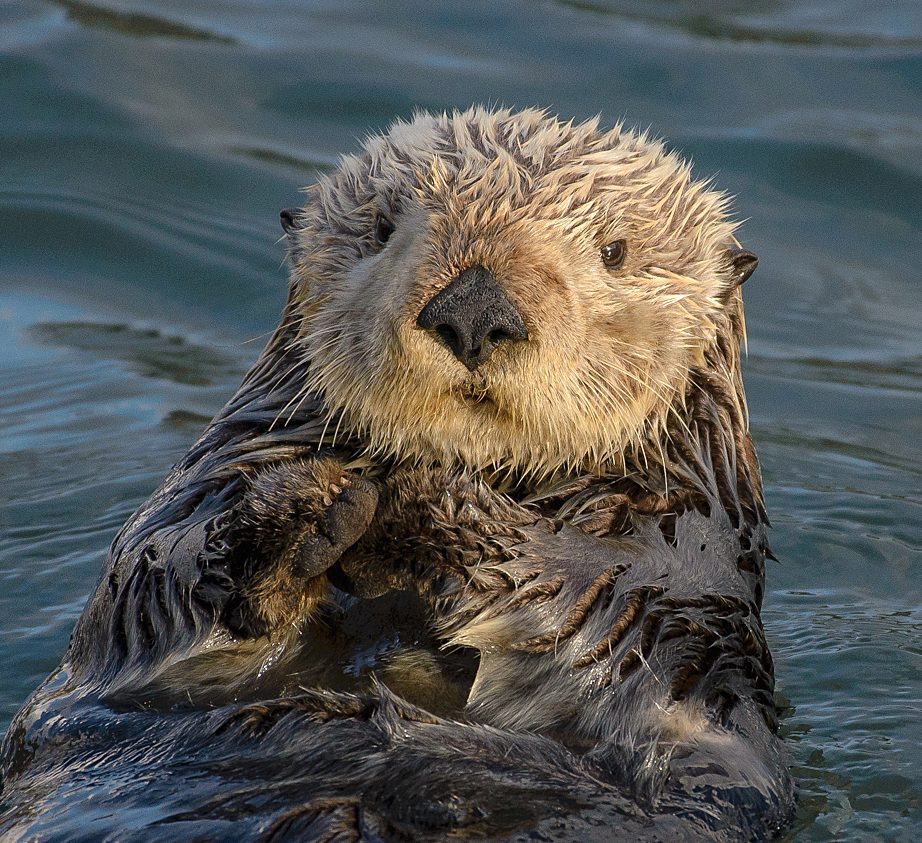
Photo: Marshal Hedin from San Diego · CC BY-SA 2.0
Sea otter
Enhydra lutris
Floating on its back among the kelp forests of the Pacific, the sea otter cracks sea urchins with a stone: one of the rare animals able to use tools.
Characteristics
Temperament
Social and mostly aquatic, floating on its back to eat and rest. Known for using tools and for the constant grooming of its insulating fur.
Diet
Carnivore: sea urchins, molluscs, crabs and other invertebrates, often opened with a stone.
A fully marine mustelid
The sea otter is the most aquatic of the mustelids and one of the mammals best adapted to life at sea. Unlike the river otter, it spends almost its whole life in the water, along the cold coasts of the northern Pacific. It spends much of its time floating on its back, a position in which it eats, sleeps and cares for its young. To avoid drifting away with the current while it rests, it often wraps itself in the kelp of the great forests.
The densest fur in the world
The sea otter has no insulating layer of blubber like seals or whales. To protect itself from the cold it relies entirely on its fur, the thickest and densest in the entire animal kingdom: millions of hairs per square centimetre trap a layer of air that insulates it from the icy water. For this reason grooming is vital, and the otter devotes a great deal of time to cleaning its fur and keeping it waterproof.
A rare tool-using animal
The sea otter is famous for an extraordinary ability: tool use. To open sea urchins, molluscs and hard-shelled crabs, it rests a stone on its chest while floating and beats the prey against it until it breaks. Some otters keep their favourite stone in a pouch of skin under the armpit. It is one of the very few non-primate mammals to use tools in the wild.
Guardian of the kelp forests
The sea otter plays a crucial ecological role. By feeding on sea urchins, it controls their populations: without the otters, the urchins would devour the kelp forests, destroying an entire ecosystem that hosts countless species. It is a textbook example of a 'keystone species', whose well-being supports that of many others.
Conservation
The sea otter is classified as an endangered species. In the past it was hunted almost to extinction for its precious fur. Today, although protected, it remains threatened by oil spills — which ruin its insulating fur and expose the animal to the cold — by pollution and by the decline of its prey. Its conservation is tied to the health of the Pacific coastal ecosystems.