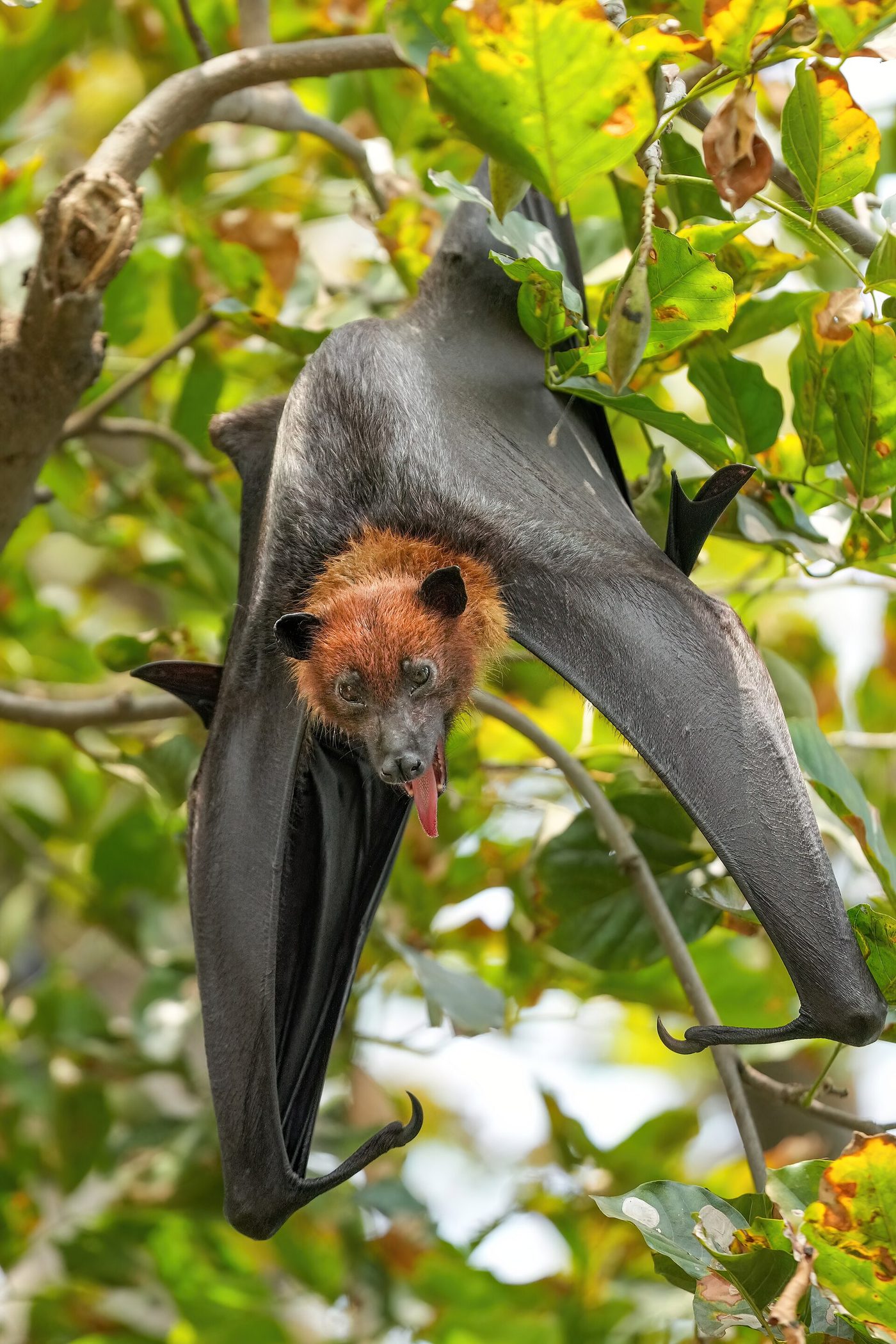
Photo: Giles Laurent · CC BY-SA 4.0
Indian flying fox
Pteropus medius
One of the largest bats in the world, the Indian flying fox is a fruit-eating bat of South Asia, with a wingspan over a metre and a fox-like face.
Characteristics
Temperament
Nocturnal, colonial, fruit-eating, shy
Diet
Frugivore: ripe fruit (mangoes, bananas), nectar
A bat as big as a fox
The Indian flying fox is one of the largest bats in the world: the body measures about 30 cm and the wingspan can exceed 1.2 metres. Its elongated muzzle, large eyes and pointed ears give it the look of a small fox, hence the name. Its fur is reddish-brown, paler on the belly. Unlike insect-eating bats, it does not use echolocation: it relies on sight and smell, both highly developed.
Habitat and distribution
It is found across the Indian subcontinent, in India, Pakistan, Bangladesh, Nepal, Sri Lanka and Myanmar. It lives in colonies that can be very large, the 'roosts', in big trees near villages, fields and ponds, where hundreds of individuals hang upside down from the branches during the day.
Behaviour and diet
It is nocturnal: at dusk it leaves the roost to feed on ripe fruit such as mangoes and bananas, and on nectar. In doing so it plays a valuable ecological role, pollinating flowers and dispersing seeds over long distances. It is sometimes seen as a pest by fruit growers, but the benefits of pollination usually outweigh the damage to crops.
Curiosities
Like other large fruit bats, it can harbour and transmit certain viruses, which makes it a subject of public-health study. Despite its imposing size, it is a shy, entirely vegetarian animal, not aggressive towards people.
Conservation
The species is common and widespread within its range and is not considered threatened. The main local pressures are persecution by farmers and the loss of large roosting trees.
Pros
- One of the largest bats in the world
- Valuable pollinator and seed disperser
- Common and widespread within its range
Cons
- Sometimes damages orchards
- Can harbour viruses: of health interest
- Depends on large roosting trees