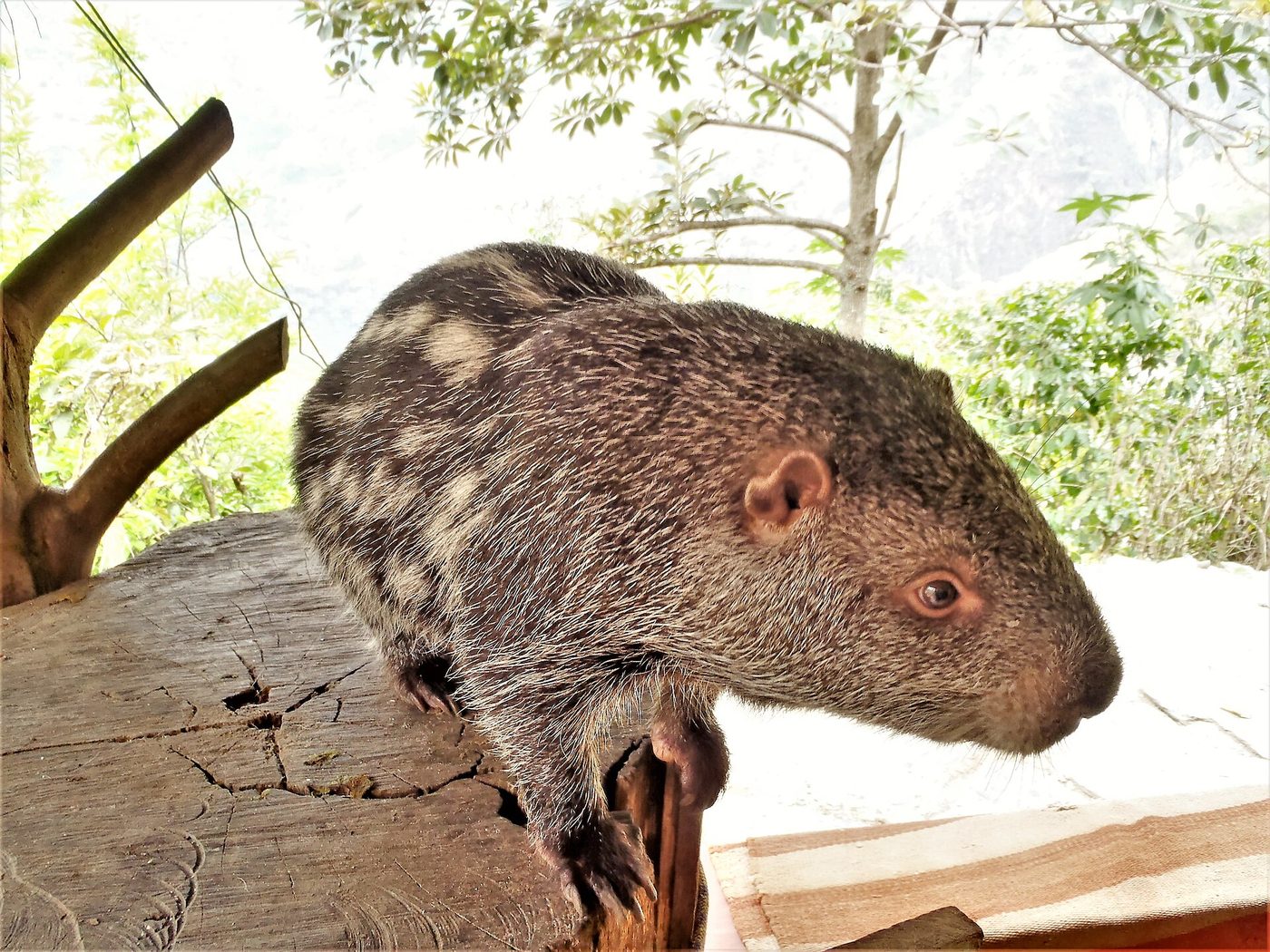
Photo: Benjamin Frable · CC0
Pacarana
Dinomys branickii
The pacarana is a large, rare, slow-moving South American rodent, with a chunky body and dark fur marked by rows of white spots.
Characteristics
Temperament
Placid and slow; social, lives in small family groups.
Diet
Herbivorous: leaves, shoots, fruit and seeds.
A large, placid rodent
The pacarana (Dinomys branickii) is a rare and slow-moving rodent of South America, the only living representative of the family Dinomyidae. It has a chunky, sturdy body, unusually large for a rodent: it can reach about 79 cm in length, not counting the thick, furry tail, and weigh up to 10–15 kg. (Note: the body-mass value listed on Wikidata, 615 kg, is clearly an error — this is an animal of 10–15 kg.) Its fur is dark brown, enlivened by distinctive rows of white spots and stripes along the flanks. Its name, in the Tupí language, means "false paca", from its superficial likeness to the paca, a rodent of another family.
Habitat and range
It lives in the humid forests of the Andes and adjacent regions, from Venezuela and Colombia to Bolivia, often in mountainous areas. It favours forest habitats with rocky crevices and dense vegetation, where it finds shelter.
Behaviour and diet
It is a placid herbivore feeding on leaves, shoots, fruit and seeds. It moves calmly, even climbing trees, and is active mainly at dusk and at night. Unlike many rodents, it appears to live in small family groups and shows unusually well-developed social behaviour.
Did you know?
It belongs to a family once far richer, which in the past included some of the largest rodents ever to exist — true prehistoric giants. Today the pacarana is its last living heir.
Conservation
The IUCN lists it as Least Concern, but it is naturally rare and little studied. Deforestation and local hunting are seen as potential pressures to monitor in some parts of its range.
Pros
- One of the largest living rodents
- The last member of its family
- Unusually social for a rodent
Cons
- Naturally rare and little studied
- Depends on montane forests
- Sensitive to deforestation and local hunting