Photo: Dcoetzee · Public domain
Greater bilby
Macrotis lagotis
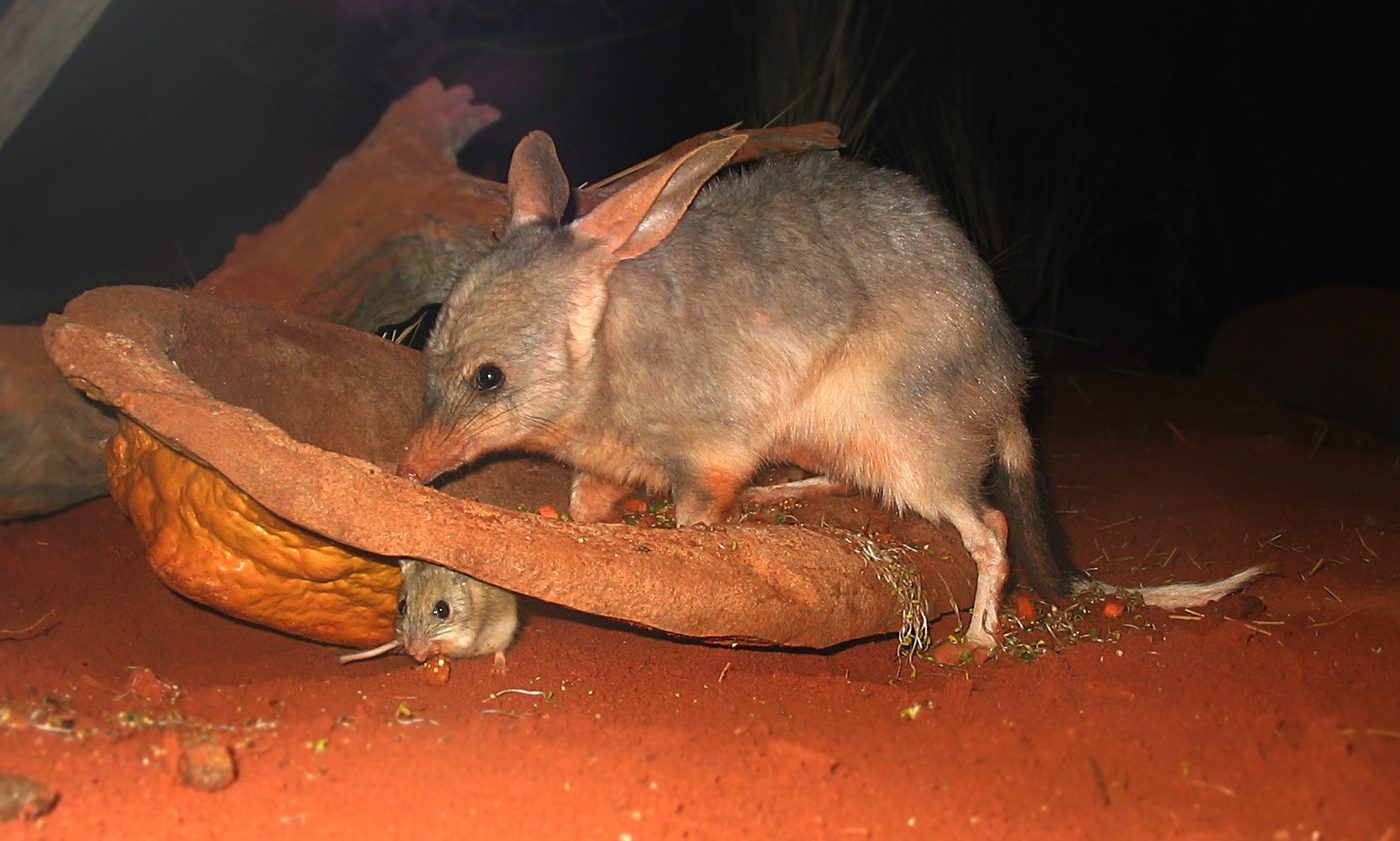
With its long rabbit-like ears, pointed snout and crested tail, the greater bilby is a small burrowing marsupial, a nocturnal symbol of the Australian deserts.
Characteristics
Temperament
Nocturnal, solitary, great digger
Diet
Omnivore: insects, seeds, fruit, bulbs and fungi
A marsupial with rabbit ears
The greater bilby is the largest of the bandicoots, a group of Australian marsupials, and has an unmistakable appearance. Its ears are long and thin, very much like those of a rabbit, and also help it to disperse heat. Its snout is tapered and pointed, suited to rooting through the ground, while its fur is soft and of a blue-grey colour with brownish tones. Its tail is long, black and white, with a characteristic crest of hairs. Its forelimbs are sturdy and equipped with strong claws, perfect tools for digging.
Habitat and distribution
It is an inhabitant of the deserts and arid areas of Australia. Once widespread across much of the continent, its presence today is reduced to some areas of the north-west and centre. It lives in deep burrows it digs in the ground, often spiral-shaped, in which it spends the daylight hours sheltered from the heat and from predators.
Behaviour and feeding
The bilby is nocturnal: it comes out of its burrow after dark to look for food. It is omnivorous and feeds on insects, seeds, fruit, bulbs and fungi, which it locates thanks to its excellent sense of smell and acute hearing, then digs up with its claws. By digging continually, it helps to mix and aerate the soil, playing a useful role for the desert ecosystem.
Conservation and curiosities
The greater bilby is classified as a vulnerable species: habitat loss, disease and above all predators introduced by humans, such as foxes and cats, have drastically reduced its populations. In Australia it has become a symbol of conservation, so much so that in some Easter traditions the 'Easter Bunny' is replaced by the 'Easter Bilby', to raise awareness of its protection.
Pros
- Unmistakable appearance with rabbit ears
- Excellent digger, aerates the soil
- Excellent sense of smell and hearing
- Symbol of Australian conservation
Cons
- Vulnerable species
- Threatened by introduced foxes and cats
- Range much reduced compared with the past