Photo: OberonNightSeer · CC BY-SA 3.0
Sugar glider
Petaurus breviceps
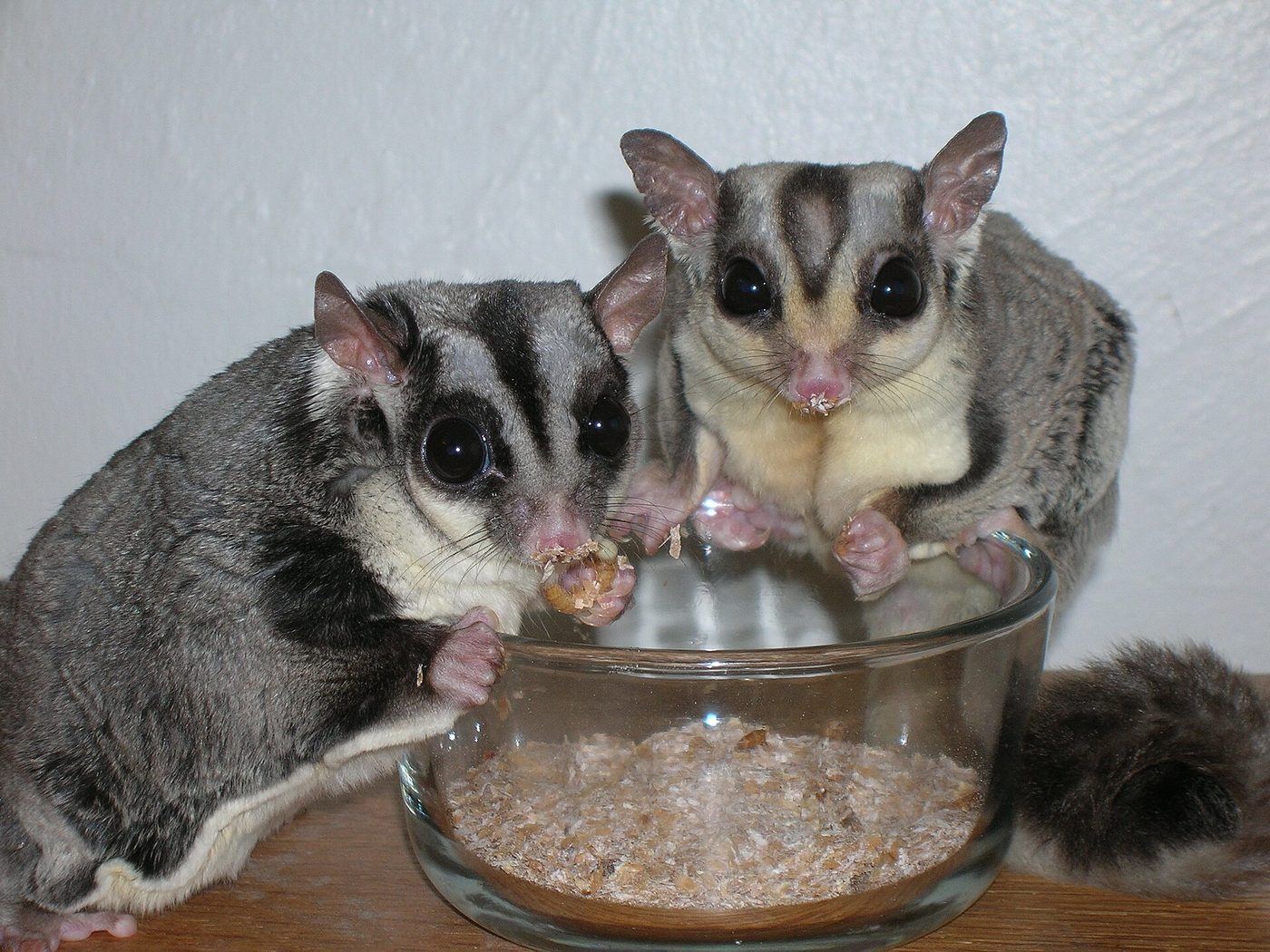
Small, nocturnal and gliding, the sugar glider is a marsupial that glides from tree to tree thanks to a membrane between its legs, like a living glider.
Characteristics
Temperament
Nocturnal, social, agile and vocal
Diet
Omnivore: sap, nectar, honeydew, insects
The marsupial that glides
The sugar glider is a small and fascinating marsupial, roughly the size of a mouse or a small squirrel. Its most extraordinary feature is a thin membrane of skin, called the patagium, which extends along its flanks connecting the front legs to the hind legs. When the animal launches itself from a branch and spreads its limbs, this membrane stretches like a small sail, allowing it to glide considerable distances from one tree to another. It has large dark eyes, suited to nocturnal life, mobile ears and a long, bushy tail that it uses as a rudder.
Habitat and distribution
It lives in the forests of Australia and New Guinea, where it inhabits the treetops. It is a strictly arboreal animal: it spends almost all its life among the branches, moving with agility and using its glides to travel without having to descend to the ground. It prefers wooded environments rich in eucalyptus and acacia trees, which offer it food and shelter.
Behaviour and diet
The sugar glider is nocturnal and social: in the wild it lives in small, close-knit groups. Its name comes from its diet: it is fond of sugary substances such as the sap and resin of trees, nectar and honeydew, which it supplements with insects and small invertebrates. It is a very vocal animal and communicates with distinctive calls; it also has scent glands with which it marks the members of its group and its territory.
Curiosities
Like all marsupials, the female raises her young in a pouch. The sugar glider's gliding ability is a fascinating example of convergent evolution: although not related to flying squirrels, it has independently developed the same kind of adaptation for gliding flight.
Keeping and care
The sugar glider is sometimes kept as an exotic pet, but it is a demanding animal with very specific needs: it requires ample vertical space, the company of its own kind, a varied and balanced diet and attentive care. Being nocturnal and social, it adapts poorly to a solitary life in cramped spaces. Before taking one in, it is essential to inform oneself thoroughly and check local regulations on keeping it.
Pros
- Extraordinary ability to glide between trees
- A social and very lively animal
- Pretty and fascinating appearance
- Wild populations not threatened
Cons
- Very specific needs if kept in captivity
- Needs companions and ample vertical space
- Nocturnal: not suited to those seeking a diurnal pet