Photo: Wikimedia Commons · CC BY-SA 3.0
Sun bear
Helarctos malayanus
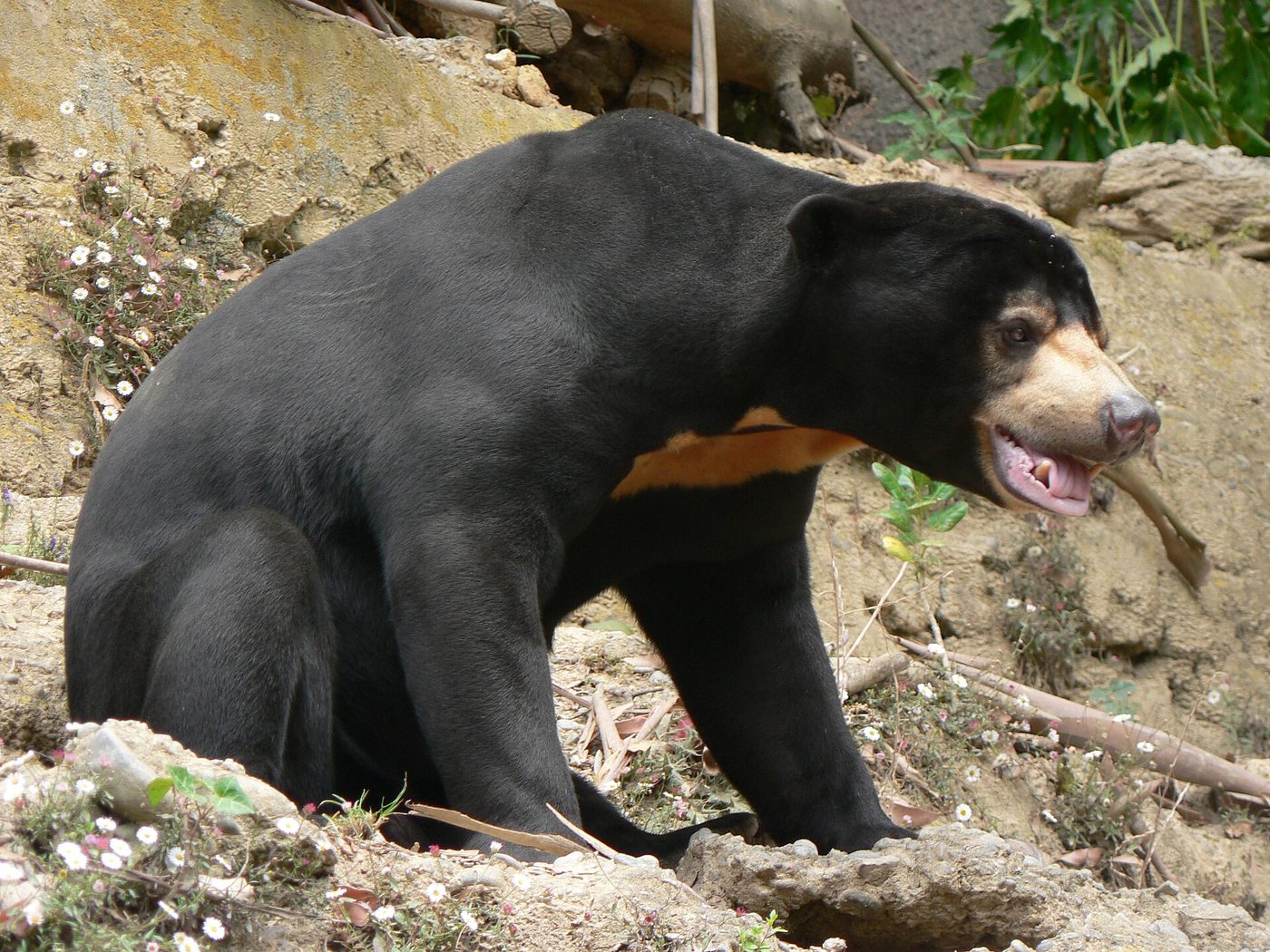
The smallest of the bears, with a striking pale sun-shaped patch on its chest and a very long tongue, the sun bear is a tree-dweller of the Asian forests.
Characteristics
Temperament
Nocturnal, solitary, an excellent climber
Diet
Omnivore: fruit, insects, honey, small animals
The smallest of the bears
The sun bear is the smallest of the living bears. It has a stocky, muscular body, covered with short, smooth black fur, and a pale muzzle. Its most distinctive feature is a striking patch of pale colour, from yellow to orange, on its chest: the shape of this patch, recalling the rising sun, has earned it its common name. It also has long, curved claws, perfect for climbing, and an extraordinarily long tongue, adapted to its diet.
Habitat and distribution
It lives in the tropical rainforests of Southeast Asia, across a broad belt including Indonesia, Malaysia, Indochina and other regions. It is an animal closely tied to the forest and extraordinarily skilled at climbing: it spends much of its time in the trees, where it searches for food, rests and builds a kind of nest among the branches.
Behaviour and diet
The sun bear is omnivorous and opportunistic. It feeds on fruit, insects, small animals and, above all, is fond of honey: its very long tongue allows it to reach the honey and larvae inside beehives and insect nests in trees, hence its English nickname of 'honey bear'. It is a mainly nocturnal, solitary and shy animal.
Curiosities
Despite its small size, the sun bear has considerable strength and powerful jaws, able to open tree trunks in search of food. The skin of its neck is particularly loose: if seized by a predator, the bear can turn around inside its own skin to bite the attacker, an unusual defence.
Conservation
The sun bear is classified as a vulnerable species. The main threats are the destruction of tropical forests, caused by logging and plantations, and poaching. Protecting the forests of Southeast Asia is essential for the survival of this small and fascinating tree-dwelling bear.
Pros
- The smallest bear in the world
- Striking sun patch on the chest, unmistakable
- Extraordinary climber
- Very long tongue for honey
Cons
- Vulnerable species
- Threatened by deforestation and poaching
- Depends on tropical forests