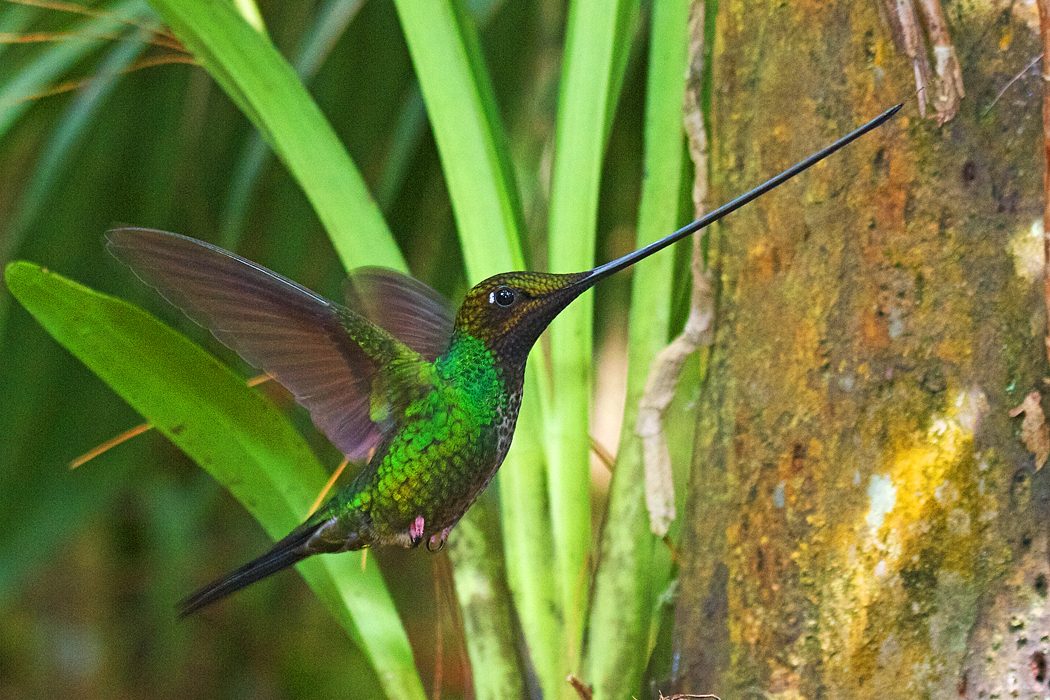
Photo: Joseph C Boone · CC BY-SA 3.0
Sword-billed hummingbird
Ensifera ensifera
The sword-billed hummingbird is the only bird in the world with a bill longer than its body, a tiny jewel of the Andes adapted to very long-throated flowers.
Characteristics
Temperament
Extremely active; hovers in front of flowers.
Diet
Nectarivorous: nectar from long-throated flowers and small insects.
The bird with a sword for a bill
The sword-billed hummingbird (Ensifera ensifera) is one of the largest hummingbirds and undoubtedly the most extraordinary: it is the only bird in the world whose bill is longer than the rest of its body (excluding the tail). This straight, slender, sword-like bill can be over ten centimetres long. It weighs very little, around 10–15 grams. (Note: the body-mass value listed on Wikidata, 1.16 kg, is clearly an error — a hummingbird weighs a few grams.) It is the only species of its genus.
Habitat and range
It lives in montane forests and forest edges of the Andes, from western Venezuela to central Bolivia, often at high elevations. It frequents habitats rich in tubular flowers, on which it depends for food.
Behaviour and diet
Like all hummingbirds it feeds on nectar, which it extracts by hovering in front of flowers on rapidly beating wings. Its extremely long bill is the key to its success: it lets it reach the nectar at the base of the longest corollas, which no other pollinator can exploit. It has coevolved in particular with Passiflora mixta, whose flowers have an equally long tube. It supplements its diet with small insects.
Did you know?
Its bill is so long that the bird cannot use it to preen, as other hummingbirds do: instead it grooms its plumage by scratching with its feet. At rest it holds its bill tilted upward to balance its weight.
Conservation
The IUCN lists it as Least Concern. It is still widespread along the Andes, but it depends on montane habitats and the flowers it has coevolved with; high-altitude deforestation is a pressure to watch.
Pros
- The only bird with a bill longer than its body
- A key pollinator of long-throated flowers
- One of the largest hummingbirds in the world
Cons
- Depends on specific tubular flowers
- Tied to Andean montane habitats
- Sensitive to high-altitude deforestation