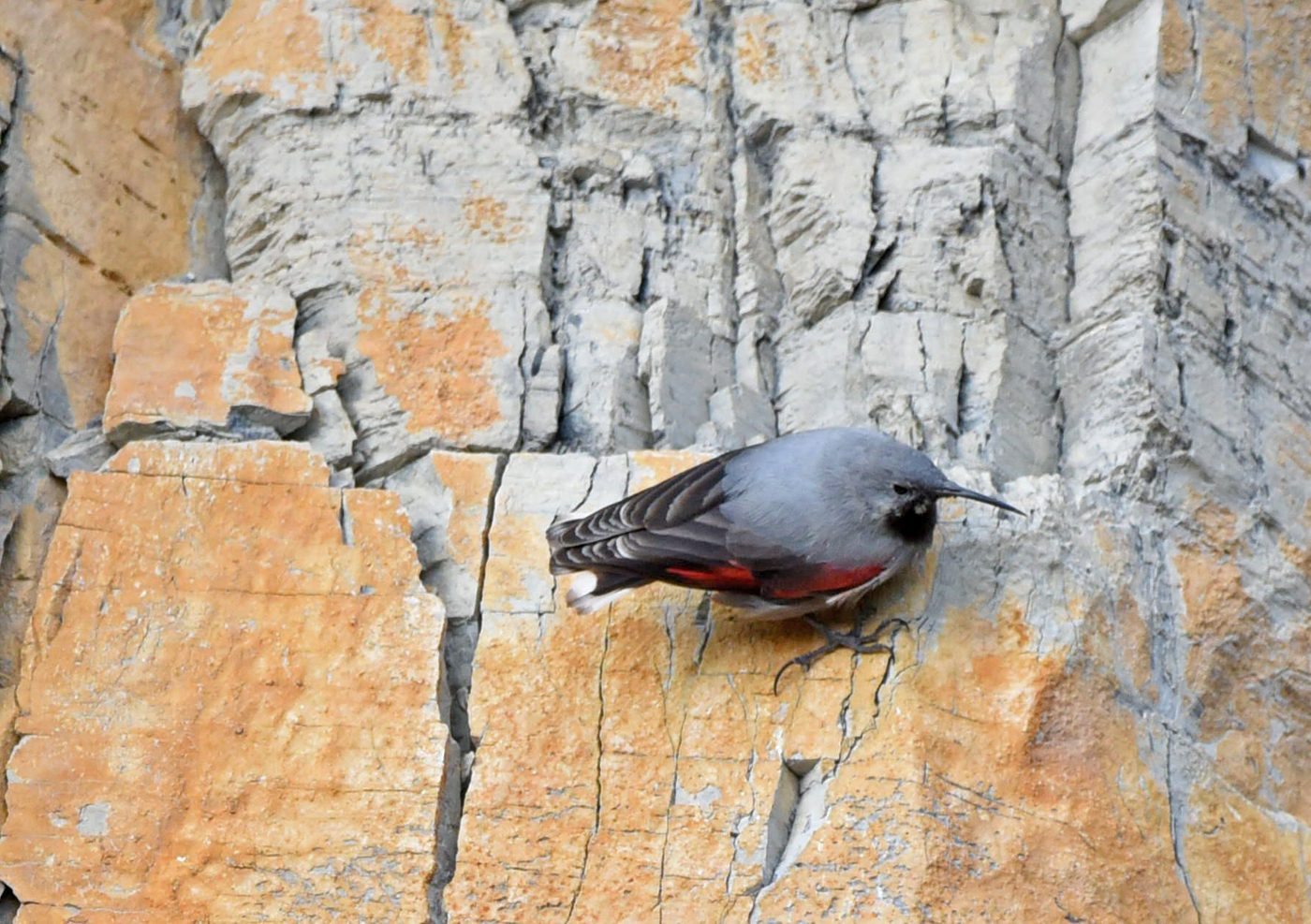
Photo: Pierre-Marie Epiney · CC BY-SA 2.0
Wallcreeper
Tichodroma muraria
With its wings streaked in bright crimson and its fluttering, butterfly-like flight, the wallcreeper is one of the most beautiful and elusive inhabitants of the high-mountain rock faces.
Characteristics
Temperament
Solitary, shy, rock climber
Diet
Insectivore: insects, spiders and larvae from crevices
The butterfly of the rocks
The wallcreeper is a small bird of unmistakable appearance. Its body is an elegant ash grey, enlivened, however, by its broad, rounded wings, streaked with a bright crimson red with white spots, which are revealed in all their splendour when the bird flies with its characteristic slow, fluttering wingbeat, resembling that of a large butterfly. The males, in the breeding season, have a black throat. Its bill is long, thin and slightly curved downwards, perfect for probing the crevices of the rock.
Habitat and distribution
It lives on the high mountains of southern Eurasia, from the Pyrenees to the Alps, right to the Himalayas and the ranges of Central Asia, where it nests on steep rock walls, even at very high altitudes, above 3,000 metres in the Alps and well over 5,000 in Tibet. In winter it descends to lower altitudes, and may appear on coastal cliffs or even on the walls of old buildings and castles.
Behaviour and feeding
It is a highly skilful rock climber: it climbs the vertical walls with short bursts, helping itself with its wings, which it opens and closes continually, exploring every crevice. With its long bill it extracts insects, spiders and larvae from the cracks in the stone, and also catches prey in flight. It is a solitary, shy bird, hard to spot because of its camouflaged colour and the rugged environment in which it lives.
Curiosities and conservation
Despite its name, the wallcreeper is not a true creeper of the woodpecker kind: it is a passerine, the only representative of its family, and its way of climbing rocks only superficially recalls that of woodpeckers on trees. It is classified as a species of least concern, but its elusive nature and extreme habitat make it one of the most sought-after birds by mountain birdwatching enthusiasts.
Pros
- Spectacular crimson wings
- Fluttering, butterfly-like flight
- Highly skilful climber of vertical walls
- The only representative of its family
Cons
- Elusive and hard to spot
- Tied to high-altitude rocky environments
- Camouflaged colouring against the grey rock