Photo: No machine-readable author provided. Moongateclimber assumed (based on copyright claims). · CC BY-SA 3.0
Verreaux's sifaka
Propithecus verreauxi
With its snow-white fur and comical sideways hopping gait, Verreaux's sifaka is one of the most fascinating lemurs of Madagascar, famous for its 'dance'.
Characteristics
Temperament
Social, arboreal, lives in small groups
Diet
Herbivore: mainly leaves, with flowers and fruit
The lemur that dances
Verreaux's sifaka is a medium-sized lemur, among the most elegant and recognisable of Madagascar. Its fur is thick and silky, of a bright white, with brown patches on the flanks, the top of the head and the arms. Its face is dark and hairless, with large, expressive eyes. Its body is perfectly adapted to life in the trees: it moves above all with powerful vertical leaps, clinging to a trunk and launching itself precisely onto the next, even several metres away.
Habitat and distribution
It is endemic to Madagascar, where it lives in the forests of the south-west of the island: from dry deciduous forests to the characteristic spiny thickets of the south, right up to more humid environments. It lives in small social groups, which defend a territory of their own and spend much of their time among the canopy.
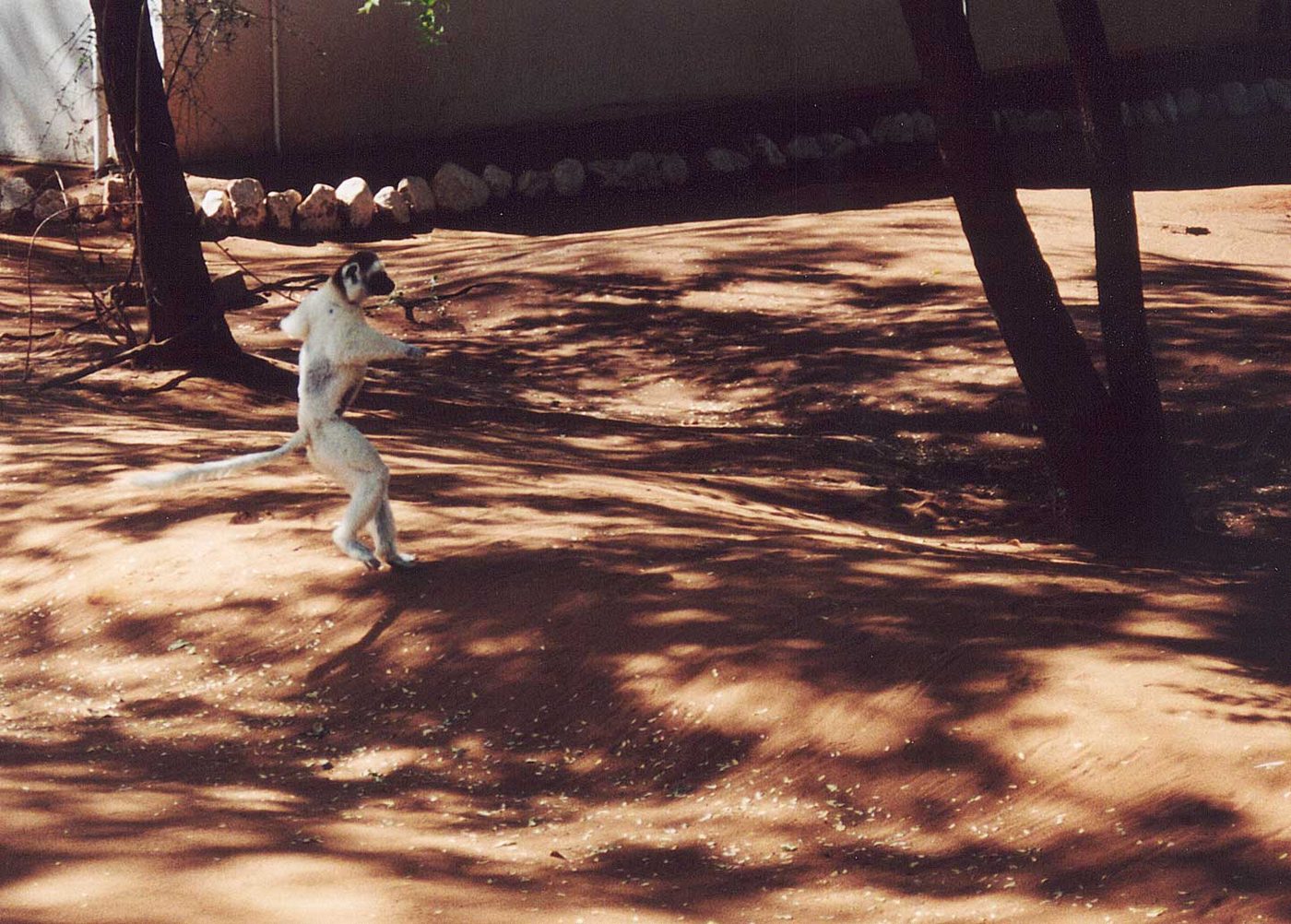
The famous 'dance'
The most famous trait of Verreaux's sifaka is the way it moves on the ground. Not being suited to walking on all fours, when it has to cross open spaces between one tree and another it proceeds with a series of comical sideways hops, keeping its torso upright and its arms raised for balance. This hopping movement looks like a genuine dance and has made the animal one of the most iconic images of Malagasy wildlife.
Feeding and conservation
It is mainly folivorous: it feeds above all on leaves, supplementing its diet with flowers, fruit and bark. Verreaux's sifaka is classified as a critically endangered species: forest destruction, agriculture and hunting have heavily reduced its populations. The protection of Madagascar's remaining forests is essential for its survival.
Pros
- Snow-white, elegant fur
- Extraordinary vertical leaps between trees
- The comical, famous 'dance' on the ground
- Iconic symbol of Malagasy wildlife
Cons
- Critically endangered species
- Threatened by deforestation and hunting
- Moves with difficulty on the ground