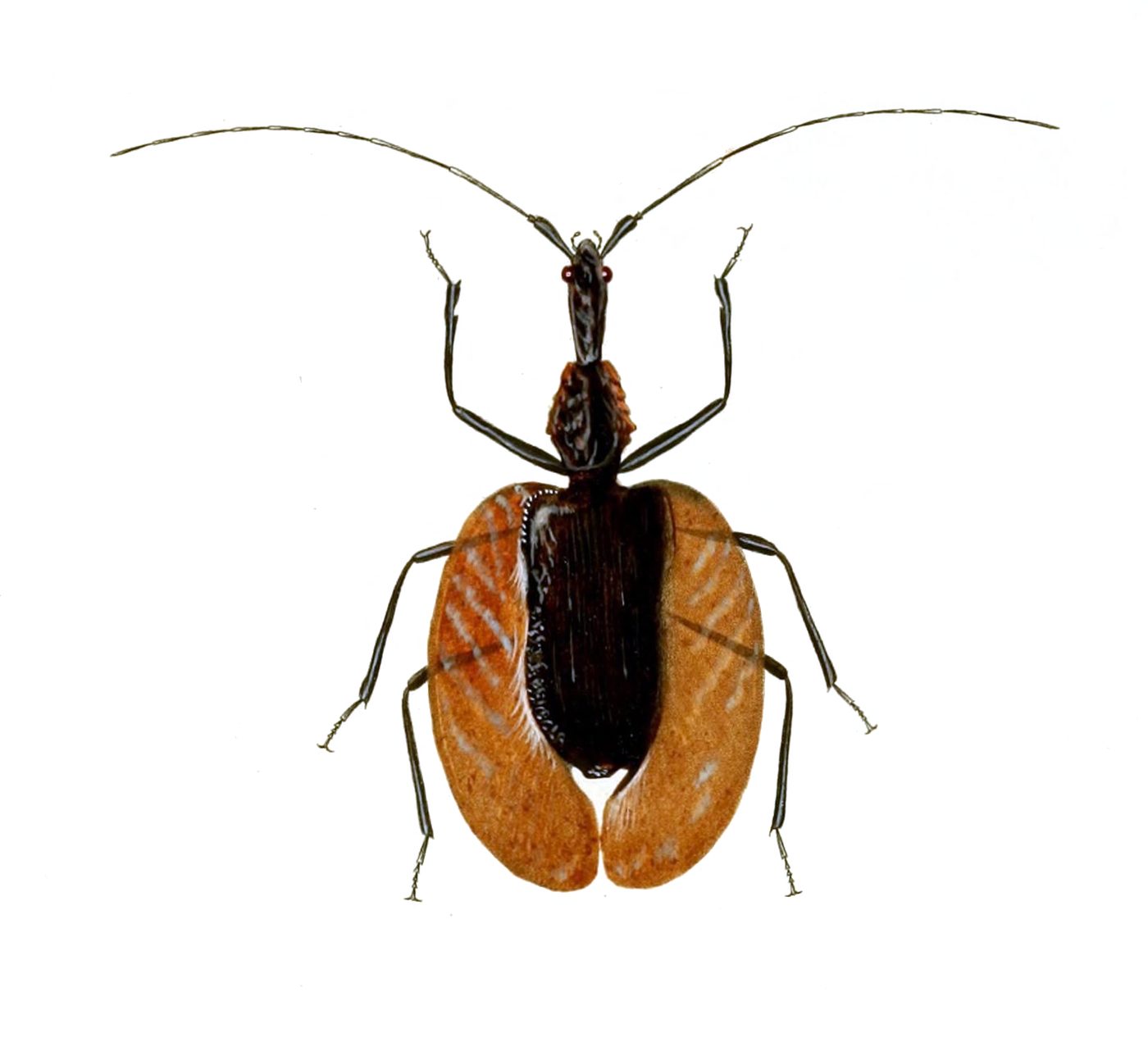
Photo: Orbigny, Charles Dessalines d' · Public domain
Violin beetle
Mormolyce phyllodes
A bizarre beetle of Southeast Asia, the violin beetle has a flat, splayed body shaped like a violin, perfect for slipping under bark and into fungi.
Characteristics
Temperament
Nocturnal, predatory, hides in crevices
Diet
Carnivore: small insects and larvae
An insect shaped like a violin
The violin beetle is one of the most bizarre insects in the world. It owes its name to its unmistakable outline: the body, between 6 and 10 centimetres long, is extremely flattened, and the elytra (the hardened wing cases covering the back) broaden at the sides into wide plates, giving the whole the profile of a violin or a dead leaf. Its head is small and elongated, thrust forward. It is a member of the ground beetles, the predatory beetles known as carabids.
Habitat and distribution
It lives in the rainforests of Southeast Asia, particularly Indonesia and Malaysia. Its extraordinarily flat body is a perfect adaptation to a very specific setting: the tight spaces under tree bark and between the gills of large bracket fungi, into which it slips in search of food and shelter.
Behaviour and defence
It is nocturnal and predatory, hunting small insects and larvae that it flushes from crevices. Like many carabids, it can defend itself by releasing irritant chemicals from glands at the tip of the abdomen, able to deter attackers. Its flat shape lets it not only hide but also escape predators by squeezing into places few others can reach.
Curiosities
Its extravagant shape has made it sought after by insect collectors, who appreciate its almost artistic appearance. It is a spectacular example of how natural selection can mould a body to fit a very specific habitat.
Conservation
The species has no formal risk assessment. As with many tropical insects, the destruction of rainforest nonetheless represents a potential long-term threat.
Pros
- Flat, violin-shaped body, unique
- Extraordinary adaptation to tight spaces
- Chemical defence against predators
Cons
- Tied to tropical rainforests
- Sought after by insect collectors
- Not a common animal to rear