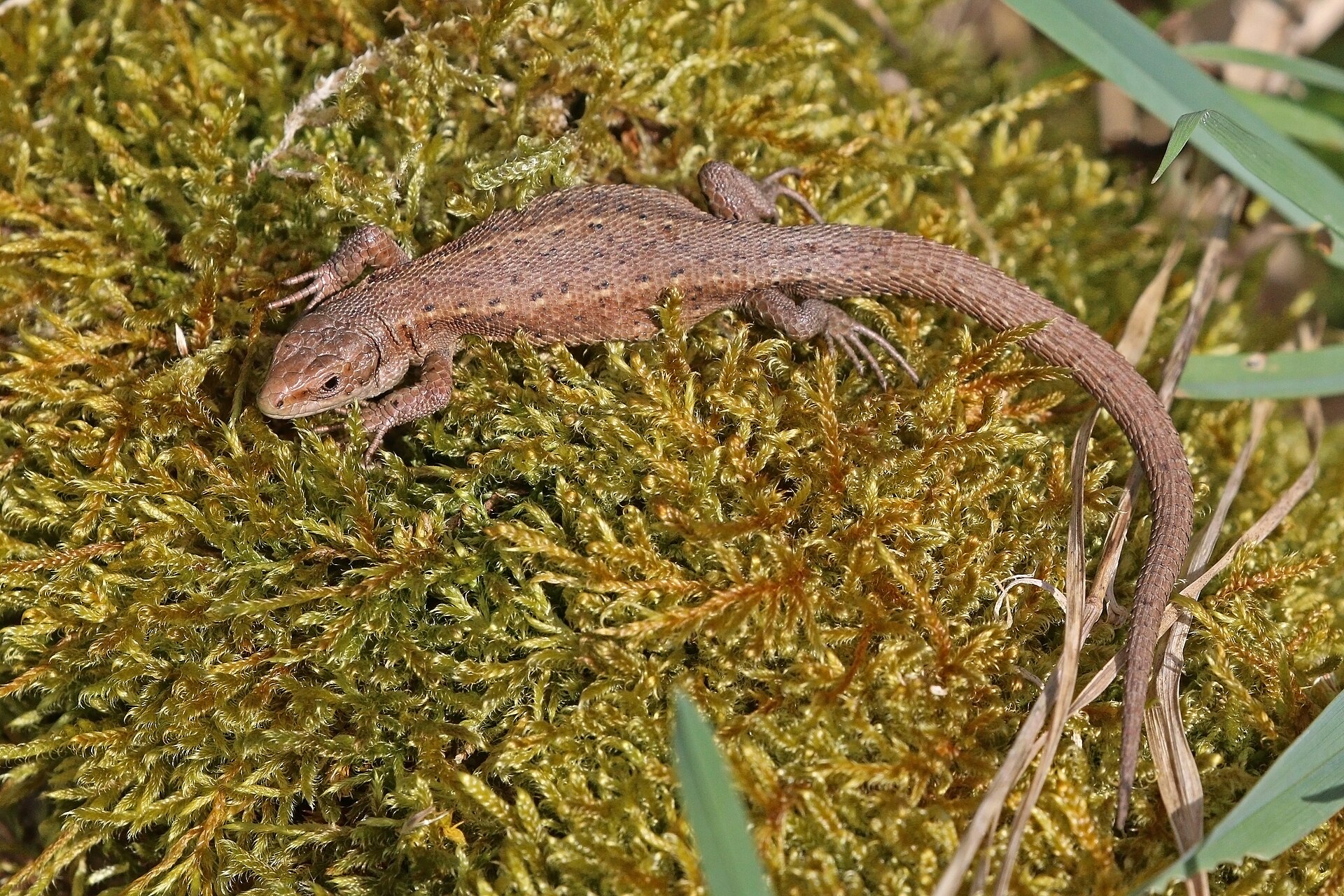
Viviparous Lizard
Zootoca vivipara
Characteristics
Temperament
Diurnal, ground-dwelling, shy and a tireless thermoregulator: it spends much of the day warming in the sun so it can hunt. Solitary and inconspicuous. Its whole biology is a challenge to the cold, won with viviparity (it usually gives birth to live young) and an extraordinary frost tolerance that makes it the world's northernmost reptile. If grabbed, it can sacrifice its tail to flee. Not a pet: a small wild lizard of cold climates.
Diet
A small insectivorous predator. It eats mainly insects (small beetles, flies, grasshoppers), spiders, earthworms, small snails and other small invertebrates. It hunts by sight, spotting moving prey and chasing it with quick dashes through grass and litter after warming in the sun to its optimal temperature. Being cold-blooded, its activity depends on temperature: it must eat enough in the short warm season to get through the long months of hibernation.
The Viviparous Lizard (Zootoca vivipara), also "common lizard", is a small lizard of cold climates and one of the most remarkable of the Old World. Famous for:
- The planet's northernmost reptile: it lives further north than any other reptile, pushing beyond the Arctic Circle
- "Viviparous" reproduction: it usually gives birth to fully formed young instead of laying eggs — a cold-climate adaptation, and the source of its name
- A huge range: one of the most widespread reptiles in the world, from Atlantic Europe to Japan
- Great cold tolerance: it survives where very few other reptiles can live
- A dual reproductive strategy: in some warmer populations, surprisingly, it still lays eggs
- A modest yet fascinating look: small, brown and discreet, it is the "mountain lizard" par excellence
IUCN status: Least Concern (LC), widespread. With it this portal "closes the circle" of the cold: after the Canada lynx, the Snowshoe hare and the Snowy owl, even among reptiles there is one that has conquered the realm of frost — and did so by reinventing the very way of bringing young into the world.
Classification and category
Order Squamata, family Lacertidae (the lacertids, the "true lizards" of the Old World), genus Zootoca (it was once classed as Lacerta vivipara, and some still use that name). It is the only species in the genus Zootoca. Not to be confused with other small lizards and lookalikes: the common wall lizard (Podarcis muralis) and Podarcis lizards (typical of walls and ruins at lower altitudes, slimmer); the sand lizard (Lacerta agilis) and the green lizard (Lacerta), larger lacertids; the slow worm (Anguis), which looks like a small snake but is in fact a legless lizard; and salamanders, superficially similar but amphibians, not reptiles (moist skin, no scales). Etymology: "Zootoca" is from Greek meaning roughly "bearing live young"; "vivipara" repeats the same idea in Latin — everything in the name turns on its most famous trait. Parameters: Total length 12-18 cm (including the tail, about half the length); body ~5-7 cm; weight a few grams. Longevity usually 5-6 years, but northern populations, which spend much of the year hibernating, can live longer. Reproduction: usually viviparous, with 3-11 young born in late summer, already independent.
Habitat and distribution
The Viviparous Lizard has one of the largest ranges of any reptile: all of temperate and cold Eurasia, from Ireland and the Iberian Peninsula to Japan, pushing north beyond the Arctic Circle (northern Scandinavia, Siberia). In Italy it occurs mainly in the Alps and the northern Apennine ranges, at medium-high altitudes. Preferred habitats — cool, damp environments: bogs, heaths, wet meadows and marshes (its typical habitat, rich in cover and insects); woodland edges, clearings and mountain pastures; and high-altitude and high-latitude environments where other reptiles cannot live. It is an ectotherm ("cold-blooded"): to become active it must warm up in the sun, and it is precisely its exceptional ability to exploit even brief warm windows that lets it live in forbidding climates. In the long cold winters it hibernates, often for many months, sheltering underground or under the litter. It is diurnal, ground-dwelling and mostly solitary. IUCN: Least Concern. A common, adaptable species over much of its range; locally it can suffer from wetland destruction and the alteration of mountain habitats.
Diet
The Viviparous Lizard is a small insectivorous predator. It eats: insects (the staple — small beetles, flies, grasshoppers and others); spiders; and earthworms, small snails and other small invertebrates. Hunting strategies: visual hunting (it spots moving prey and chases it with quick dashes through grass and litter); "strategic" thermoregulation (it warms in the sun until it reaches its optimal temperature, then becomes active and hunts efficiently; in cold climates this means exploiting every available ray of sun); and direct capture (it seizes the prey with its jaws and swallows it, sometimes after "working" it a little). Crucially, being small and cold-blooded, its activity depends closely on temperature: it lives a race against time, having to eat enough during the short warm season to store the energy needed to survive the long months of hibernation.
Physical features
The Viviparous Lizard is a small, sturdy, modest-looking lizard, seemingly "ordinary" but extraordinary in biology. Livery: a ground colour from brown to bronze, with greyish or reddish tones; a pattern of dark streaks, spots and dots along the back and flanks, varying between individuals; a coloured belly in males (yellow or orange, often dark-flecked), paler in females. The body: a compact, sturdy build with relatively short legs; a tail about as long as the rest of the body; small, inconspicuous scales; and an overall "stocky" look compared with the slimmer lizards of warm climates. Performance: tail autotomy (like many lizards, it can "shed" its tail to escape a predator; the tail keeps writhing, distracting the attacker, and later regrows, shorter); cold tolerance (its true "superpower", opening habitats closed to other reptiles); quick dashes and agility among grass and stones; and swimming (it can swim and dive to escape danger).
Behaviour and curiosities
The Viviparous Lizard is a diurnal, shy and tireless thermoregulator. Much of its day, in cold climates, is spent "chasing the sun", alternating spells in the sun to warm up with spells of activity and hunting. Its whole existence is a challenge to the cold, won with a series of unique adaptations.
"Giving birth instead of laying eggs": its most famous trait — the one that names it — is viviparity; rather than laying eggs in the ground and entrusting them to outside heat (risky in cold climates), the female keeps the eggs in her body and "incubates" the embryos internally by basking in the sun, finally giving birth to fully formed, independent young; it is a trick that lets it reproduce even where it is too cold for eggs to develop in the soil — the key to its success in the far north. The Arctic reptile: the viviparous lizard holds an absolute record — it is the world's northernmost reptile, pushing beyond the Arctic Circle, into regions where winter lasts most of the year; it is also one of the planet's most widespread terrestrial reptiles; in a group, the reptiles, that we instinctively associate with heat and deserts, it is the exception that conquered the frost. The species with "two ways of being born": a detail fascinating to biologists — although called "viviparous", not all its populations bear live young; in some warmer, southern parts of the range (for example the Pyrenees and southern France) there are populations that still lay eggs, so the viviparous lizard is one of the very few vertebrates in which both reproductive strategies (oviparity and viviparity) coexist, a "living laboratory" for studying how and why viviparity evolves, probably in response to cold. The self-sacrificing tail: like many lizards, it can resort to autotomy — if seized by the tail by a predator, it sheds it along preset break points; the severed tail keeps moving and writhing for a few moments, drawing the predator's attention and giving the lizard time to flee; the tail then regrows, though shorter and different-looking; it is a dear price (the tail stores fat and aids balance), but better the tail than life. "Cold blood" in the cold: living as an ectothermic reptile in icy climates seems a paradox, but the viviparous lizard solves it efficiently — it takes advantage of every sunny spell to warm quickly, is active at body temperatures other reptiles would avoid, and faces the long winters with deep hibernation; some northern populations even tolerate partial freezing of their tissues, surviving conditions that would kill most reptiles. The useful little insectivore: tiny and discreet though it is, the viviparous lizard plays a valuable ecological role, eating large numbers of small insects and other invertebrates and itself serving as prey for birds, snakes and small mammals — a key link in the food chains of bogs, heaths and mountain environments.
Pros
- Rettile più settentrionale del mondo: adattamenti unici al freddo
- IUCN Least Concern, tra i rettili più diffusi del pianeta
- Viviparità (e in alcune popolazioni oviparità): caso di studio per la scienza
- Utile insettivoro, anello chiave delle catene alimentari di torbiere e montagne
Cons
- Non è un animale da compagnia (piccola lucertola selvatica)
- Localmente minacciata dalla distruzione di torbiere e zone umide
- Molto sensibile alle alterazioni climatiche e di habitat in montagna
- Spesso scambiata con altre piccole lucertole o con le salamandre