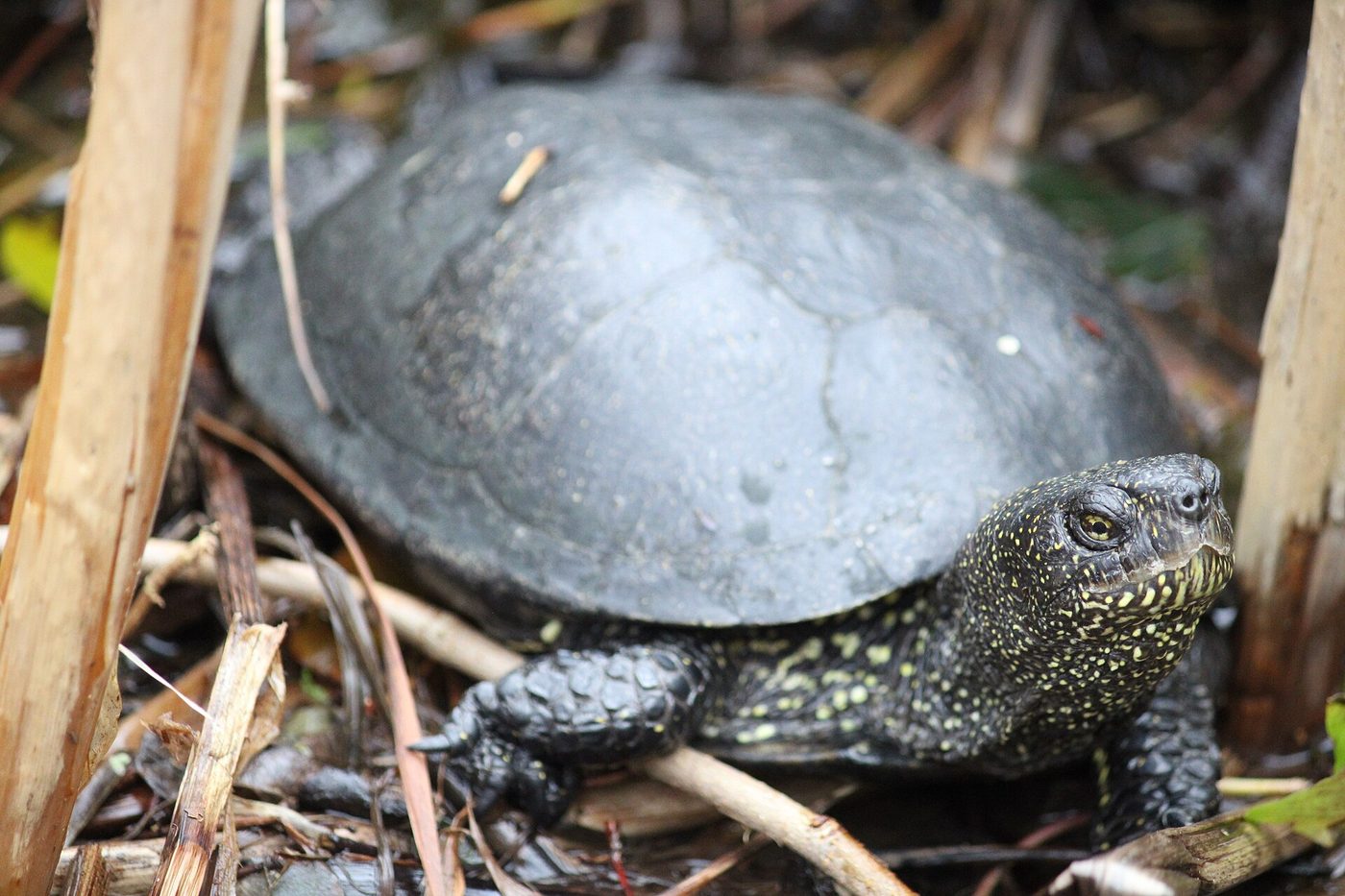
European pond turtle
Emys orbicularis
A discreet dweller of ponds and canals, the pond turtle is the only freshwater turtle native to much of Europe, and one of the longest-lived.
Characteristics
Temperament
Aquatic, diurnal and shy. Agile in water, cautious on land; it spends many hours basking in the sun and dives at the slightest alarm.
Diet
Mainly carnivorous, especially when young: aquatic insects, tadpoles, small fish, molluscs and worms, with plant matter as an adult.
A freshwater turtle
The European pond turtle is a small-to-medium aquatic turtle, with a smooth, dark carapace, often blackish, dotted with small yellow-gold spots and lines that form a radiating star pattern. The skin of head, neck and legs is likewise dark and sprinkled with the same golden speckling. Its feet are webbed, adapted for swimming, and its tail is relatively long. It is the only freshwater turtle native to much of the European continent.
A trait that makes it special is its longevity: it can live several decades, and very old individuals are documented in captivity.
Where it lives
It favours still or slow-flowing water with abundant vegetation: ponds, marshes, canals, ditches, oxbows and the quiet banks of lakes and rivers. It needs sunny banks and emerging logs or rocks on which to leave the water and warm itself. It occurs across much of southern and central Europe, as well as western Asia and North Africa.
What it eats and how it lives
It is mainly carnivorous, especially when young: it feeds on aquatic insects, tadpoles, small fish, molluscs, worms and crustaceans, adding plant matter to its diet in adulthood. It hunts in water, where it is agile and swift, while on land it is slower and more cautious. Like all reptiles it is ectothermic and depends on the sun: it spends many hours basking on emerging logs, ready to dive at the slightest alarm.
Breeding and rest
In spring the female leaves the water to reach sunny, soft ground, where she digs a hole in which to lay her eggs. As in many turtles, the incubation temperature influences the sex of the hatchlings. Through winter the animal enters a state of rest, often on the bottom of ponds and marshes, reducing its vital functions to a minimum.
Conservation
The European pond turtle is listed as near threatened and in many regions is in serious decline. The main causes are the destruction and pollution of wetlands, illegal capture and competition with introduced exotic turtles, such as the red-eared slider released from aquariums. It is a protected species and the subject of conservation programmes.