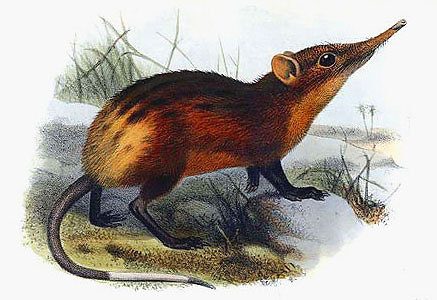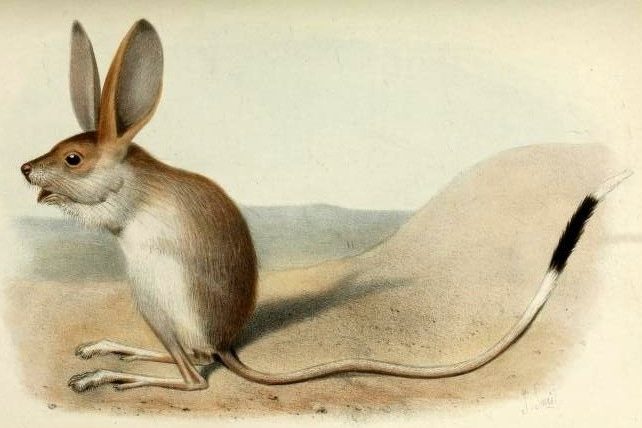
Photo: Joseph Smit (1836–1929) · Public domain
Long-eared jerboa
Euchoreutes naso
The long-eared jerboa is a tiny nocturnal rodent of Central Asian deserts, unmistakable for its enormous ears and long, springing leaps.
Characteristics
Temperament
Nocturnal, solitary and shy; extremely agile at leaping.
Diet
Insectivorous: hunts insects on desert nights.
The rodent with giant ears
The long-eared jerboa (Euchoreutes naso) is a small nocturnal rodent of the family Dipodidae, so distinctive that it is the only species in both its genus and its subfamily, Euchoreutinae. Its most striking feature is its ears — among the largest relative to body size of any mammal, far taller than its head. It has a tiny body, a long pointed snout, elongated hind legs built for jumping, and a long tail with a tuft at the tip that acts as a balancing rod during its leaps.
Habitat and range
It lives in the deserts and arid steppes of Central Asia, particularly the Gobi and the Taklamakan, between China and Mongolia. It favours sandy habitats with sparse vegetation, where soft ground lets it dig burrows to shelter in during the day.
Behaviour and diet
It is strictly nocturnal, emerging after dark to hunt insects, bounding along in long hops like a miniature kangaroo. Its proportionally enormous ears give it acute hearing, useful both for detecting prey and for sensing approaching predators in the silence of the desert. It spends the hottest hours sheltered in underground burrows.
Did you know?
It was long poorly known: only in recent decades has it been filmed in the wild, revealing habits and leaps never documented before. Its rarity and charming looks have made it a small conservation celebrity.
Conservation
The IUCN lists it as Least Concern, but information on the species remains scarce. Disturbance of desert habitats and human activity across its range are seen as potential threats worth monitoring.
Pros
- Ears among the largest relative to body size
- Extraordinarily agile leaper
- Unique species of its genus and subfamily
Cons
- Poorly known and hard to observe
- Tied to fragile desert habitats
- Population data still scarce