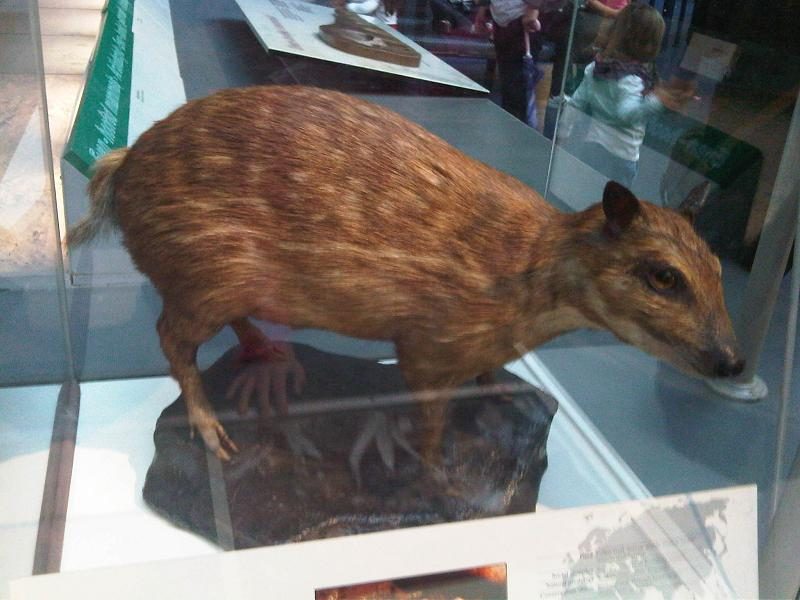
Photo: Emőke Dénes · CC BY-SA 4.0
Water chevrotain
Hyemoschus aquaticus
A small, archaic-looking African ruminant, the water chevrotain has tusk-like canines and, when threatened, plunges in and escapes underwater. It is the largest chevrotain.
Characteristics
Temperament
Nocturnal, solitary, shy, semi-aquatic
Diet
Frugivore: fallen fruit, leaves, shoots, invertebrates
An ungulate of ancient aspect
The water chevrotain, also known as the fanged deer, is a small ruminant that preserves many traits of the ancestors of today's even-toed ungulates. It has a stocky, arched body, slender legs and a reddish-brown coat dotted with white spots and stripes that mimic the dappled light of the forest floor. Unlike deer it bears no antlers: instead the males sport elongated, tusk-like upper canines used in fights between rivals. It is the largest of the roughly ten chevrotain species, yet it is barely bigger than a small dog.
Habitat and distribution
It lives in the rainforests and along the watercourses of West and Central Africa, always close to rivers, streams and swamps. It is a water-bound animal, favouring the dense bankside vegetation where it finds both food and shelter.
Behaviour
It is nocturnal, solitary and very shy. It spends the day hidden in vegetation and becomes active at dusk to feed on fallen fruit, leaves, shoots and, occasionally, small invertebrates and carrion. Its escape strategy is unusual for an ungulate: when pursued by a predator it throws itself into the water and swims, even staying partly submerged, to shake off its trail.
Curiosities
Chevrotains are regarded as among the living ruminants most similar to the ancestral forms that appeared tens of millions of years ago — true "living fossils". Despite some common names likening it to musk deer, the water chevrotain is not related to the Asian musk deer at all: the resemblance is only superficial.
Conservation
The IUCN lists the species as Least Concern, but populations are affected locally by hunting for meat and by forest loss. Its elusive nature makes it hard to estimate numbers with any precision.
Pros
- The largest and most striking of the chevrotains
- Remarkable escape strategy into water
- Archaic traits that make it a "living fossil"
Cons
- Extremely elusive, rarely seen
- Locally threatened by hunting and deforestation
- Not a pet: highly specialised wild needs