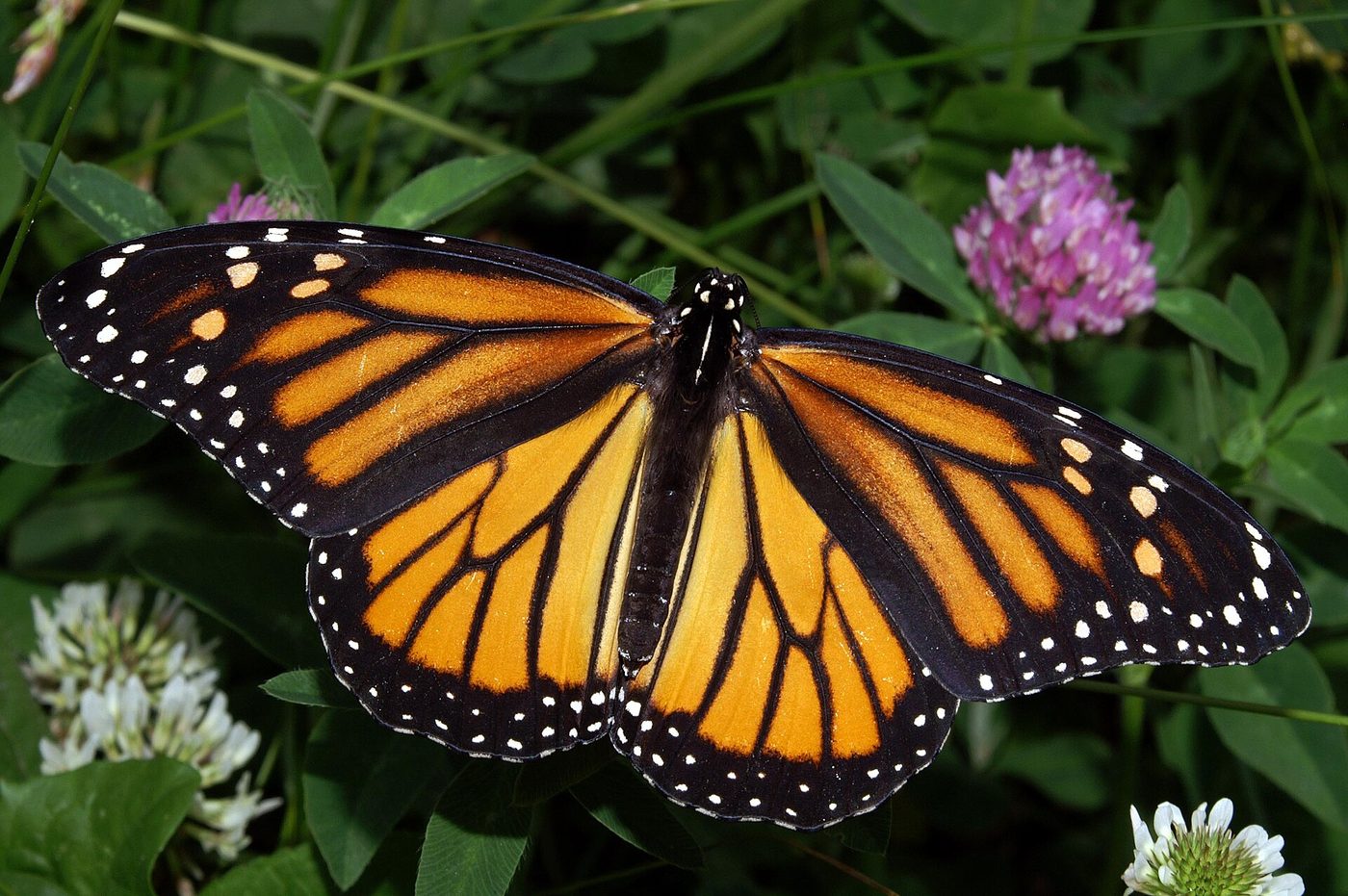
Photo: Kenneth Dwain Harrelson · CC BY-SA 3.0
Monarch butterfly
Danaus plexippus
Orange and black like a stained-glass window, the monarch butterfly makes one of the most incredible migrations on the planet, a journey of thousands of kilometres across generations.
Characteristics
Temperament
A day-flying butterfly and extraordinary migrant. Its bright colours warn predators of its toxicity; it makes journeys of thousands of kilometres across generations.
Diet
The adults feed on nectar; the caterpillars feed exclusively on milkweed, from which they get their toxic substances.
An unmistakable butterfly
The monarch butterfly is one of the most famous and recognisable lepidopterans in the world. Its wings, of an intense orange crossed by black veins and bordered with white dots, look like a small stained-glass window. This showy colouring is no accident: it is a warning. From the caterpillar stage, the monarch feeds on the leaves of a plant called milkweed, which contains toxic substances. The butterfly accumulates them in its body, becoming poisonous and unpleasant to predators, which learn to avoid it.
The impossible migration
What makes the monarch legendary is its extraordinary migration. Each year, millions of North American butterflies travel thousands of kilometres, from Canada and the United States to specific mountain forests in Mexico, where they spend the winter massed in their millions on the trees. The journey is so long that no single butterfly completes it in both directions: the return north takes place across several successive generations, each of which travels part of the way.
A mystery of orientation
How the monarchs manage, generation after generation, to find the same Mexican forests that their ancestors never saw is still in part a mystery. Scientists believe they use a combination of a 'sun compass', an internal biological clock and perhaps the perception of the Earth's magnetic field. It is one of the most extraordinary feats of navigation in the animal world.
Life cycle
The monarch passes through the classic stages: egg, caterpillar with yellow, black and white stripes, chrysalis with golden reflections, and finally the adult butterfly. The adults feed on the nectar of flowers, contributing to pollination.
Conservation
The monarch butterfly is classified as a vulnerable species. Its migratory populations are in steep decline because of the disappearance of milkweed, essential to the caterpillars, the use of pesticides, the destruction of the overwintering forests in Mexico and climate change. Planting milkweed and nectar-rich flowers and avoiding pesticides are concrete ways to help it.