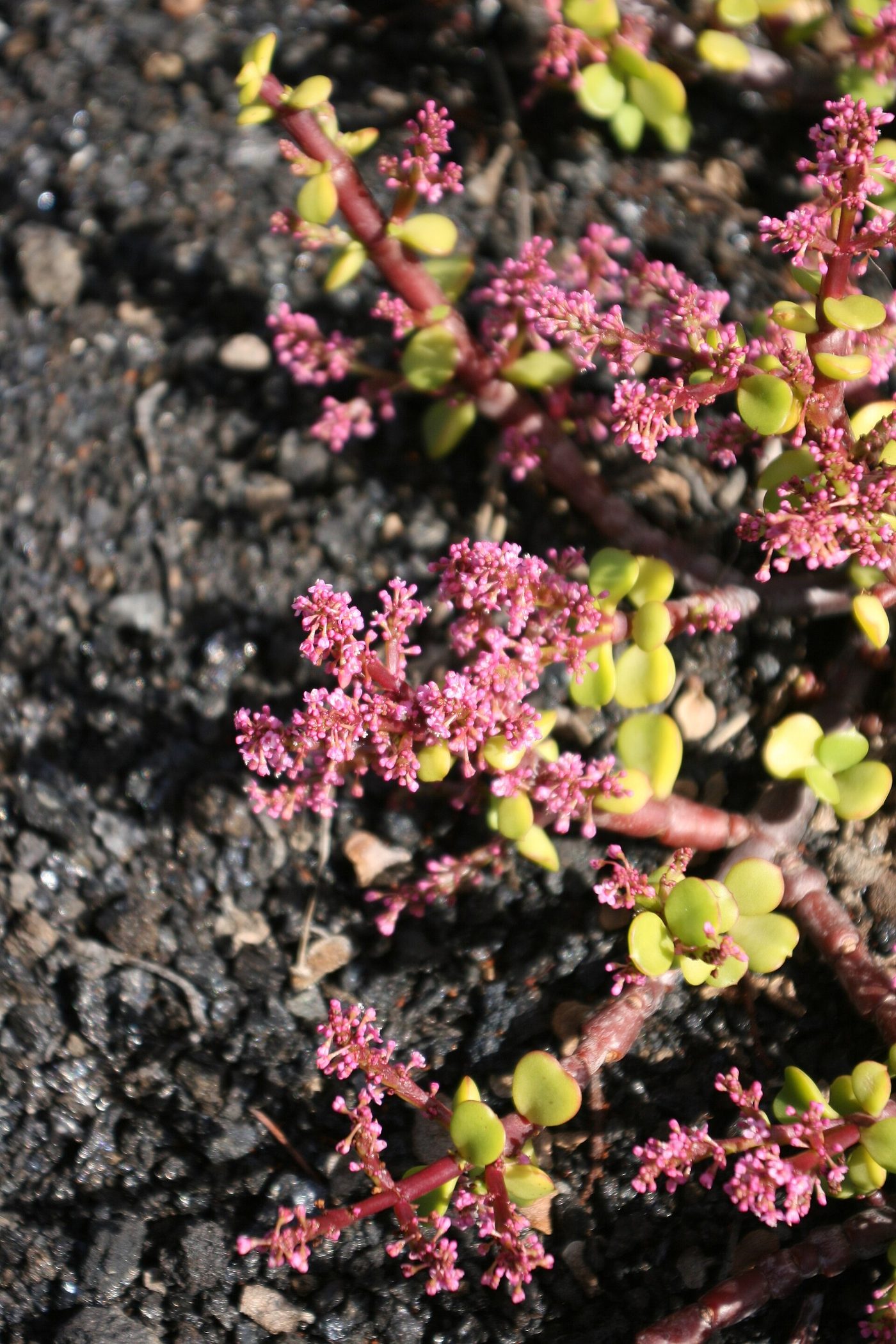
Photo: Frank Vincentz · CC BY-SA 3.0
Elephant bush
Portulacaria afra
Portulacaria afra is a South African succulent with reddish stems and tiny round leaves, extremely easy to grow and prized for bonsai.
Characteristics
A succulent with tiny round leaves
Portulacaria afra is a succulent shrub with fleshy, reddish stems and small, glossy round leaves of a bright green. It resembles the jade plant (Crassula ovata), to which it is not related: its leaves are much smaller and its twigs more flexible. There is also a variegated form, with cream-edged leaves, common in cultivation. In South Africa it is an important food plant for elephants, hence the name elephant bush.
Origin and habitat
It is native to southern and eastern Africa: South Africa, eSwatini, Mozambique and Kenya. It grows in hot, arid environments on stony, well-drained soils, where it forms dense bushes and, in older specimens, small trees.
Cultivation
It is one of the easiest succulents to grow, and thus perfect for beginners. It loves full sun or bright light but also tolerates part shade. Grow it in a very free-draining mix and water sparingly, letting the soil dry out between waterings. It is hardier to cold than many succulents but still dislikes frost. It propagates extremely easily from stem cuttings.
Bonsai and ecology
Thanks to its sturdy stems and tiny leaves, it is among the most popular plants for indoor bonsai. In South Africa it is also valued in ecological restoration: it is highly efficient at fixing carbon dioxide and is used to re-green degraded land in the thicket biome.
Care
With plenty of light and little water, Portulacaria afra is vigorous and long-lived. Regular pruning keeps it compact and encourages branching; cuttings root with the greatest ease.
Flowering season
Practical tips
Water needs: Low, soil dry between waterings — always check soil moisture before watering.
Prefers Full sun or bright light, tolerates part shade: provide the right light and rotate the plant for even growth.
Recommended soil: Very free-draining, mineral succulent mix. Refresh the substrate every 1-2 years.
Dust the leaves with a damp cloth to support photosynthesis.
Feed during the growing season (spring-summer) and stop in winter.
Pros
- Extremely easy to grow, ideal for beginners
- Perfect for indoor bonsai
- Non-toxic to people and pets
Cons
- Dislikes frost
- Suffers from waterlogging