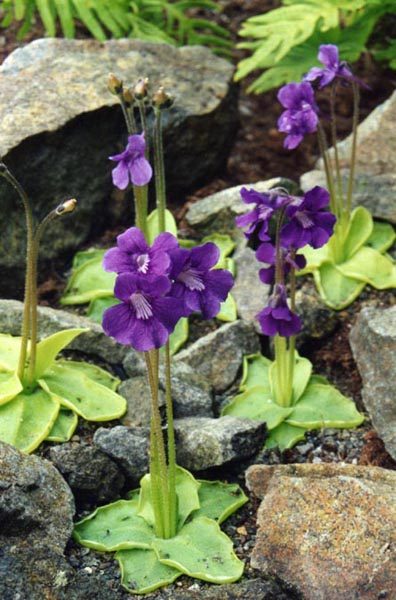
Large-flowered butterwort
Pinguicula grandiflora
A carnivorous plant of the European mountains, the large-flowered butterwort catches insects with sticky leaves and bears showy violet flowers larger than the genus average.
Characteristics
A carnivore with honeyed leaves
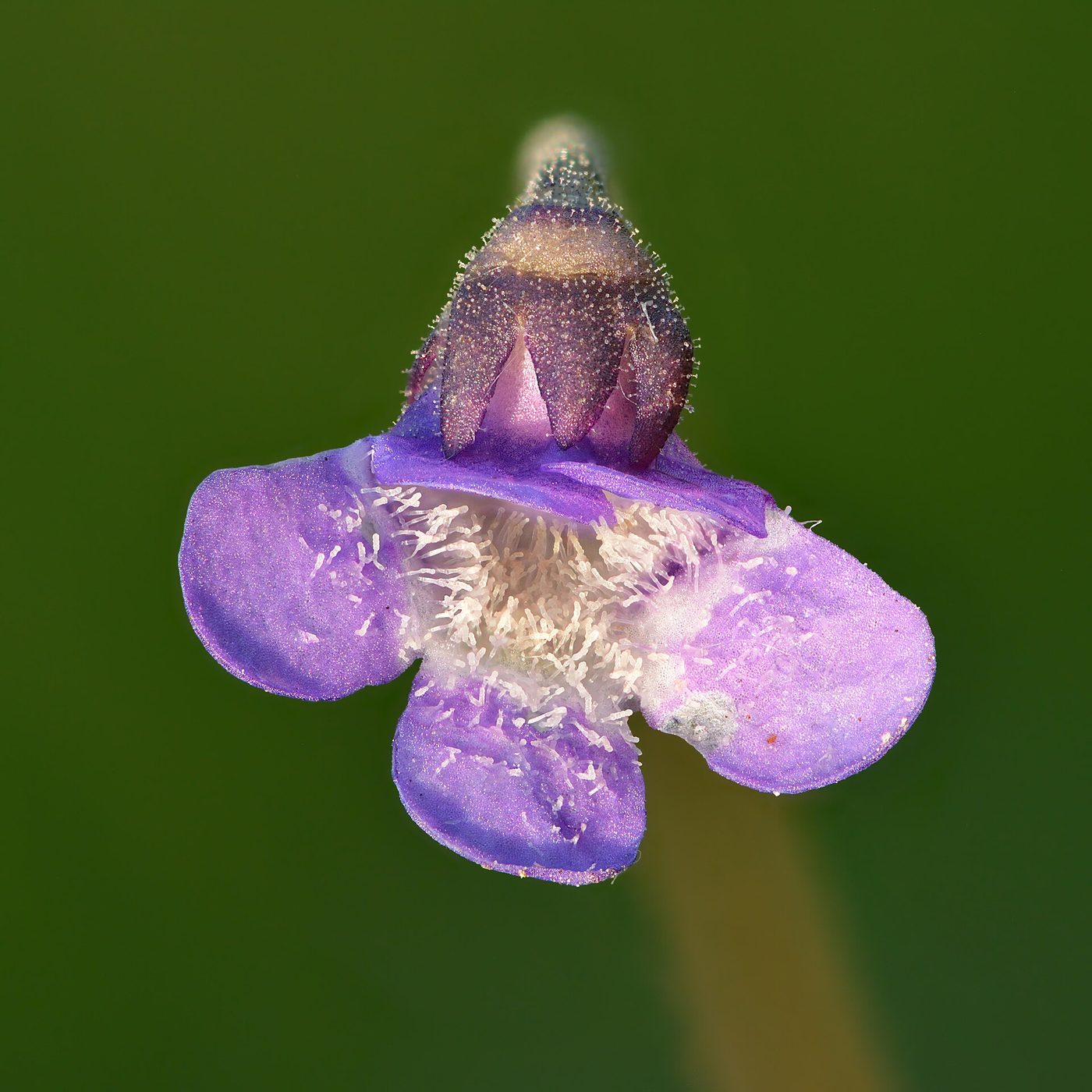
The large-flowered butterwort is a small carnivorous plant that forms a rosette of fleshy leaves, glossy yellowish-green and greasy to the touch. That sticky film is no ornament: it is a veil of glue on which small insects become trapped. The leaves, with no moving parts, work like living flypaper and digest their prey thanks to glands scattered over the surface. Its most striking feature, though, is the flowers: large violet spurred blooms, much wider than the genus average, borne on erect stalks.
Habitat and distribution
It is native to the mountains of Europe, particularly the Pyrenees and the Alps, but also occurs in Ireland and other cool, damp temperate regions. It grows in bogs, wet meadows, springs and dripping rock faces, on poor soils where catching insects makes up for the scarcity of nitrogen.
Life cycle and cultivation
It is a perennial of cool climates: in winter the summer rosette withdraws into a small, compact resting bud (hibernaculum), from which it resprouts in spring, when it flowers. In cultivation it needs plenty of light, a poor, always-moist substrate watered with mineral-free water, and cool temperatures with a winter rest. It is prized by enthusiasts for combining carnivory with fine flowers.
Curiosities
The sticky leaves have traditionally been used in some areas to curdle milk, exploiting their enzymes. Butterworts are related to the bladderworts, other famous carnivores.
Conservation
The species is of no particular concern where common, but it depends on mountain wetlands, fragile habitats threatened by drainage and disturbance. Plants for sale should come from cultivation.
Flowering season
Practical tips
Water needs: High: permanently moist substrate — always check soil moisture before watering.
Prefers Full sun or very bright light: provide the right light and rotate the plant for even growth.
Recommended soil: Peaty or damp calcareous, poor. Refresh the substrate every 1-2 years.
Dust the leaves with a damp cloth to support photosynthesis.
Feed during the growing season (spring-summer) and stop in winter.
Pros
- Sticky leaves that catch insects
- Large, showy violet flowers
- Good for those wanting a hardy mountain carnivore
Cons
- Needs a cool climate and winter rest
- Always-moist substrate with mineral-free water
- Slow growth