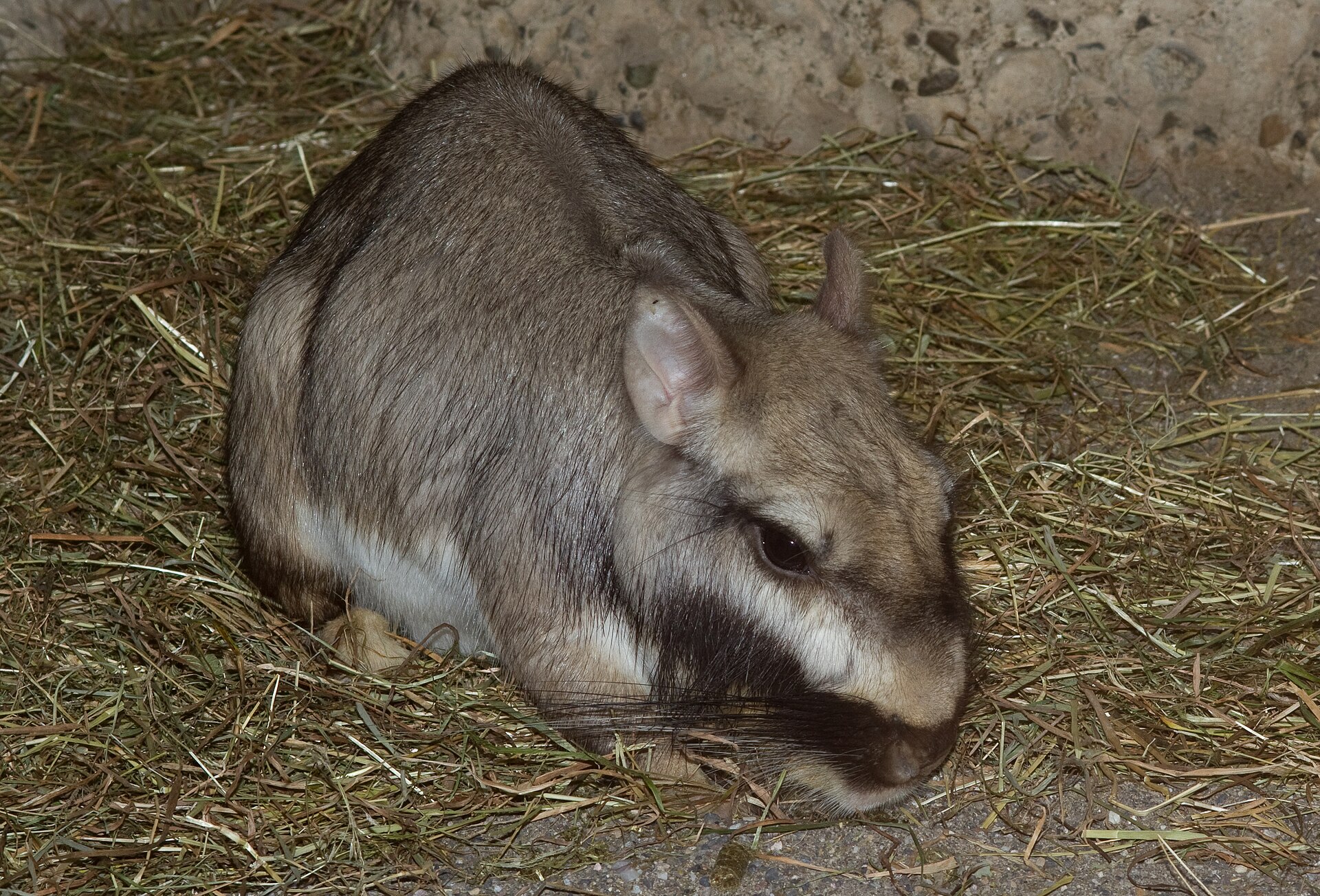
Plains Viscacha
Lagostomus maximus
Characteristics
Temperament
A nocturnal, strongly social, colonial wild rodent that lives in large groups within extensive burrow systems (the vizcacheras). Shy and cautious, by day it stays safe underground and at night it comes out to graze in company, with "sentinel" individuals alert to predators. It is known for the bizarre behaviour of collecting and piling objects in front of its burrows. It is NOT a pet: it is native wildlife of the pampas, to be observed and safeguarded in its environment, and its burrows are a valuable refuge for many other species.
Diet
A herbivore feeding mainly on grasses and graminoids, as well as seeds, roots and other plant parts, grazed near the burrow. It comes out to graze at night and dusk, in the company of the other colony members and with sentinel individuals, ready to take refuge in the vizcachera at the first alarm. Its intense grazing "mows" the vegetation around the burrows, creating short-grass areas. Precisely because of its appetite for grasses and crops it was historically considered a competitor of livestock, but today its ecological role is also recognized.
The Plains Viscacha (Lagostomus maximus) is one of the largest, most social and most curious rodents in South America: a relative of the chinchilla with colonial and collecting habits. Famous for:
- Colonial life: it digs huge communal burrow systems, the "vizcacheras", inhabited by dozens of individuals
- The "collecting" habit: it gathers and piles objects of all kinds in front of its burrows, even things lost by humans
- The facial "mask": a characteristic pattern of black-and-white stripes on the face
- The kinship with the chinchilla: it belongs to the same family, the Chinchillidae
- Strong dimorphism: males are much larger than females
- The ecological role: its burrows host and protect many other animals
IUCN status: Least Concern (LC). It enters the portal in the group of New World rodents, alongside the Agouti, Coendou and Paca: another representative of the extraordinary diversity of South American rodents, and in particular of that branch (the caviomorphs) that also includes chinchillas, capybaras and guinea pigs.
Classification and category
Order Rodentia (the rodents), family Chinchillidae — the same as the chinchillas and the mountain viscachas. The plains species is Lagostomus maximus, the only one of its genus. In the portal it is placed among the New World rodents, the group of South American "caviomorph" rodents. It is useful to tell it apart from its relatives and similar animals: the chinchilla, also in the portal, is much smaller and with very fine, precious fur; the Viscacha is large, stocky and with more ordinary fur; the mountain viscachas (genus Lagidium) resemble long-tailed rabbits and live among the rocks of the Andes; the plains viscacha instead lives on the lowlands, in dug burrows; the Mara (also in the portal) is a "hare-like" rodent, but belongs to a different family (the cavies). Etymology: the genus name "Lagostomus" comes from Greek and means roughly "hare-mouth"; "maximus" emphasizes the size, considerable for a rodent; the name "viscacha" (Spanish vizcacha) comes from Andean indigenous languages. Parameters: Weight very variable due to dimorphism — males can reach 7-9 kg, females generally 3-5 kg. Length body around 50 cm, plus the tail. Appearance a stocky, robust body, a large head. Longevity: in the wild a few years, up to about 7-9 years. Reproduction: prolific and tied to colonial life; the young are born and grow up in the safety of the vizcachera.
Habitat and distribution
The Plains Viscacha is a typically South American rodent: its range covers the plains of Argentina, Paraguay, Bolivia and neighbouring areas, with the famous Argentine pampa as its prime environment. Preferred habitats — open plains and soils suitable for digging: pampas, grasslands and short-grass steppes; arid and semi-arid environments with soil suitable for building burrows; and flat areas, including agricultural land and pastures. The Viscacha is a fossorial, colonial animal: it lives in large underground burrow systems, the vizcacheras, dug with numerous entrances and tunnels and inhabited by groups of many individuals, often for generations. It is mainly nocturnal and crepuscular: by day it stays safe underground, while at dusk it comes out to graze around the burrow. It was long considered a "pest" for agriculture and pastures, and persecuted for this, but it remains widespread in many areas. IUCN: Least Concern. The species is still relatively common, although locally it has suffered persecution and the transformation of environments. Its burrows, however, have great ecological value, because they offer refuge to many other species.
Diet
The Viscacha is a herbivore with "close-to-the-ground" habits. It eats: grasses and graminoids (the basis of its diet, grazed near the burrow); and seeds, roots and other parts of plants. Feeding habits: nocturnal grazing near the burrow (it comes out in the dark and feeds nearby, ready to take refuge in the vizcachera at the first alarm); grass-cutting (by grazing intensively, it tends to "mow" the vegetation around the colony, creating clearly visible short-grass areas); and group living (grazing takes place in the company of the other colony members, with sentinels alert to danger). Crucially, the Viscacha's intense grazing around the vizcacheras modifies the vegetation and the soil, creating particular micro-environments. Precisely because of its appetite for grasses and crops, it was historically seen as a competitor of livestock and persecuted by farmers.
Physical features
A robust, unmistakable rodent, especially for its facial pattern. The face and head — the distinguishing trait: a large head with a characteristic "mask": black-and-white stripes arranged on the muzzle and cheeks, recalling "moustaches" or a facial design; relatively small ears. The body and coat: a stocky, massive body, with a robust rear; grey-brown fur, paler on the underparts; strong hind legs for digging and moving in leaps. The dimorphism: a strong difference between the sexes — males are much larger and heavier than females, one of the most marked dimorphisms among rodents. Performance: an excellent digger (it builds the large vizcacheras); a complex social life, with communication between colony members; and a unique "collector" behaviour (see curiosities).
Behaviour and curiosities
The Viscacha is a markedly social, nocturnal, colonial animal. Its colonies can number many individuals sharing the same network of burrows, and group life is rich in interactions. It is a rodent of habits curious enough to have made it a star of South American folklore.
The "collector" of the pampas: the Viscacha's most famous and bizarre feature is its mania for collecting objects; these rodents carry and pile in front of their burrow entrances all sorts of material: bones, twigs, stones, dung and — according to popular tradition — even objects lost by humans, such as watches, keys or tools; for this reason, in the Argentine countryside, it is said that "if you've lost something, look for it in the vizcachera"; the reason for this behaviour is not entirely clear: perhaps it serves to signal the colony's presence or to keep the area around the burrow "tidy". The vizcacheras: the Viscacha's burrows, called vizcacheras, are true "underground cities"; dug with numerous entrances and tunnels, they can be very old, enlarged and inhabited by generations of viscachas; these structures host not only viscachas: as with prairie-dog burrows, they become refuge for many other animals — burrowing owls, snakes, small mammals — that exploit their protection; the vizcachera is thus a small ecosystem around which the life of many pampa species revolves. The chinchilla's cousin: though so different in appearance and size, the Viscacha is a close relative of the chinchilla: both belong to the family Chinchillidae; while the chinchilla is small, with very fine fur and tied to the Andean mountains, the plains viscacha is large, stocky and of the lowlands; it is a fine example of how the same rodent family can have given rise to very different forms by adapting to different environments. The giant male: the Viscacha shows one of the most marked sexual dimorphisms among rodents; adult males can be much larger and heavier than females, weighing several kilos more; this size difference is tied to competition between males and to the social structure of the colonies, in which dominant males play an important role. The "pest" reassessed: for a long time the Viscacha was considered an agricultural and pasture pest, because it grazes the grasses that livestock also feed on and because its burrows can "riddle" the ground; for this it was long hunted and poisoned; today, however, its positive ecological role is increasingly recognized: its colonies create habitat for other animals and contribute to the biodiversity of the pampa. The nocturnal life: like many rodents of open, warm areas, the Viscacha avoids the hottest, brightest hours, staying safe in the cool of the burrow during the day; it comes out mainly at night and dusk to graze, when the risk of dehydration and of being spotted by diurnal predators (such as raptors) is lower; its life is thus marked by the rhythm of dark and light.
Pros
- Roditore affascinante e poco noto, dal comportamento "collezionista" unico
- Molto sociale: vive in colonie complesse (vizcacheras)
- Ingegnere dell'ecosistema: le sue tane offrono rifugio a molte altre specie della pampa
- IUCN Least Concern: ancora relativamente diffusa nelle pianure sudamericane
Cons
- NON è un animale da compagnia: è fauna selvatica autoctona
- Storicamente perseguitata come "nociva" per agricoltura e pascoli
- Localmente in calo per persecuzione e trasformazione degli ambienti
- Le colonie e gli scavi possono entrare in conflitto con le attività agricole