Photo: Diego González Dopico · CC BY 4.0
Iberian ribbed newt
Pleurodeles waltl
The Iberian ribbed newt is Europe's largest newt, an aquatic amphibian with an extraordinary defence: it pushes its sharp ribs out through its skin.
Characteristics
Temperament
Nocturnal, largely aquatic, shy
Diet
Carnivorous: aquatic invertebrates, tadpoles and eggs
The newt with sharp ribs
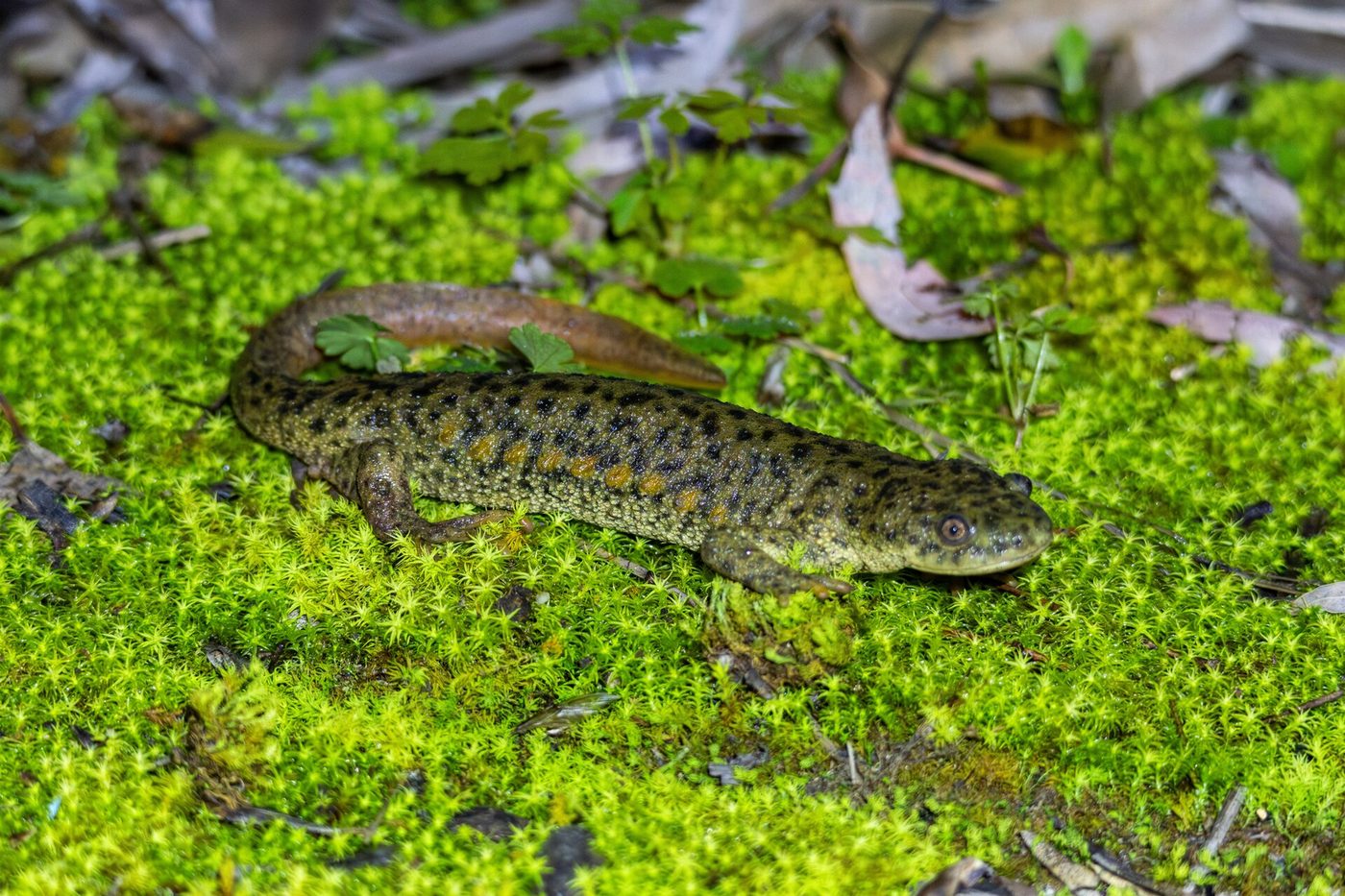
The Iberian ribbed newt, or gallipato, is Europe's largest newt: it can reach 30 cm in length, of which about half is the tail. It has a robust, flattened body, grey-brown or olive, often mottled, with a row of yellow-orange tubercles along its flanks. At these very tubercles lies its most unusual weapon: when threatened, it pushes its sharp ribs forward until they protrude through the skin of its sides, passing through poison glands that coat their tips.
Habitat and range
It lives in the central and southern Iberian Peninsula and northern Morocco. It is a largely aquatic species: it frequents ponds, pools, cisterns, canals and slow watercourses, where it can stay in the water year-round if conditions allow. It also tolerates brackish water and human-modified environments.
Behaviour and diet
It is a nocturnal, opportunistic hunter: it feeds on aquatic invertebrates, small amphibians, tadpoles and eggs. Its rib-based defence is unique: the tips, protruding through the toxic glands, inject venom into anything that tries to bite it, without lasting harm to the newt, whose skin heals over.
Notable facts
For its robustness and adaptability, the gallipato has been chosen as a model organism for scientific experiments, including research in space aboard orbital stations. It is also one of the few amphibians able to regenerate not only limbs but also parts of the eyes and internal organs.
Conservation
The species is listed as Least Concern by the IUCN and remains widespread. Locally it is affected by wetland loss, pollution and the introduction of predatory fish.
Pros
- Europe's largest newt
- Unique defence with protruding ribs
- Extraordinary regenerative abilities
Cons
- Skin and ribs with toxic secretions
- Vulnerable to wetland loss