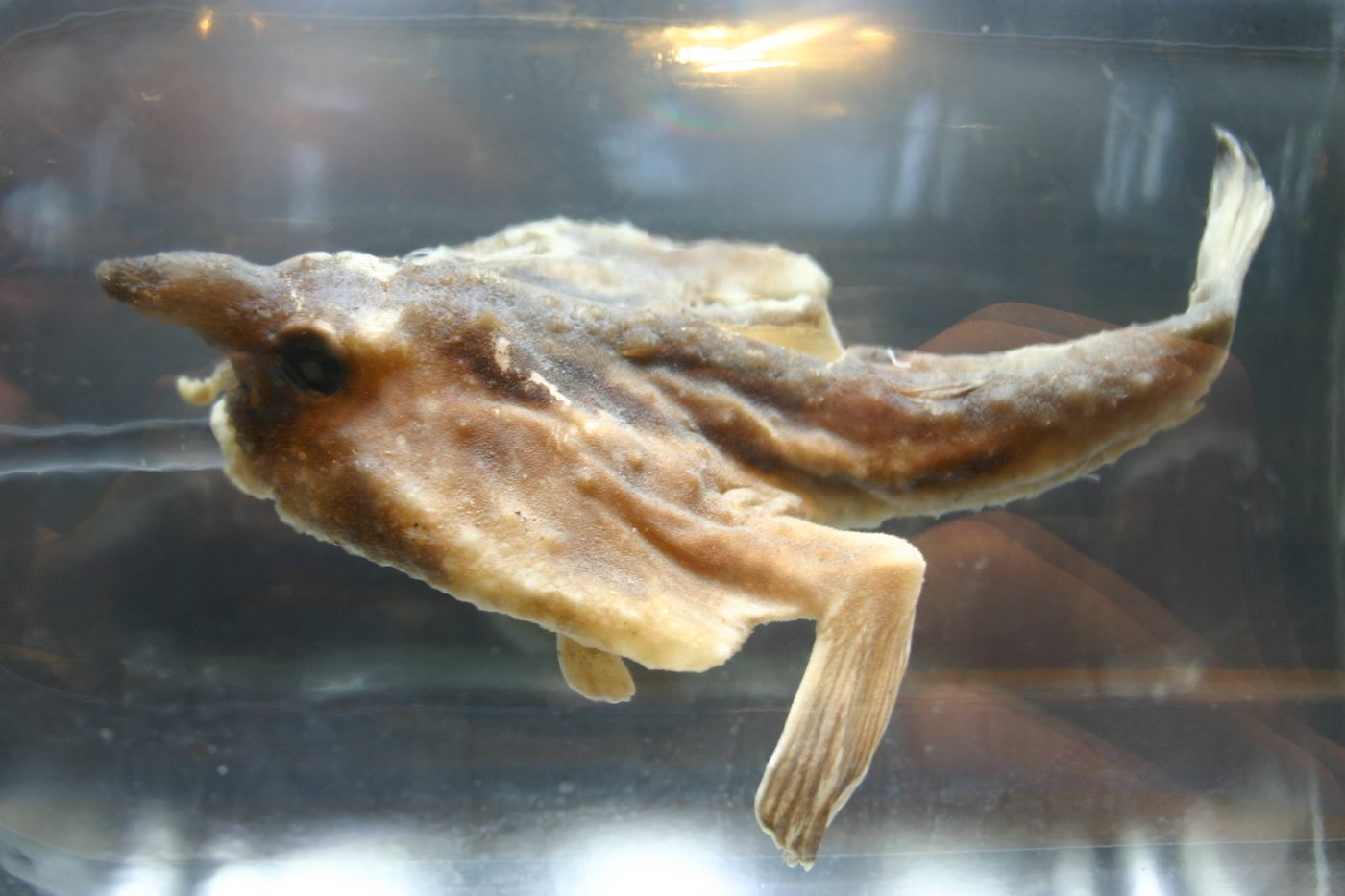
Photo: ideonexus on Flickr · CC BY-SA 2.0
Red-lipped batfish
Ogcocephalus darwini
The red-lipped batfish is a bizarre fish of the Galápagos that, instead of swimming, "walks" on the seabed, flaunting vivid fire-red lips.
Characteristics
Temperament
Sedentary and cryptic; "walks" on the bottom rather than swimming.
Diet
Carnivorous: small fish, crustaceans and invertebrates lured in.
A fish that walks on the seabed
The red-lipped batfish (Ogcocephalus darwini), also called the Galápagos batfish, is a fish of truly unusual morphology. Its flattened body, covered in small bumps, is dominated by lips of a vivid red — the species' most famous feature. It is a poor swimmer: instead of swimming, it uses its sturdy, leg-like pectoral, pelvic and anal fins to "walk" across the ocean floor. In adults, the dorsal fin is reduced to a single spine-like projection.
Habitat and range
It lives in the waters around the Galápagos Islands and along the coasts of Ecuador and Peru, on sandy and rocky bottoms at depths of about 3 to 76 metres. It is closely related to the rosy-lipped batfish, which lives near Cocos Island off Costa Rica.
Behaviour and diet
Like other anglerfish, it has a small mobile appendage on its head (the illicium) that, retracted into a cavity above the mouth, it uses as a lure to attract prey — small fish, crustaceans and other invertebrates. It spends much of its time motionless on the bottom, camouflaged, moving in short steps when needed.
Did you know?
The function of the red lips is not fully understood: they may play a role in recognition between individuals or in courtship. The scientific name honours Charles Darwin, reflecting the fish's strong link to the Galápagos.
Conservation
The IUCN lists it as Least Concern. It is not considered threatened, but like all Galápagos species it depends on the health of that unique marine ecosystem.
Pros
- Unique look with bright red lips
- "Walks" on the seabed with its fins
- Least Concern, not threatened
Cons
- A poor swimmer, very slow
- Tied to the Galápagos ecosystem
- Hard to spot due to its cryptic habits