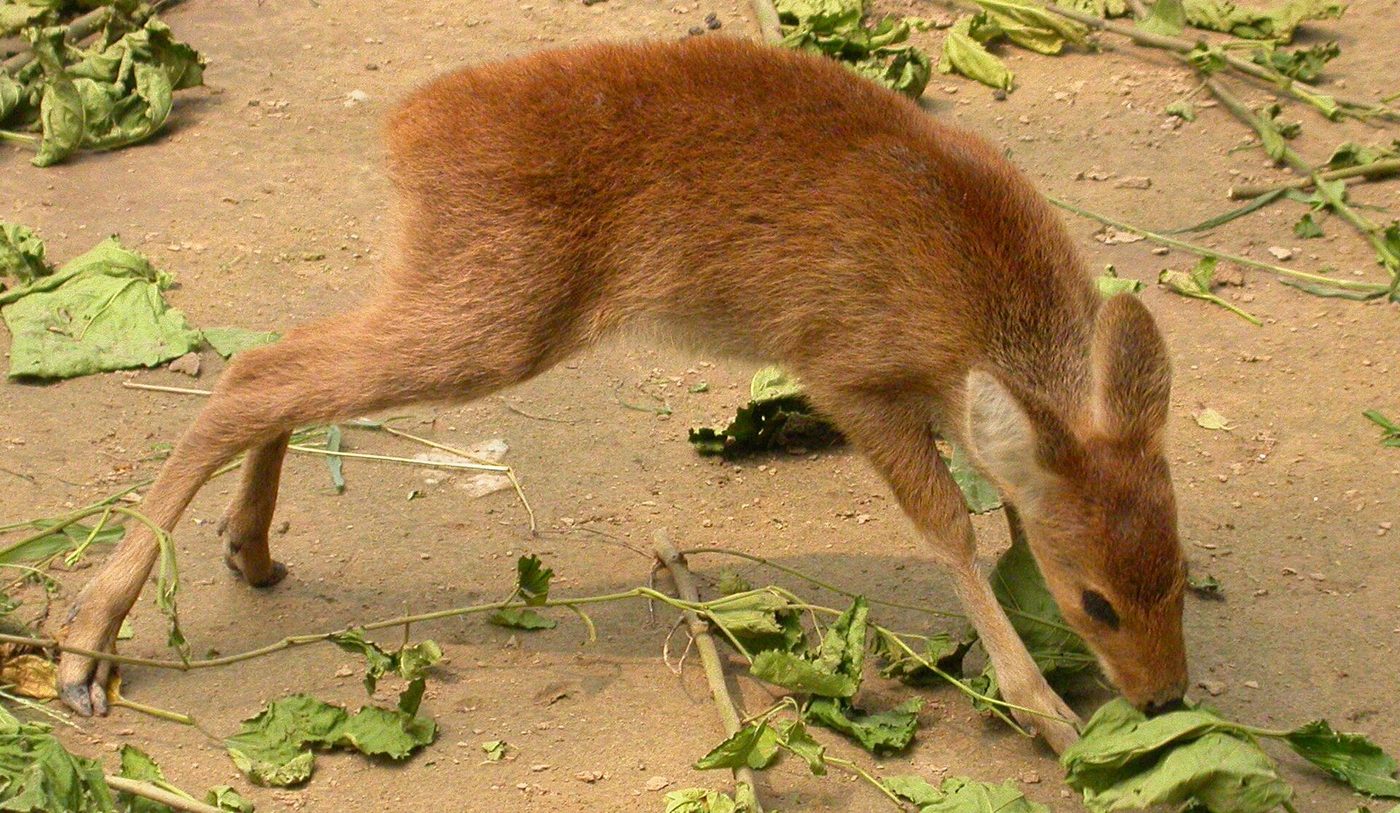
Photo: Snowyowls · CC BY-SA 2.0
Water deer
Hydropotes inermis
A small Asian deer with no antlers but long tusks, the water deer lives among reeds and rivers and is nicknamed the 'vampire deer'.
Characteristics
Temperament
Solitary, crepuscular, shy; a good swimmer
Diet
Herbivore: grasses, reeds, shoots, aquatic plants
The deer with tusks
The water deer is a small deer of unusual appearance. Unlike almost all other deer, the males bear no antlers: in their place they sport two long upper canines shaped like tusks, jutting from the mouth like little sabres and used in fights between rivals. It is precisely these tusks that have earned it the nickname 'vampire deer'. Its body is stocky, its coat tawny-brown, and its large eyes and rounded ears give it a plush-toy look.
Habitat and distribution
It is native to Korea and eastern China, where it lives in wetlands: reed beds, riverbanks, marshes and flooded meadows. It is a strong swimmer and unafraid of water, hence the name. Introduced populations also live feral in Great Britain and France.
Behaviour and reproduction
It is solitary and mainly crepuscular, shy and elusive. It feeds on grasses, reeds, shoots and aquatic plants. One peculiarity sets it apart from other deer: the female can give birth to several young at a time, sometimes up to five or six, an unusually high reproductive rate for a deer.
Curiosities
Despite its name and some resemblances, it is not related to the Asian musk deer: genetic analyses place it close to the European roe deer. The males' tusks are mobile and can be slightly retracted while feeding.
Conservation
The IUCN classifies the species as Vulnerable: in its native range it is threatened by hunting and the loss of wetlands. Paradoxically, the populations introduced to Europe are increasing and hold a significant share of the world's individuals.
Pros
- Long tusks instead of antlers, unique
- Skilled swimmer of the wetlands
- High reproductive rate for a deer
Cons
- Vulnerable in its native range
- Depends on declining wetlands
- Not a pet: a wild deer