Photo: Jens Petersen · CC BY 2.5
Bluespotted ribbontail ray
Taeniura lymma
An elegant ray of Indo-Pacific coral reefs, the bluespotted ribbontail ray is dotted with vivid blue spots and carries a venomous spine on its tail.
Characteristics
Temperament
Shy, shelters under coral; sometimes in groups
Diet
Carnivore: molluscs, worms, shrimps, small fish
A ray of dazzling colours
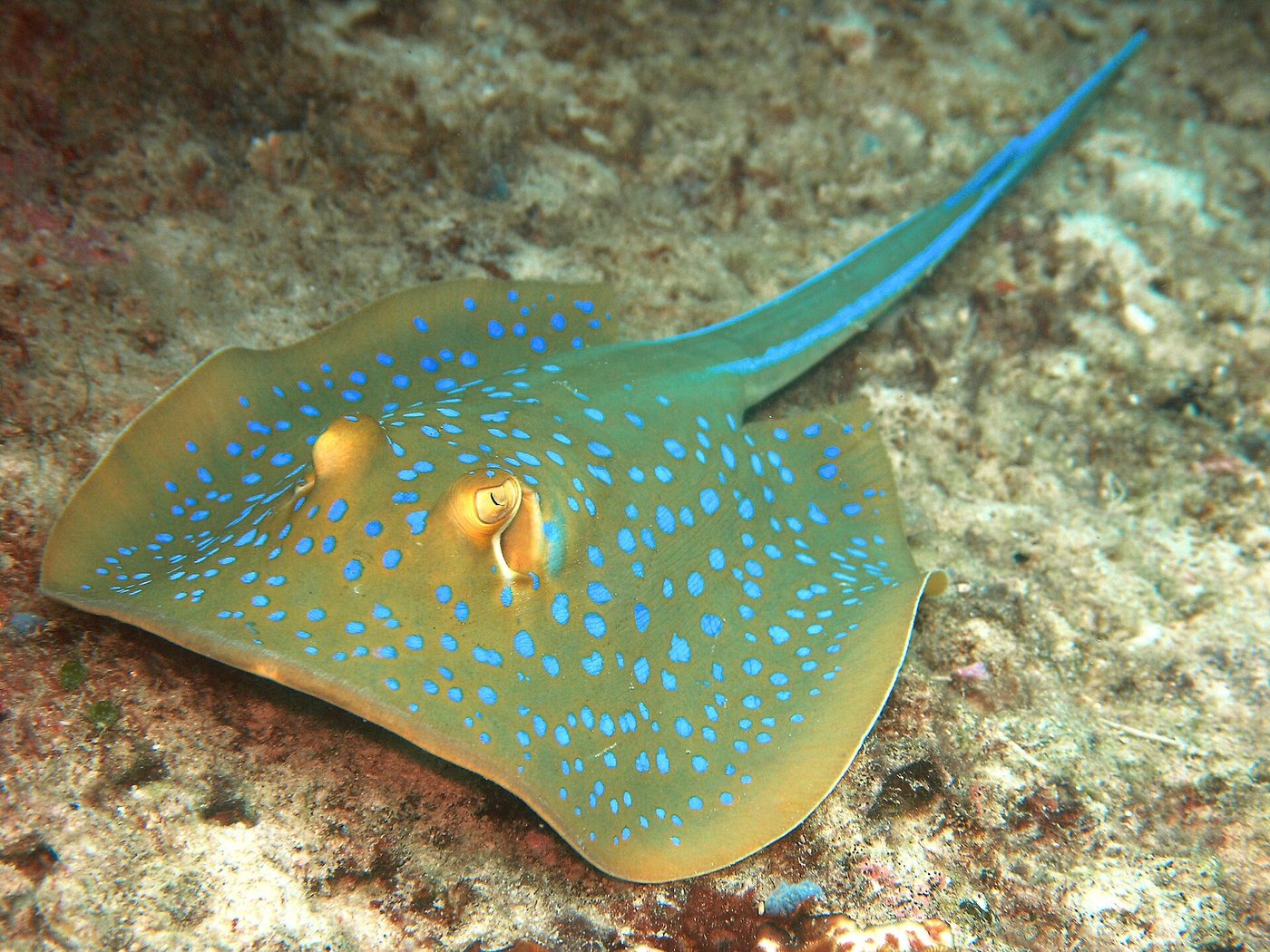
The bluespotted ribbontail ray is a small ray with an unmistakable livery: its oval pectoral disc, no more than 35 cm across, is a yellowish-green dotted with numerous spots of intense electric blue, while a pair of blue stripes run along the tail. Its eyes are large and protruding, its tail short and stout. At the base of the tail it carries one or more venomous spines, used only for defence.
Habitat and distribution
It lives in the tropical waters of the Indian and western Pacific Oceans, always near coral reefs, from the tidal zone down to about thirty metres deep. It favours sandy bottoms near coral and caves in which to shelter.
Behaviour and hunting
Unlike many rays it does not like to bury itself completely: it hides instead beneath coral overhangs. At high tide it moves onto the shallows to hunt, rooting in the sand for molluscs, worms, shrimps and small fish, which it flushes out by blowing jets of water and sucking up the prey. It often moves in small groups.
Curiosities
Its bright colours are a warning (aposematism): they signal the presence of the venomous spine to potential predators. The beauty of this ray makes it highly sought after for public aquariums, but it is delicate and difficult to keep in captivity.
Conservation
The IUCN lists the species as Least Concern, but it is nonetheless subject to fishing pressure for the aquarium trade and is affected by the degradation of coral reefs.
Pros
- Spectacular blue-spotted livery
- Interesting behaviour on the reef
- Wide range, not threatened
Cons
- Venomous spine: not to be touched
- Delicate and difficult in an aquarium
- Depends on the health of coral reefs