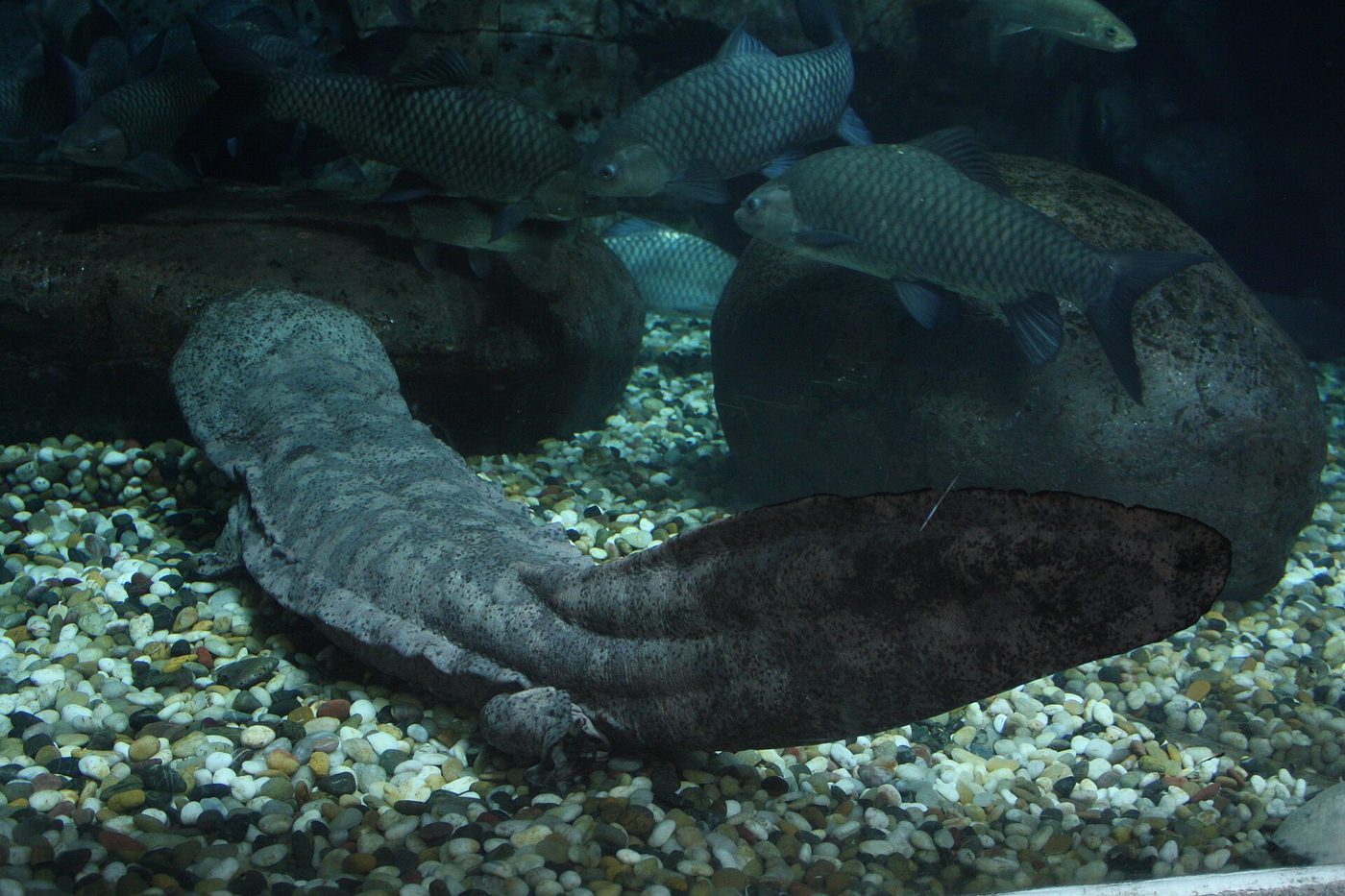
Photo: J. Patrick Fischer · CC BY-SA 3.0
Chinese giant salamander
Andrias davidianus
The Chinese giant salamander is the largest living amphibian on Earth: an aquatic giant of China's mountain rivers that can exceed a metre and a half in length.
Characteristics
Temperament
Solitary, nocturnal and secretive; entirely aquatic.
Diet
Carnivorous: fish, crayfish, aquatic insects, frogs and small amphibians.
The world's largest amphibian
The Chinese giant salamander (Andrias davidianus) is the largest living amphibian on the planet: including its tail it can reach up to about 1.8 metres, although wild individuals today are usually far smaller. Its bulky, flattened body has wrinkled brown skin with broad lateral folds, a wide head and tiny eyes. Like other cryptobranchids it breathes almost entirely through its skin, absorbing oxygen directly from the water.
Habitat and range
It is endemic to the rocky mountain streams and lakes of the Yangtze river basin in central China, where it favours cold, clear, well-oxygenated water. It has also been introduced to Kyoto Prefecture in Japan and possibly to Taiwan. It lives hidden among rocks and in cavities on the streambed, emerging mainly at night.
Behaviour and diet
It is a nocturnal ambush predator, feeding on fish, crayfish, aquatic insects, frogs and small amphibians, which it sucks in with a swift snap of its large mouth. Its eyesight is poor, so it detects prey through skin sensors that pick up vibrations in the water. Females lay eggs in underwater dens, where the male guards them until they hatch.
Did you know?
It belongs to a very ancient group of amphibians that has changed little over tens of millions of years, and is regarded as a true living fossil. It is among the priority species of the EDGE project, which protects evolutionarily unique and threatened animals.
Conservation
The IUCN lists it as Critically Endangered. Habitat loss and degradation, pollution and above all overcollection — it is prized as a delicacy and used in traditional medicine — have decimated wild populations. It is farmed on a large scale in China, but many animals on the farms are still taken from the wild.
Pros
- The largest living amphibian in the world
- A true living fossil of ancient origin
- A priority species for conservation (EDGE)
Cons
- Critically endangered
- Very sensitive to river pollution and degradation
- Threatened by collection for food and traditional medicine