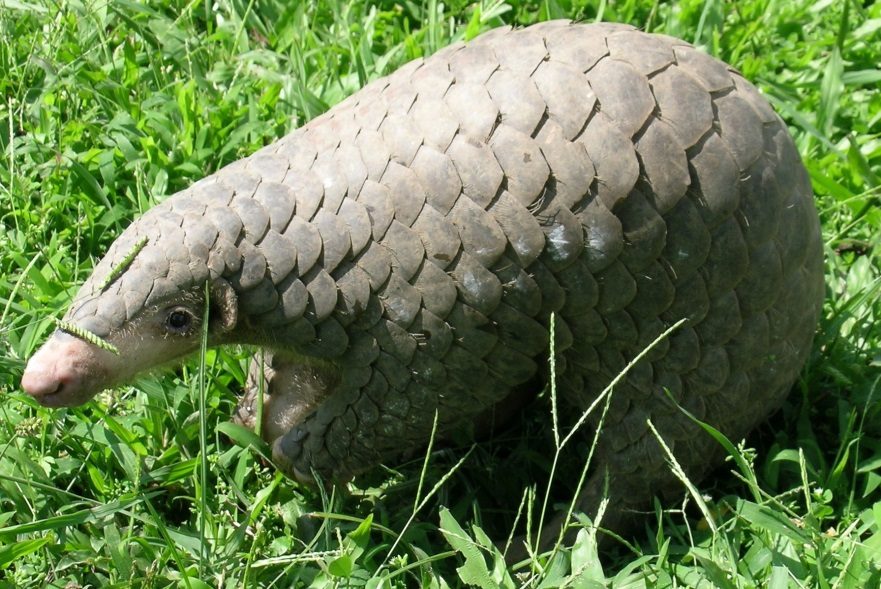
Chinese pangolin
Manis pentadactyla
Covered in scales like a living pine cone, the Chinese pangolin rolls into a ball to defend itself: a unique mammal, today sadly the most trafficked in the world.
Characteristics
Temperament
Nocturnal, solitary and elusive
Diet
Insectivore: almost only ants and termites
A mammal armoured in scales
The Chinese pangolin is one of the most unusual mammals on the planet: its body is almost entirely covered with large, hard, overlapping scales made of keratin, the same substance as our nails. This makes it look like a living pine cone or a small armoured dragon. It is a medium-sized animal, with an elongated snout, sturdy clawed legs and a long tail. It has no teeth: in their place it has an extremely long, sticky tongue, perfect for catching its prey.
Habitat and distribution
It lives in Asia, across a broad belt including southern China, Taiwan, the Himalayas and part of Southeast Asia. It frequents forests, scrubland and hilly areas, where it moves both on the ground and, when needed, by climbing. It spends many hours in underground burrows dug with its powerful claws, coming out mainly at night to search for food.
Behaviour and defence
The pangolin is a nocturnal, solitary and elusive animal. It feeds almost exclusively on ants and termites, which it flushes out by breaking open nests with its claws and gathers with its long tongue: for this reason it is sometimes called a 'scaly anteater'. Its most famous defence is spectacular: when threatened, it rolls up tightly into an almost impenetrable ball, protected on every side by its sharp scales. In this position even large predators struggle to get the better of it.
Curiosities
The name 'pangolin' comes from a Malay word meaning precisely 'one that rolls up'. The scales, though they seem sturdy, are paradoxically the cause of its ruin: they are the object of a ruthless illegal trade.
Conservation
The Chinese pangolin is classified as critically endangered, a step away from extinction in the wild. It is considered the most trafficked mammal in the world: it is illegally hunted for its scales, used in some traditional medicines with no scientific basis, and for its meat. To this is added habitat loss. The fight against poaching and illegal trade, together with the protection of forests, is today the only hope for the survival of this extraordinary species.
Pros
- Unique defence: rolls into an armoured ball
- Valuable ally: controls ants and termites
- Mammal with extraordinary, fascinating anatomy
Cons
- Critically endangered
- The most trafficked mammal in the world
- Very hard to protect and to keep in captivity