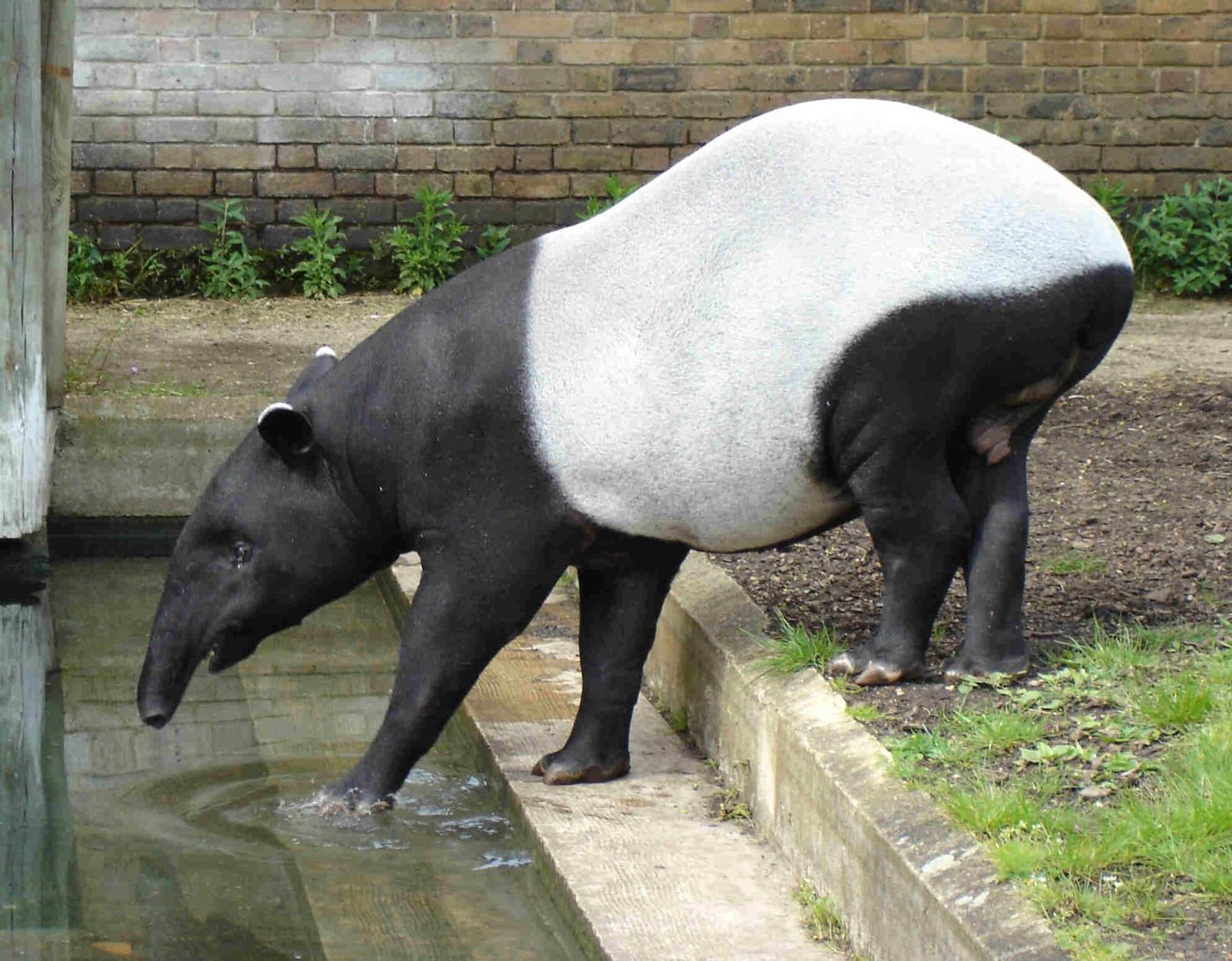
Photo: Wikimedia Commons · CC BY-SA 3.0
Malayan tapir
Tapirus indicus
The Malayan tapir is the largest of the tapirs and the only one in the Old World, recognisable by the bold white 'saddle' over its black body.
Characteristics
Temperament
Solitary, nocturnal and shy; an excellent swimmer.
Diet
Herbivorous: tender leaves, shoots, fruit and aquatic plants.
The black-and-white tapir
The Malayan tapir (Tapirus indicus), also called the Asian tapir, is the largest living tapir species and the only one found outside the Americas. It has a massive, stocky body with unmistakable markings: the front and legs are black, while the back and flanks are white, like a large "saddle", hence its name. Its snout ends in a short, mobile, prehensile trunk, which it uses to grasp leaves and shoots. The young, by contrast, are born brown with pale stripes and spots — excellent camouflage.
Habitat and range
It lives in the rainforests of Southeast Asia, from the Malay Peninsula to Sumatra, though its range was once far larger. It favours lowland forest but can occur above 2,000 metres. It needs wetlands and watercourses, where it loves to wallow.
Behaviour and diet
It is a solitary, mainly nocturnal herbivore feeding on tender leaves, shoots, fruit and aquatic plants. An excellent swimmer, it often takes to water to cool off and escape predators. Its eyesight is poor but its sense of smell and hearing are excellent.
Did you know?
Its black-and-white colouring, striking by day, actually works as camouflage in the night forest: in moonlight the body appears broken in two, blurring its outline. The tapir is a "living fossil", little changed for millions of years.
Conservation
The IUCN lists it as Endangered: fewer than 2,500 mature individuals are thought to remain. The main threats are the destruction of forests for agriculture, habitat fragmentation and hunting.
Pros
- The largest living tapir
- Unmistakable black-and-white markings
- A 'living fossil' of ancient origin
Cons
- Endangered (fewer than 2,500 adults)
- Very sensitive to forest destruction
- Slow breeding, a single calf per birth