Photo: Thomas Bresson · CC BY 2.0
Hummingbird hawk-moth
Macroglossum stellatarum
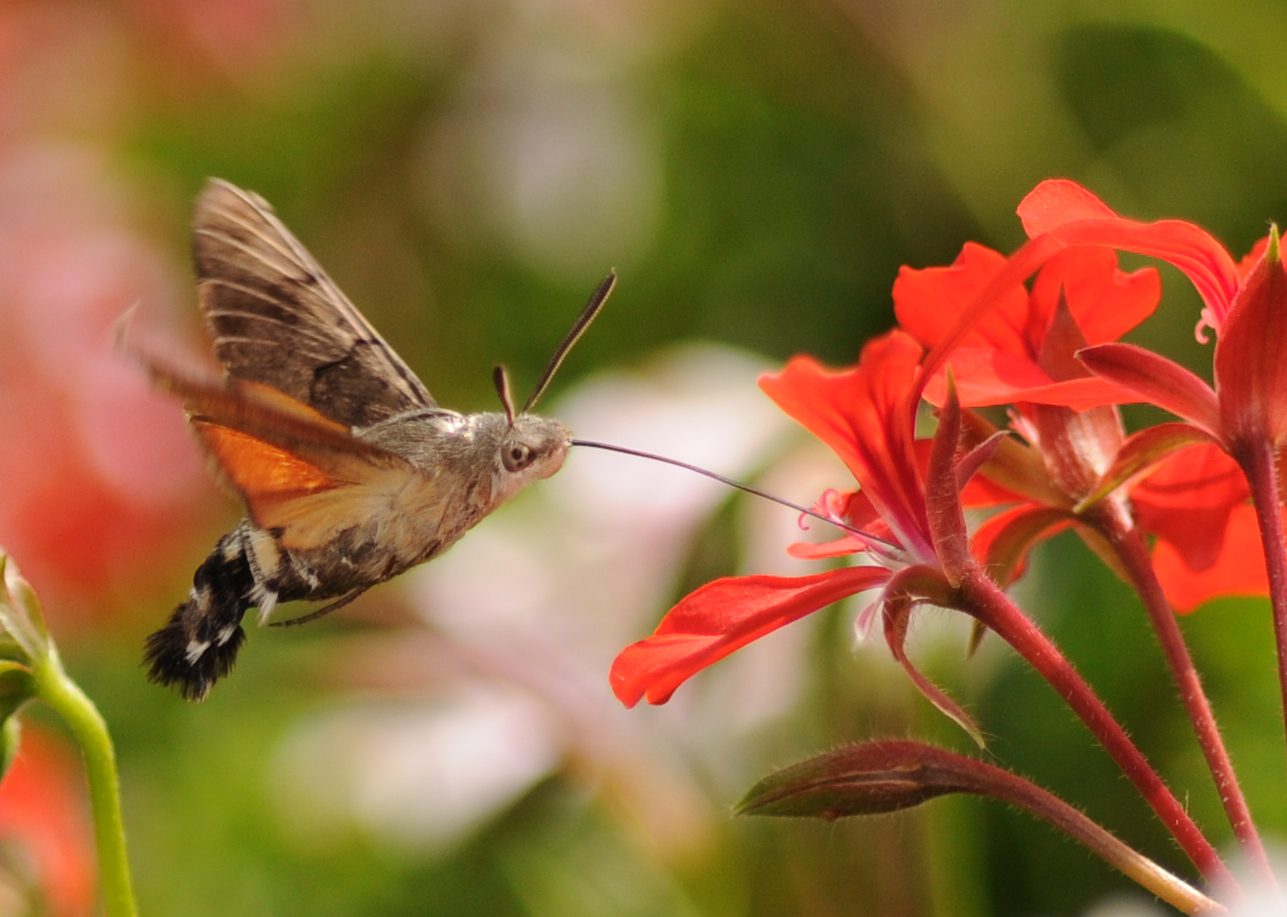
Often mistaken for a small hummingbird, the hummingbird hawk-moth is in fact a day-flying moth that hovers in front of flowers, sipping nectar with its long proboscis.
Characteristics
Temperament
Diurnal, fast, with a hovering flight
Diet
Nectarivore: flower nectar
A moth that looks like a hummingbird
The hummingbird hawk-moth is one of the most fascinating and surprising moths. Its name comes from an extraordinary resemblance: while feeding, it hovers perfectly in front of flowers, beating its wings so rapidly as to produce a hum, exactly as a hummingbird would. Many people, on seeing it, are convinced they are looking at a tiny bird. It is a sturdy insect, with greyish-brown forewings and orange hindwings, a stocky body and a tail of bristles that it fans out in flight.
Habitat and distribution
It is widespread across much of Europe, Asia and North Africa, and is known for its migrations: in the warm season it can travel long distances, pushing even far north. It frequents gardens, flowery meadows, woodland edges and sunny areas rich in flowers, which are its main source of food.
Behaviour and feeding
Unlike most moths, the hummingbird hawk-moth is active mainly by day, when flowers are open. It feeds on nectar, which it sips thanks to a very long proboscis, unrollable like a straw, that allows it to reach the bottom of tubular flowers without ever landing. Its hovering flight and the speed with which it moves from flower to flower make it a fascinating spectacle to watch in summer gardens.
Life cycle
Like all butterflies and moths, the hummingbird hawk-moth undergoes a complete metamorphosis. Females lay their eggs on specific host plants, in particular bedstraws, from which the caterpillars hatch. These grow by feeding on the leaves, then turn into a chrysalis and finally emerge as adults. In some regions the adults spend the winter sheltered in protected places.
Curiosities
The hummingbird hawk-moth is a perfect example of 'apparent' convergent evolution: although not related to hummingbirds at all, it has developed a remarkably similar flying and feeding style, driven by the same need to gather nectar on the wing. It is a completely harmless insect and valuable as a pollinator.
Pros
- Hovers like a hummingbird
- Active by day, easy to observe
- Valuable pollinator
- Completely harmless to humans
Cons
- Often mistaken for a bird
- Depends on the availability of nectar-rich flowers
- Relatively short adult life