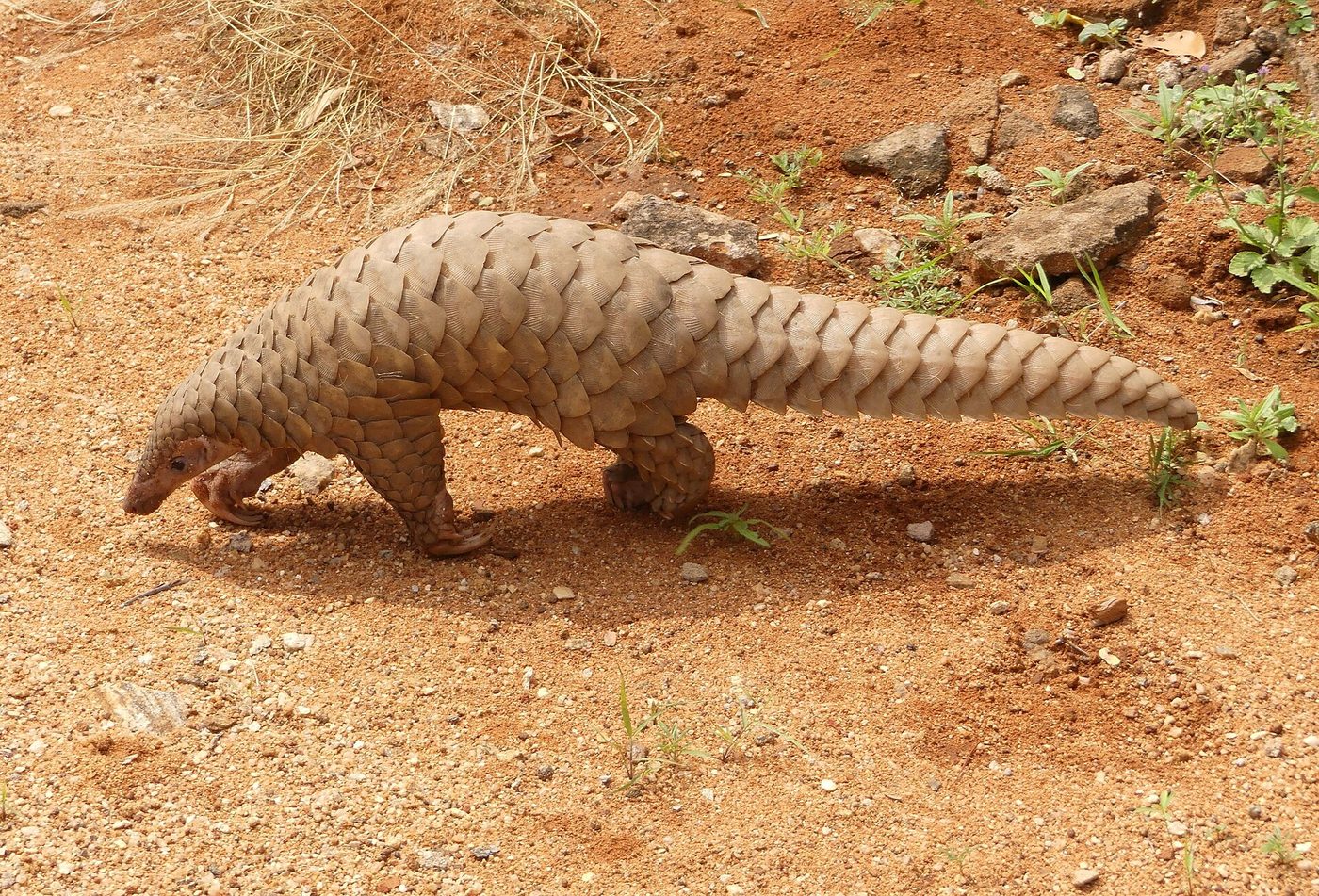
Indian pangolin
Manis crassicaudata
Covered in large scales like armour, the Indian pangolin is a nocturnal, solitary mammal that feeds on ants and termites and can roll into a ball to defend itself.
Characteristics
Temperament
Nocturnal, solitary, shy
Diet
Insectivore: ants and termites
The mammal armoured in scales
The Indian pangolin is a mammal of unique appearance, its body covered in large, overlapping horny scales that give it the look of a giant living pine cone. The scales, made of keratin like our nails, form a true protective armour and are the largest of all the Asian pangolins. Their colour tends to blend in with that of the surrounding earth. It has a long, sturdy tail, a tapered toothless snout and powerful claws on its forelimbs, almost as long as the limbs themselves.
Habitat and distribution
It lives in the Indian subcontinent, in countries such as India, Pakistan, Bangladesh and Sri Lanka. It adapts to many different environments: dense forests, open landscapes and even semi-desert areas. It spends much of its time in deep burrows it digs in the ground, where it shelters and rests during the day.
Behaviour and feeding
It is a nocturnal, solitary animal that sleeps in its galleries by day and comes out to hunt at night. It is a specialised insectivore: it feeds almost exclusively on ants and termites, which it digs out of mounds and logs with its powerful claws and captures with its long sticky tongue. When it feels threatened, it curls up into a tightly closed ball, protected by its scales against predators even as large as the tiger.
Curiosities
The Indian pangolin, while mainly ground-dwelling, is also a good climber and can use its tail to help itself. Having no teeth, it swallows small pebbles and sand which, together with the powerful muscles of its stomach, serve to grind up the insects it feeds on.
Conservation
The Indian pangolin is an endangered species. Illegal hunting is its main threat: it is killed for its scales and other body parts, used in traditional medicine and traded on the international black market. To this are added habitat loss and the high human density within its range. It is today one of the most trafficked mammals in the world and needs strict protection measures.
Pros
- Scale armour unique among mammals
- Valuable controller of ants and termites
- Can roll into a ball to defend itself
- Adapts to many different environments
Cons
- Endangered species
- Among the most trafficked mammals in the world
- Threatened by poaching and habitat loss