Photo: Wikimedia Commons · Public domain
Long-tailed pangolin
Phataginus tetradactyla
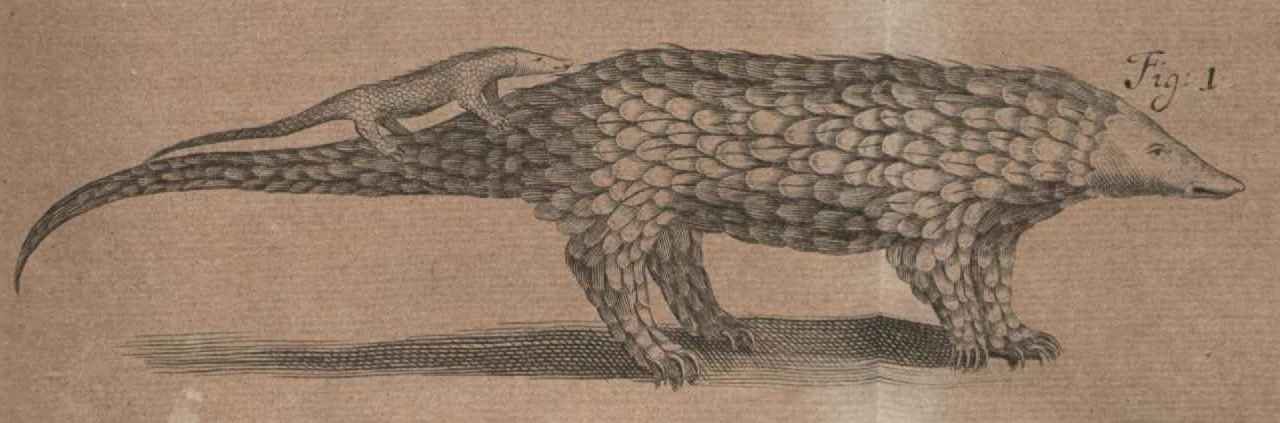
The smallest and most arboreal of the African pangolins, the long-tailed pangolin has an extremely long prehensile tail and a body entirely covered in scales.
Characteristics
Temperament
Diurnal, arboreal, solitary, rolls into a ball
Diet
Specialised insectivore: almost only ants
A mammal clad in scales
The long-tailed pangolin is the smallest of the African pangolins and the most adapted to life in the trees. Like all pangolins, its body is covered in large, overlapping horny scales made of keratin — the same material as our nails — giving it the look of a small living pine cone. Its belly and the inner sides of its limbs are instead covered in dark hair, hence one of its names, the "black-bellied pangolin". Its most extraordinary feature is the tail: exceptionally long and prehensile, among the longest relative to body size of any mammal, it uses it as a fifth limb to grip branches.
Habitat and distribution
It lives in the rainforests and swamp forests of West and Central Africa, where it favours flooded, water-rich environments. It is a skilled climber and, unusually for a pangolin, is active by day. It swims well and is at home in the water.
Behaviour and diet
It is a dietary specialist, feeding almost exclusively on ants, which it gathers with its long sticky tongue after tearing open nests with its strong claws. It has no teeth and grinds its food in a muscular stomach. Like all pangolins, when threatened it rolls into a ball, protecting its soft parts behind its shield of scales — the name "pangolin" comes from a Malay word meaning "something that rolls up".
Curiosities
Pangolins hold the grim record of being the most trafficked mammals in the world: they are hunted for their meat and for their scales, used in traditional medicine despite having no curative properties. This illegal trade is their main threat.
Conservation
The IUCN classifies the species as Vulnerable. Poaching for the international trade and forest destruction put its populations at risk. All pangolins are now protected under CITES, which bans their trade.
Pros
- Exceptionally long prehensile tail
- Scale armour unique among mammals
- Good climber and swimmer
Cons
- Vulnerable: the most trafficked mammal in the world
- Hyper-specialised diet, hard in captivity
- Not a pet: protected under CITES