Photo: Tim Ross · Public domain
Rhinoceros iguana
Cyclura cornuta
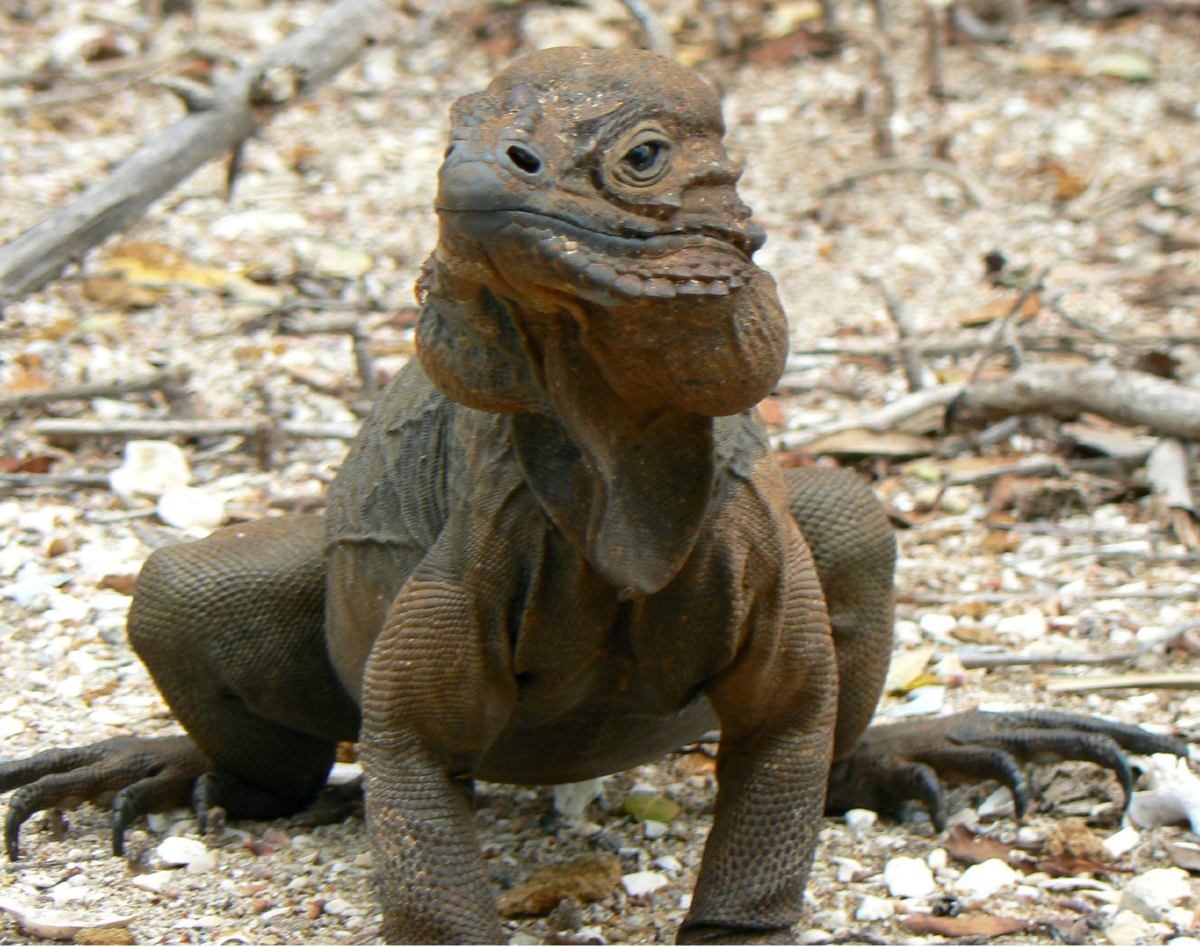
The rhinoceros iguana is a massive Caribbean lizard, recognisable by the small bony horns on its snout that recall a rhino's horn.
Characteristics
Temperament
Territorial but calm, tolerates captivity well
Diet
Mainly herbivorous: leaves, flowers and fruit
A lizard with horns
The rhinoceros iguana is a large, stocky iguana, measuring from 60 to 136 cm, with colours ranging from steely grey to dark green and brown. The feature that gives it its name is the set of bony, horn-like outgrowths on the snout, especially prominent in adult males along with a fleshy pad on the nape. The body is heavy-set, the legs powerful and the tail muscular.
Habitat and range
It is endemic to the island of Hispaniola, shared by Haiti and the Dominican Republic, and to a few surrounding islets. It prefers arid, rocky terrain, coastal scrub and dry forest, where it shelters in burrows and crevices in the ground or rocks.
Behaviour and diet
It is mainly herbivorous, feeding on the leaves, flowers and fruit of many plants and helping to disperse their seeds. It matures earlier than other iguanas of the genus Cyclura: males at 4 to 5 years, females at 2 to 3. After mating in May, the female lays on average around seventeen eggs, which hatch after roughly 85 days.
Notable facts
Together with Ricord's iguana, it is the only rock iguana that shares its range with another species of the same group. It is also the most widely kept Cyclura iguana in captivity worldwide, which provides an important reservoir for the species.
Conservation
The IUCN lists it as Endangered. In the wild it is threatened by predators introduced to the island — dogs, cats and mongooses — and by habitat loss. It is therefore the focus of numerous conservation and captive-breeding programmes.
Pros
- Long-lived, can exceed 30 years
- Herbivorous and a seed disperser
- Well represented in breeding programmes
Cons
- Endangered by introduced predators
- Adult males can be territorial