Photo: Wikimedia Commons · CC BY-SA 3.0
Rosy maple moth
Dryocampa rubicunda
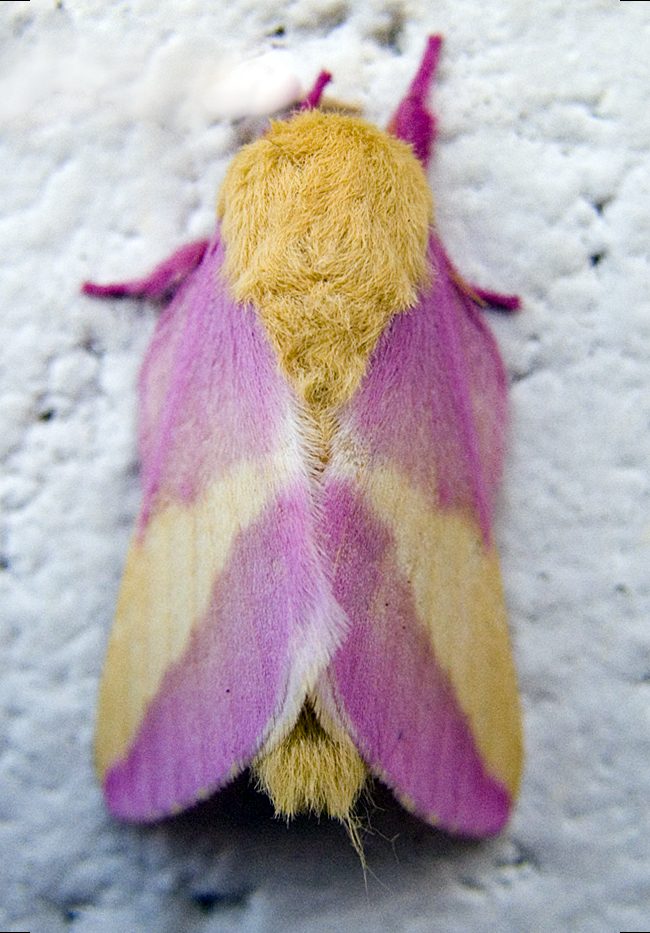
The rosy maple moth is a small North American moth in pastel pink and yellow, with a woolly body, one of the prettiest of its family.
Characteristics
Temperament
Nocturnal and harmless; adults very short-lived.
Diet
Caterpillars: maple and oak leaves; adults: do not feed.
A moth in pastel colours
The rosy maple moth (Dryocampa rubicunda) is a small moth of the family Saturniidae, the great silk moths, and one of the smallest members in North America. It is unmistakable for its two-tone pastel colouring — pink and yellow — and its stout, woolly, almost furry body. The shade is highly variable: some individuals are bright pink, others paler, cream or nearly white. Males have bushier, feathery antennae than females, which they use to detect pheromones when seeking a mate.
Habitat and range
It ranges across eastern North America, from Canada to Florida and west to the Great Plains. As its name suggests, it is closely tied to maples: it is among their foliage that it lives and lays its eggs.
Life cycle and diet
The caterpillars, green with stripes, feed mainly on maple leaves but also on oaks and other trees. The adults, by contrast, do not feed at all: like many saturniids they have reduced mouthparts and live only a few days, long enough to breed, drawing on the reserves built up as caterpillars. They are active at night.
Did you know?
Its bright, unusual colours have made it a small internet celebrity, often called one of the world's "cutest" moths. The pink-and-yellow combination may serve as camouflage among flowers and leaves, as well as a signal.
Conservation
It has no major species-specific IUCN assessment and is considered common across its range. As with many insects, its conservation depends on the health of broadleaf woodlands and on reducing pesticide use.
Pros
- Unmistakable pastel pink and yellow
- Woolly body, among the prettiest of moths
- Common and not threatened
Cons
- Adults very short-lived (a few days)
- Depends on maples and broadleaf woods
- Sensitive to pesticide use