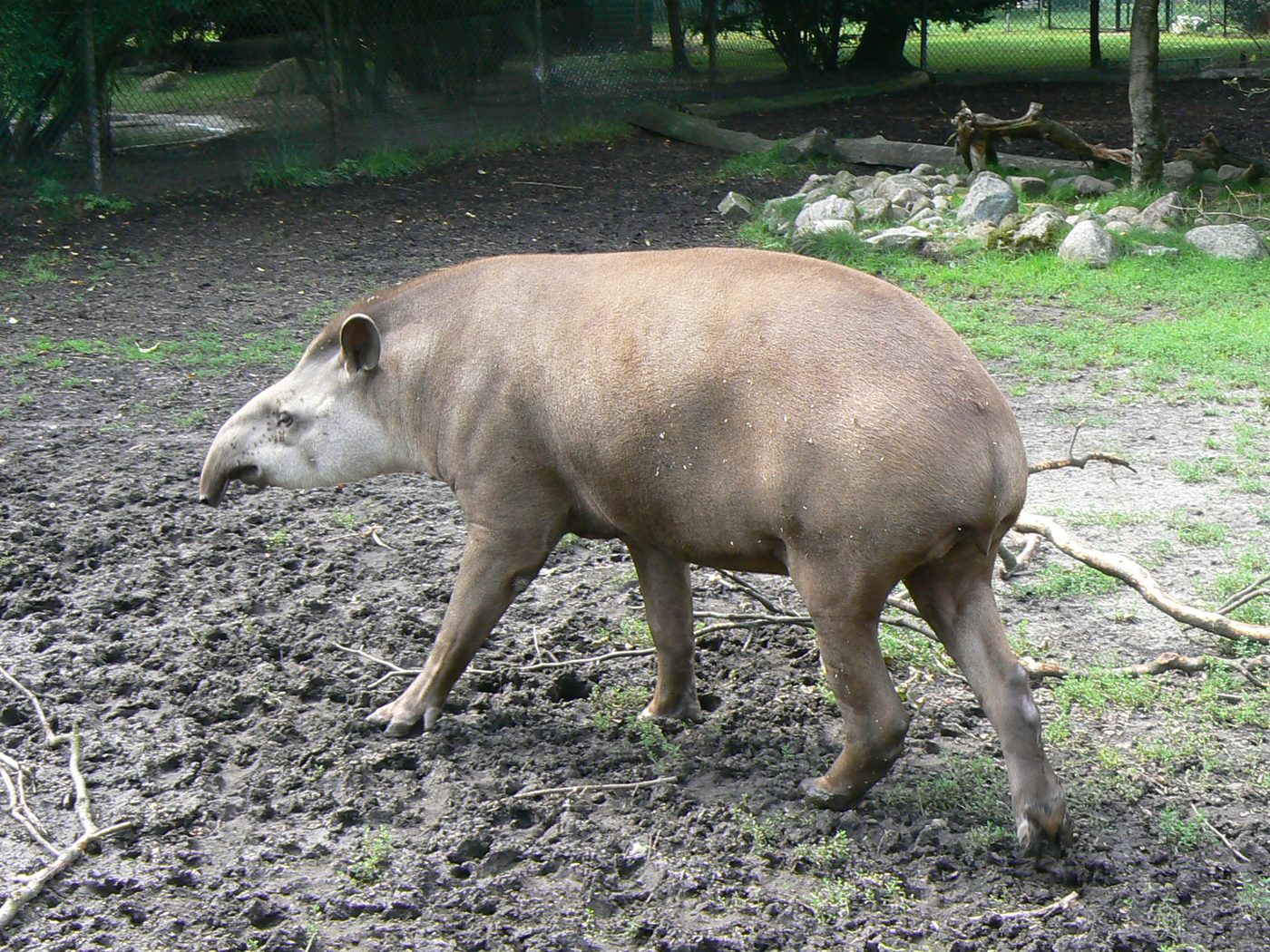
Photo: LadyofHats · Public domain
South American tapir
Tapirus terrestris
The largest land mammal in the Amazon, the South American tapir has a small mobile trunk and spreads the forest's seeds as it roams.
Characteristics
Temperament
Solitary, nocturnal, shy, a good swimmer
Diet
Herbivore: leaves, shoots, fruit, aquatic plants
A herbivore with a small trunk
The South American tapir is the largest native land mammal in the Amazon. It has a massive, rounded body about two metres long, with short sturdy legs and a weight that can reach 300 kilograms.
(Note: the mass value given by Wikidata, 4.5 kg, is plainly wrong for an animal of this size; its true weight is on the order of 150–300 kg.)
Its most distinctive feature is the snout, extended into a short, flexible, prehensile trunk that the animal uses to grasp leaves and fruit. The young have a brown coat striped and spotted with pale markings, a camouflage that fades as they grow.
Habitat and distribution
It lives in the rainforests and wetlands of much of South America, from the Amazon regions to northern Argentina. It is closely tied to water: it swims and dives with ease, and often seeks cool relief and shelter in rivers.
Behaviour and ecological role
It is solitary, mostly nocturnal and herbivorous, feeding on leaves, shoots, fruit and aquatic plants. By swallowing fruit whole and travelling long distances, it is a key seed disperser — so much so that it is nicknamed the "gardener of the forest". When alarmed it flees into the undergrowth or plunges into water.
Curiosities
Tapirs are regarded as "living fossils": their appearance has changed little over millions of years, and they are related to horses and rhinoceroses. In some Argentine provinces it is protected as a natural monument.
Conservation
The IUCN classifies the species as Vulnerable. The main threats are hunting for meat and forest destruction. The loss of tapirs impoverishes the whole forest, which loses a key player in seed dispersal.
Pros
- The largest land mammal in the Amazon
- 'Gardener of the forest': disperses seeds
- A 'living fossil' related to horses and rhinos
Cons
- Vulnerable to hunting and deforestation
- Slow breeding, one calf at a time
- Not a pet: highly specialised wild needs